


Updated
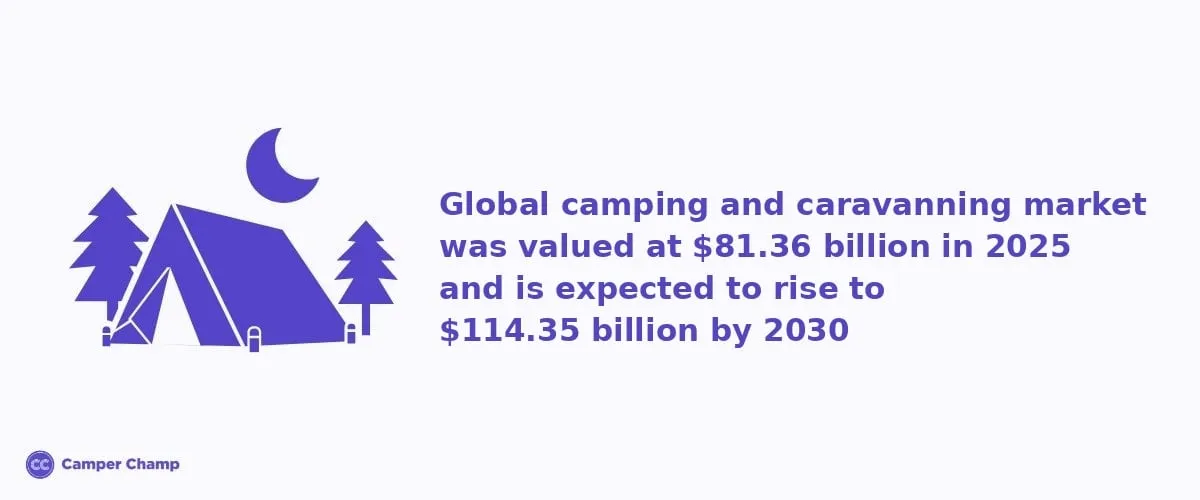
The global camping and caravanning market is worth $86.52 billion in 2026, up from $81.36 billion in 2025, and is projected to reach $114.35 billion by 20301. North America is the largest market, with more than 52 million households camping in 20252, while campers spent 433 million nights at campsites and RV parks across the European Union3.
Camping statistics at a glance
- The global camping and caravanning market is valued at $86.52 billion in 2026 and is projected to grow 7.2% a year to $114.35 billion by 20301.
- More than 52 million North American households went camping at least once in 2025, and more than 2.2 million new campers tried it for the first time2.
- Campers spent $66 billion in local communities in 2025, and average daily spending passed $200 per person2.
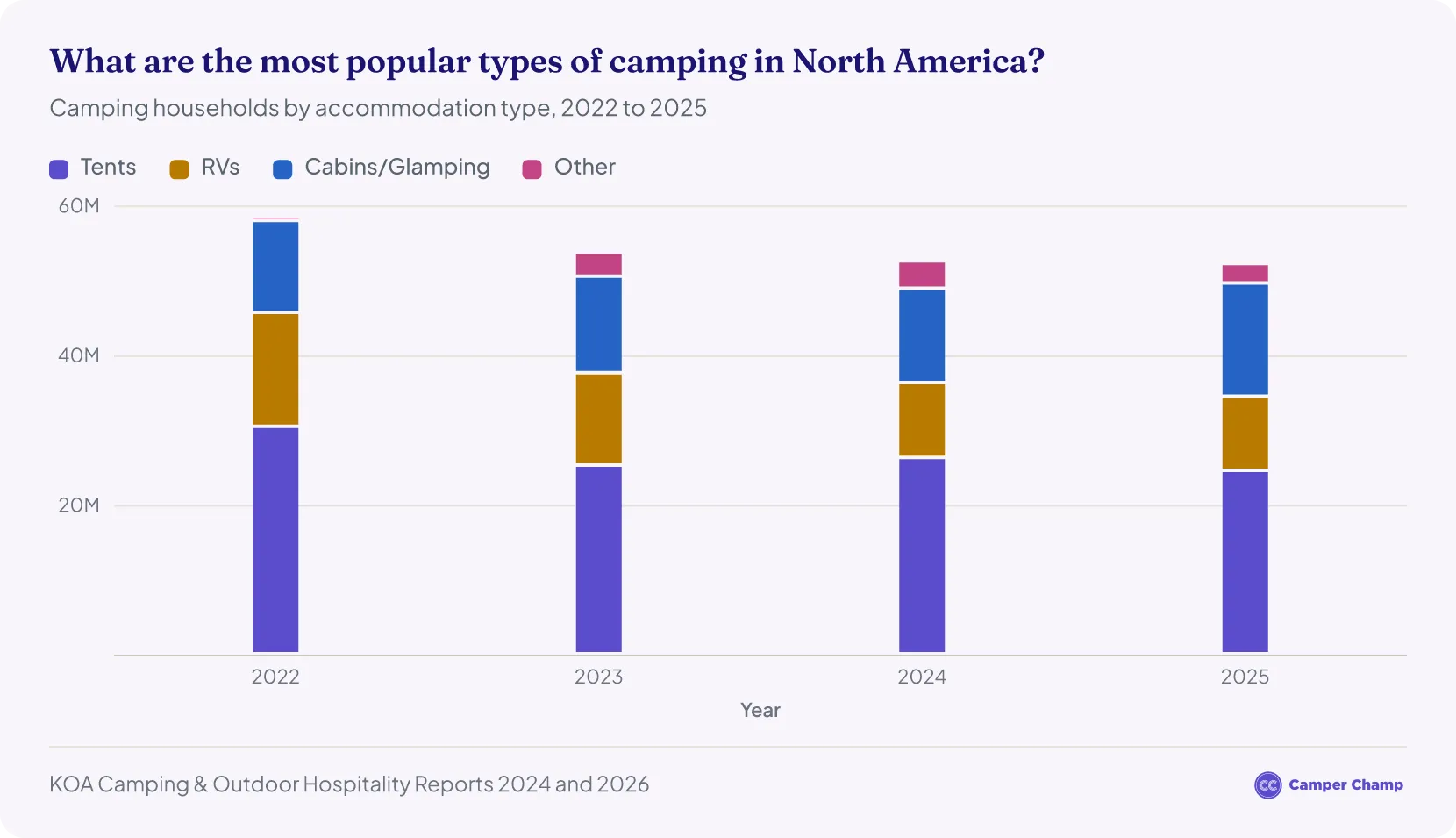
- Tents are still the most common way to camp, at 47% of camping in 2025, ahead of cabins and glamping (29%) and RVs (19%)2.
- Campers spent 433 million nights at camping grounds, RV parks and trailer parks across the EU in 2025, 5.8% more than in 20243.
- France is Europe's biggest camping country, with 153.8 million camping nights in 2025, more than a third of the EU total3.
- RV shipments reached 342,220 units in 2025, up 2.5% on 20244.
How big is the global camping market?
The global camping and caravanning market was valued at $81.36 billion in 2025 and is expected to rise to $86.52 billion in 2026.1 Projections indicate the market will reach $114.35 billion by 2030. From 2026 to 2030, the market is projected to grow at a CAGR of 7.2%.
Which countries camp the most?
- North America was the biggest camping and caravanning market in 20251. More than 52 million households there went camping that year2.
- Western Europe is the second-largest market, and it is also growing fastest1. Campers spent 433 million nights at campsites, RV parks and trailer parks across the EU in 20253. France led with 153.8 million, more than a third of the total, followed by Italy, Spain and Germany.
- In Asia-Pacific, camping demand remains strong in Australia, though trips are getting shorter. Australians took 17.3 million caravan and camping trips in 2025, spending 57.9 million nights away and A$12.6 billion5. Guests spent about 9.3 million nights at New Zealand's holiday parks and campgrounds, 3% fewer than in 20246.
| Camping nights by country in Europe, 2025 | ||
|---|---|---|
| Country | Camping nights, 2025 | Change vs 2024 |
| France | 153.8 million | +4.0% |
| Italy | 69.5 million | +27.2% |
| Spain | 49.8 million | +1.4% |
| Germany | 44.7 million | +4.2% |
| Netherlands | 25.9 million | −1.0% |
| Croatia | 21.9 million | +2.0% |
| Sweden | 17.3 million | +3.1% |
| Denmark | 12.0 million | −1.7% |
| Austria | 8.8 million | +3.5% |
| Norway | 8.4 million | +5.7% |
| Portugal | 7.0 million | −3.4% |
| Switzerland | 5.2 million | +8.2% |
| European Union (27 countries) | 432.8 million | +5.8% |
Source · Eurostat, Nights spent at tourist accommodation establishments (tour_occ_ninat), updated September 2026.
Camping trends for 2026
Who goes camping? Campers by generation
Millennials (born 1981-1996) and Gen Z (born 1997-2012) are major contributors to the camping market.
Their preference for unique, outdoor experiences has led to increased participation in camping.
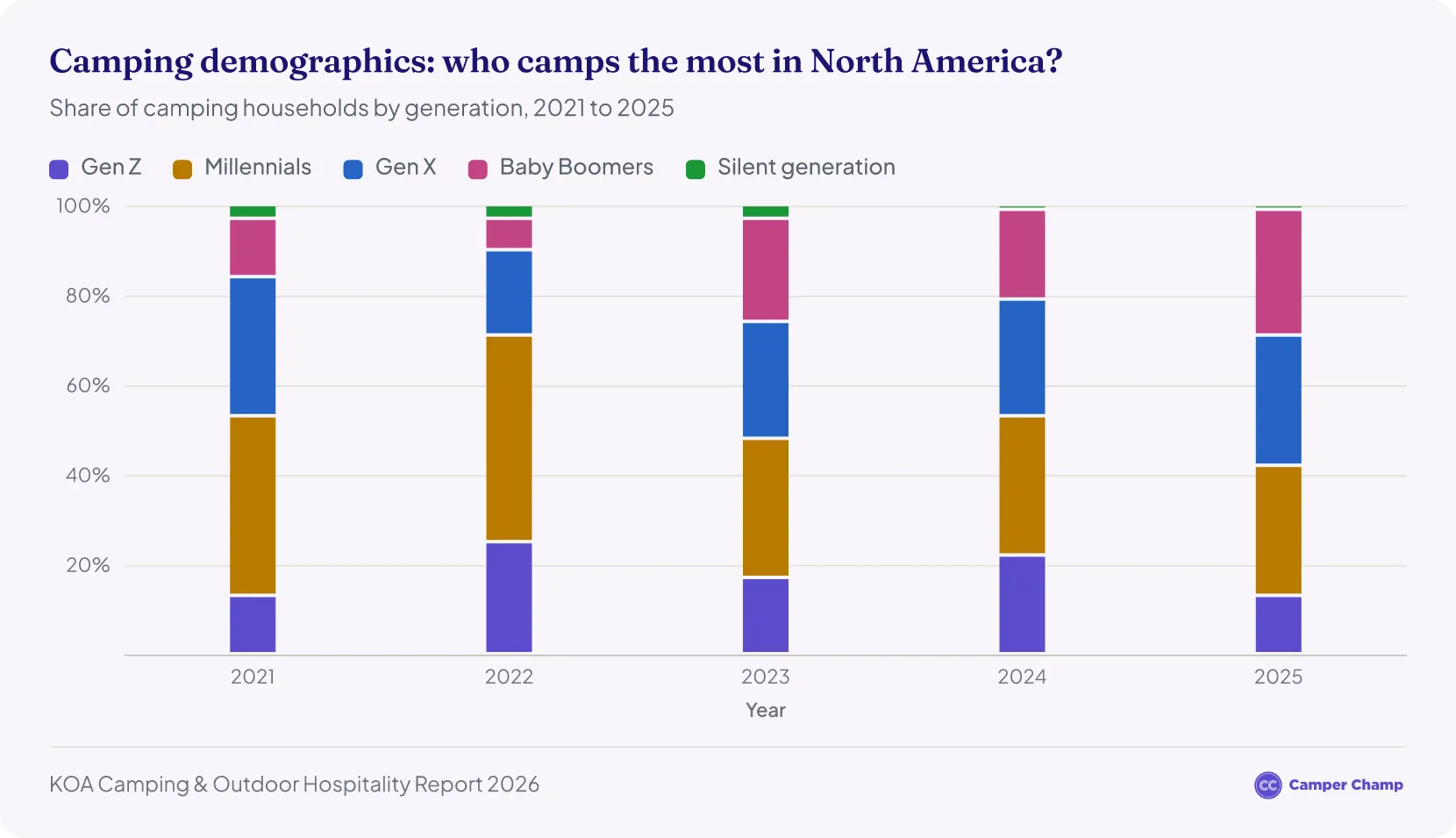
- In KOA's annual survey of US and Canadian households, conducted by Cairn Consulting Group, Gen Zers and millennials made up 61% of new campers in 2024.7 In 2025, millennials accounted for 29% of camping households and Gen Zers for 13%, down from 31% and 22% in 2024, as money pressures cut Gen Z camping.2
How popular is glamping?
Glamping, or "glamorous camping", continues to gain popularity as a comfortable alternative to traditional camping.
- In 2022, cabins and glamping made up 21% of all camping, about 12.3 million households.2
- That share rose to 24% in 2023 (about 12.9 million households)2, even as tents and RVs lost ground, a sign of rising demand for more comfortable, experience-focused outdoor stays.
- Although glamping dipped slightly to 12.60 million households in 2024, it stayed well ahead of RV camping, which saw a sharp drop to 9.98 million.7
- In 2025, cabins and glamping made up 29% of all camping, up from 24% in 2024, and over 15 million households went glamping.2
Do campers want Wi-Fi at campsites?
The integration of technology at campsites is becoming increasingly important.
- When Wi-Fi is available, campers add an average of 5.2 extra camping nights a year, down from 6.8 in 2024, and RVers add 9.3 nights.2 Nearly half of campers (47%) say Wi-Fi is very important, rising to 50% of new campers and 70% of those who work while camping. Campsites are responding to this demand by offering Wi-Fi and improving technological infrastructure.
- Additionally, digital platforms for booking campsites and navigating camping routes are gaining traction, contributing to the growth of the camping market.
Eco-Friendly Camping
The trend towards eco-friendly camping is growing, driven by increased environmental awareness. Campers are adopting sustainable practices, such as reducing plastic waste and minimising energy use.
- Many campsites, especially in Europe and North America, are offering eco-friendly options, such as solar-powered facilities and waste recycling systems, to attract environmentally conscious travellers.
How many people go camping each year?
Camping has settled well above pre-pandemic levels: the number of active camping households in 2025 was nearly identical to 20242.
- In 2025, approximately 52.2 million households participated in camping trips in North America2, with RV travel emerging as a popular choice due to its flexibility and comfort.
Off-grid and dispersed camping statistics
Remote and off-grid camping is growing in popularity as campers seek solitude and a deeper connection with nature.
- In 2025, 21% of camper nights were spent on public or privately owned land other than a campsite, compared with 34% in national, state or provincial parks and about 3 in 10 at private campsites or glamping resorts2.
- Free camping is mainstream: 59.8% of campers surveyed for The Dyrt's 2026 Camping Report camped for free at least once in 2025, and 79.1% of those went dispersed camping on public land such as national forests and BLM areas8.
- Cost-saving behaviour is a key driver, as campers increasingly turn to “boondocking” and dispersed camping to avoid paid campsites, particularly under inflationary pressure.
How many people camp in US national parks?
National parks continue to be major destinations among campers.
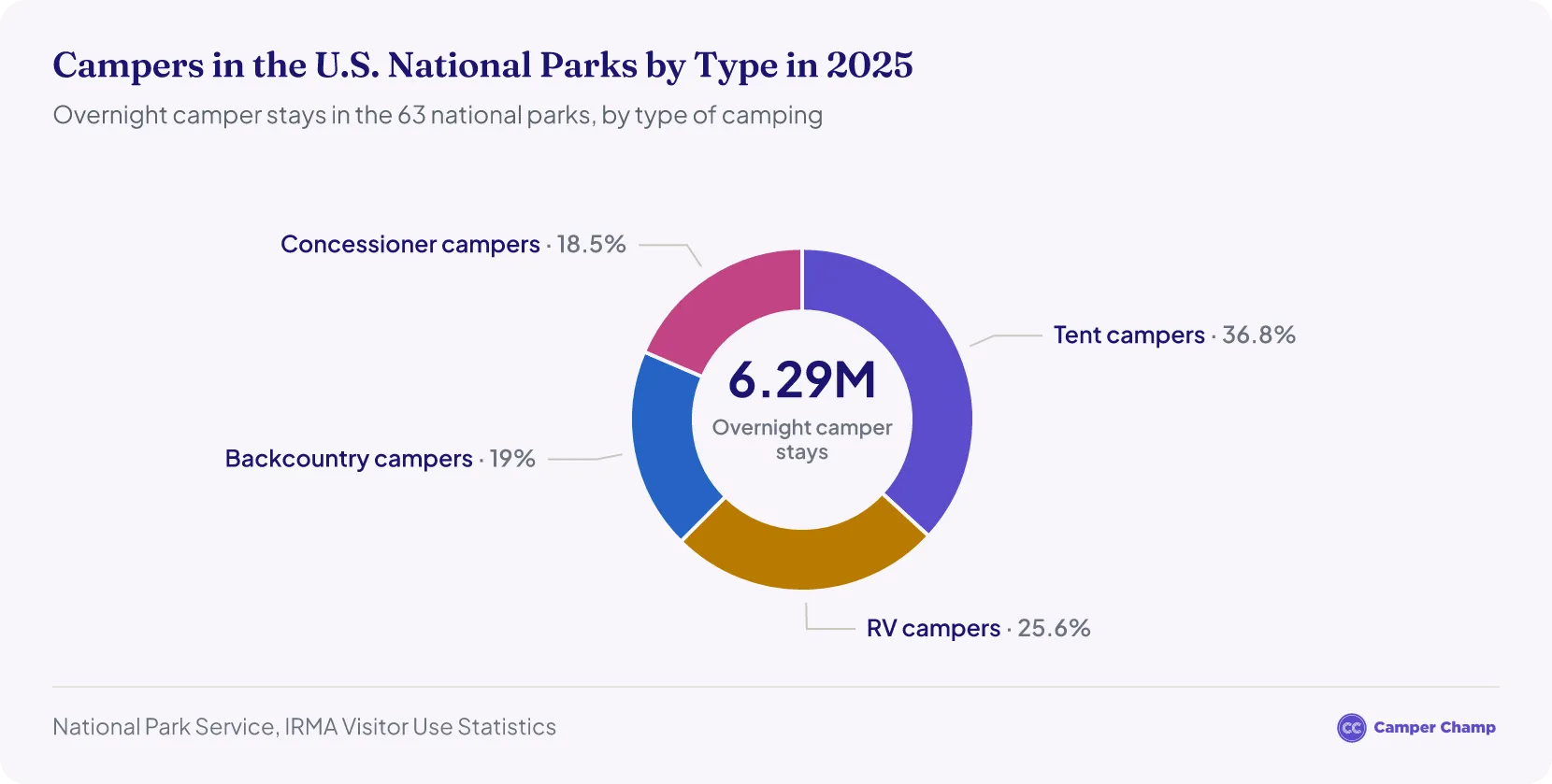
- In 2025, total recreational visits to 63 US National Parks totalled 93.89 million9. Campers accounted for 6.29 million overnight stays that year, counting tent, RV, backcountry and concessioner camping10.
- Tent camping was the most popular type of camping in the US National Parks with 2.32 million tent campers in 2025, followed by RV camping with 1.61 million RV campers10.
RV camping statistics
RV parks and campsites continue to be the primary choice for camping enthusiasts.
- RV camping remains popular, especially in North America, where 9.91 million households went RVing in 2025, level with 2024 (9.98 million) but below the 2022 peak of 15.2 million.2
The ability to travel comfortably and visit multiple locations has made RV camping appealing for families and long-term campers.
- In 2025, 342,220 RV shipments were recorded.4
Holiday parks and vacation camps
Recreational and vacation camps, from children's summer camps to adult retreats and family resorts, are a market of their own, and North America is the largest11.
- Vacation camps are becoming popular among families and youth groups, offering organised activities such as hiking, fishing, and educational programmes that cater to various interests.
- In 2022/23, the UK holiday park and campsite sector generated £12.2 billion in visitor expenditure, contributing £7.2 billion in Gross Value Added (GVA) to the UK economy.12
- In 2024, 55.9 million Americans went camping (car, backyard and RV camping), the third most popular outdoor activity after hiking and fishing, as outdoor recreation reached a record 181.1 million participants13.
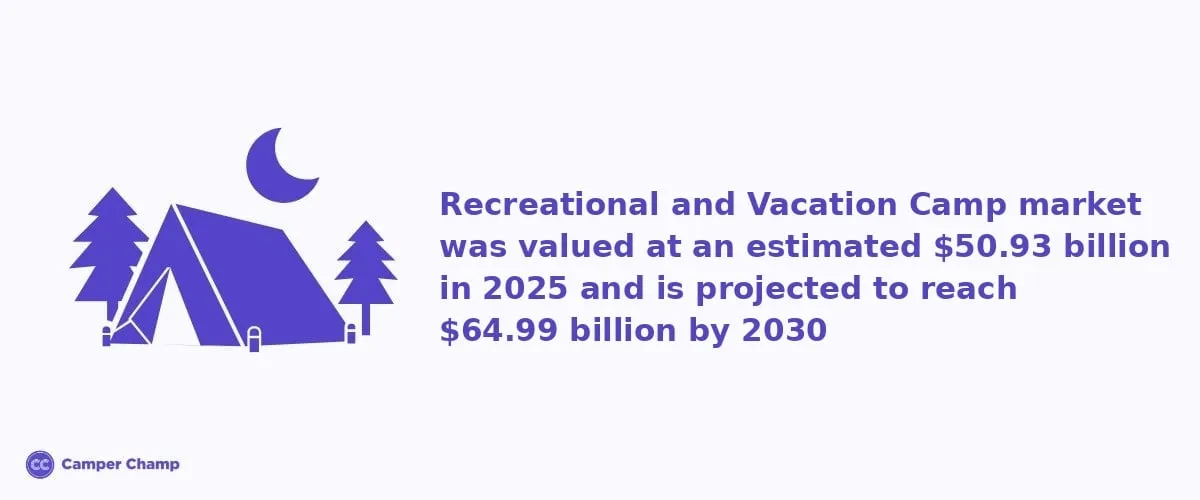
- The Recreational and Vacation Camp market was valued at an estimated $50.93 billion in 2025 and is projected to grow to around $64.99 billion by 2030, registering a compound annual growth rate (CAGR) of over 5% during the forecast period of 2025-203011.
Camping statistics by region
More travel statistics
Glossary
Baby Boomer - Born 1946-1964
Camping - Any occasion when you spent at least one night outside of your primary residence and stayed in accommodations such as a tent, trailer, RV, or vehicle or cabin/cottage at a campground.
Car camping - Those who travel and sleep in their vehicles (versus other types of accommodation, including RVs).
Camping households - Those who identify as campers.
Dispersed Camping - The term used for camping anywhere in the National Forest outside of a designated campground. Dispersed camping means no services such as rubbish removal, and little or no facilities which may or may not include tables and firepits.
Generation X (Gen X) - Born 1965-1980
Generation Z (Gen Z) - Born 1997-2012
Glamping - Defined as staying in unique accommodations with enhanced services and amenities.
Incidence - For camping incidence, this figure is calculated by dividing the total number of households with at least one person who camps divided by the total number of eligible households.
Millennial - Born 1981-1996
Overlanding - An "overlanding" experience is where you travel in an off-road vehicle, taking back roads, no services/amenities, you are completely self-sustaining and the purpose is the journey.
Peer-to-Peer RV Rental - A rental that occurs between a private RV owner and a renter. Generally, this is facilitated by a designated marketplace.
Public Land Camping - Staying at a public campground in a national park, state park, municipal campground, national forest campground, national forest land, BLM land, or designated wilderness areas.
RV - Includes type A, B, or C motorhomes, travel trailers, fifth-wheels, pick-up campers, pop-up trailers, and small van campers.
RVing Experience (used in new camping experiences) - Where you travel in an RV from destination to destination.
Silent/Mature - Born prior to 1946
Van Life - Defined as a form of adventure tourism that involves a van that is liveable and self-sustained.
References
- Camping And Caravanning Global Market Report · thebusinessresearchcompany.com ↑ b c d e
- 2026 KOA Camping & Outdoor Hospitality Report (Cairn Consulting Group for Kampgrounds of America) · koa.uberflip.com ↑ b c d e f g h i j k l m n
- Eurostat — Nights spent at tourist accommodation establishments (tour_occ_ninat) · ec.europa.eu ↑ b c d e
- RV Shipments End 2025 with 342,220 Units, Up 2.5% YoY (RVBusiness, citing the RV Industry Association December 2025 survey) · rvbusiness.com ↑ b
- State of the Industry 2026: Resilience in a changing market (Caravan Industry Association of Australia) · caravanindustry.com.au ↑
- Guest nights spent in holiday parks and campgrounds in New Zealand (MBIE Accommodation Data Programme, via Figure.NZ) · figure.nz ↑
- 2025 KOA Camping & Outdoor Hospitality Report (Cairn Consulting Group for Kampgrounds of America) · koa.uberflip.com ↑ b
- Nearly 60% of Campers Camp for Free, The Dyrt Finds (RV PRO, citing The Dyrt 2026 Camping Report) · rv-pro.com ↑
- National Park Annual Visitation · irma.nps.gov ↑
- NPS Visitor Use Statistics Data Package, 2025 (National Park Service) · catalog.data.gov ↑ b
- Recreational and Vacation Camp Market Size (Mordor Intelligence, 2025–2030) · mordorintelligence.com ↑ b
- UKCCA — 2024 Economic Benefit Report · ukcca.org.uk ↑
- 2025 Outdoor Participation Trends Report (Outdoor Foundation / Outdoor Industry Association) · material-civet.files.svdcdn.com ↑
- 2024 Outdoor Participation Trends Report · outdoorindustry.org
- North American Camping Report · koa.com
- The Dyrt 2024 Camping Report · thedyrt.com
- RVIA Reports & Trends — RV Shipment 2023 and 2024 Report · rvia.org
- Eurostat — Trips and Night Spent by Campers · ec.europa.eu
- Camping And Caravanning Market Size, Share & Trends Analysis Report · grandviewresearch.com