

Updated
Camping continues to grow as a popular outdoor activity worldwide. More people are participating in different forms of camping, exploring various accommodation options, and adopting new travel patterns. To cater to these evolving preferences, campgrounds are expanding their services to include RV camping, glamping, and eco-friendly options.
These changes are evident in the latest camping statistics and trends in North America.
Key Camping Trends in North America
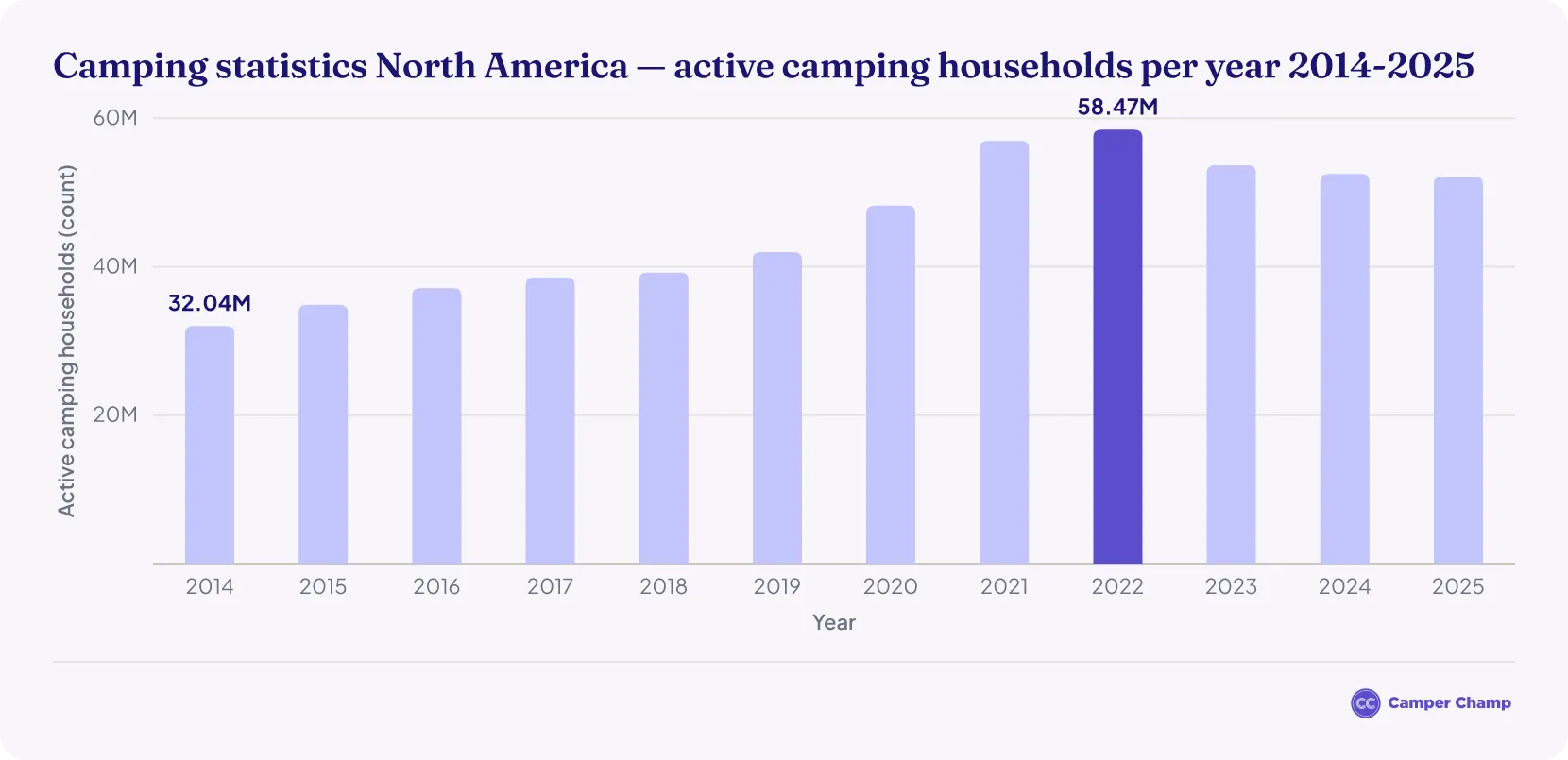
- 52.16 million North American households camped in 2025, almost unchanged from 20241.
- 87.99 million North American households identified as camping households in 20232.
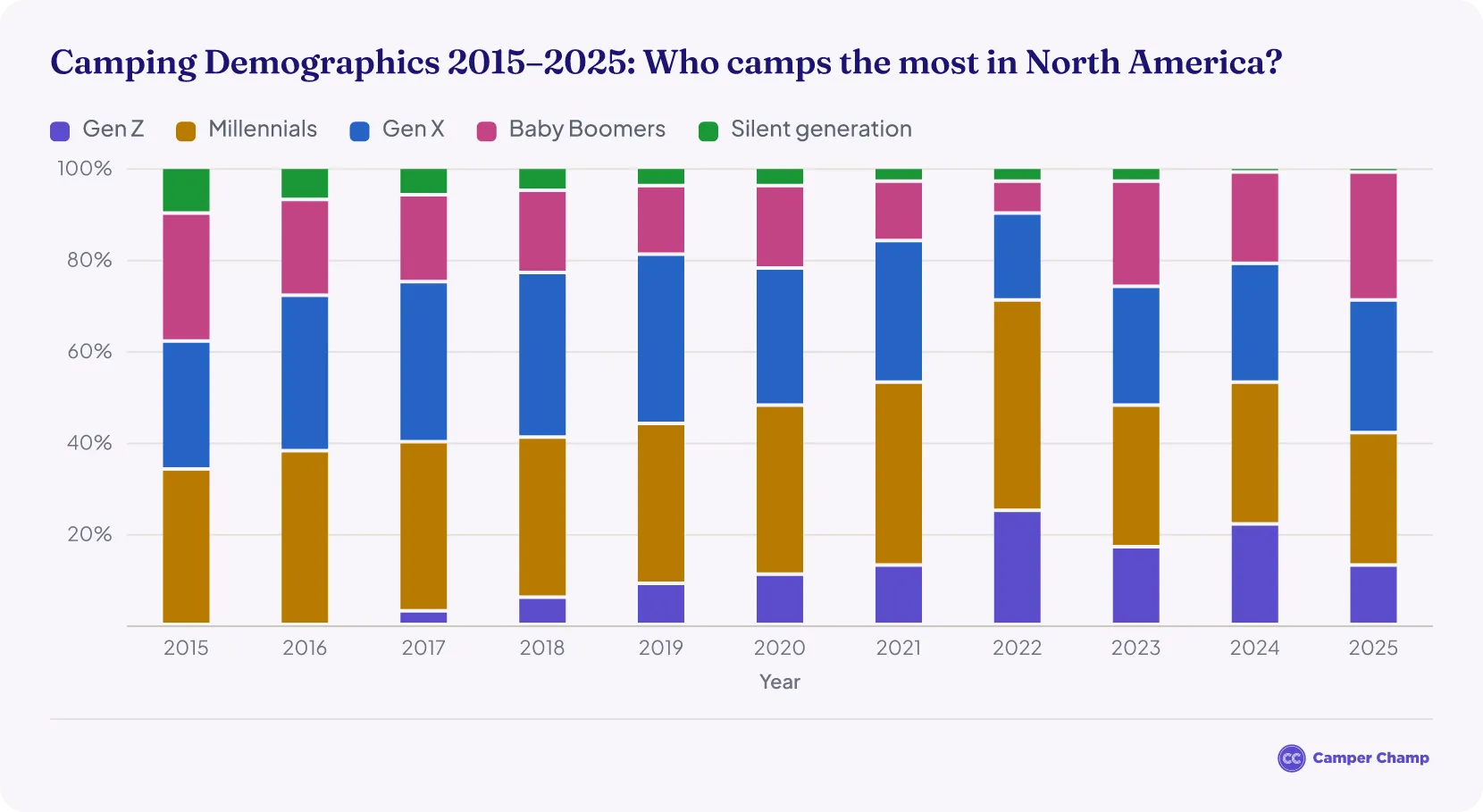
- 42% of campers in 2025 were Millennials and Gen Zers1.
- More than 2.2 million North American households camped for the first time in 2025, and a quarter of new campers were Baby Boomers.1
- Total camping households grew 63% between 2014 and 2025, from 32.04 million to 52.16 million1.
- Just over 9.9 million North American households camped in an RV in 2025, and 67% of them traveled in an RV they own.1
- Over 15 million households glamped in 2025, or 29% of camping households, up from 24% in 2024.1
- One in five campers said the shoulder season is the best time of year to camp in 2025, and 76% of Boomers camp off-season to avoid crowds.1
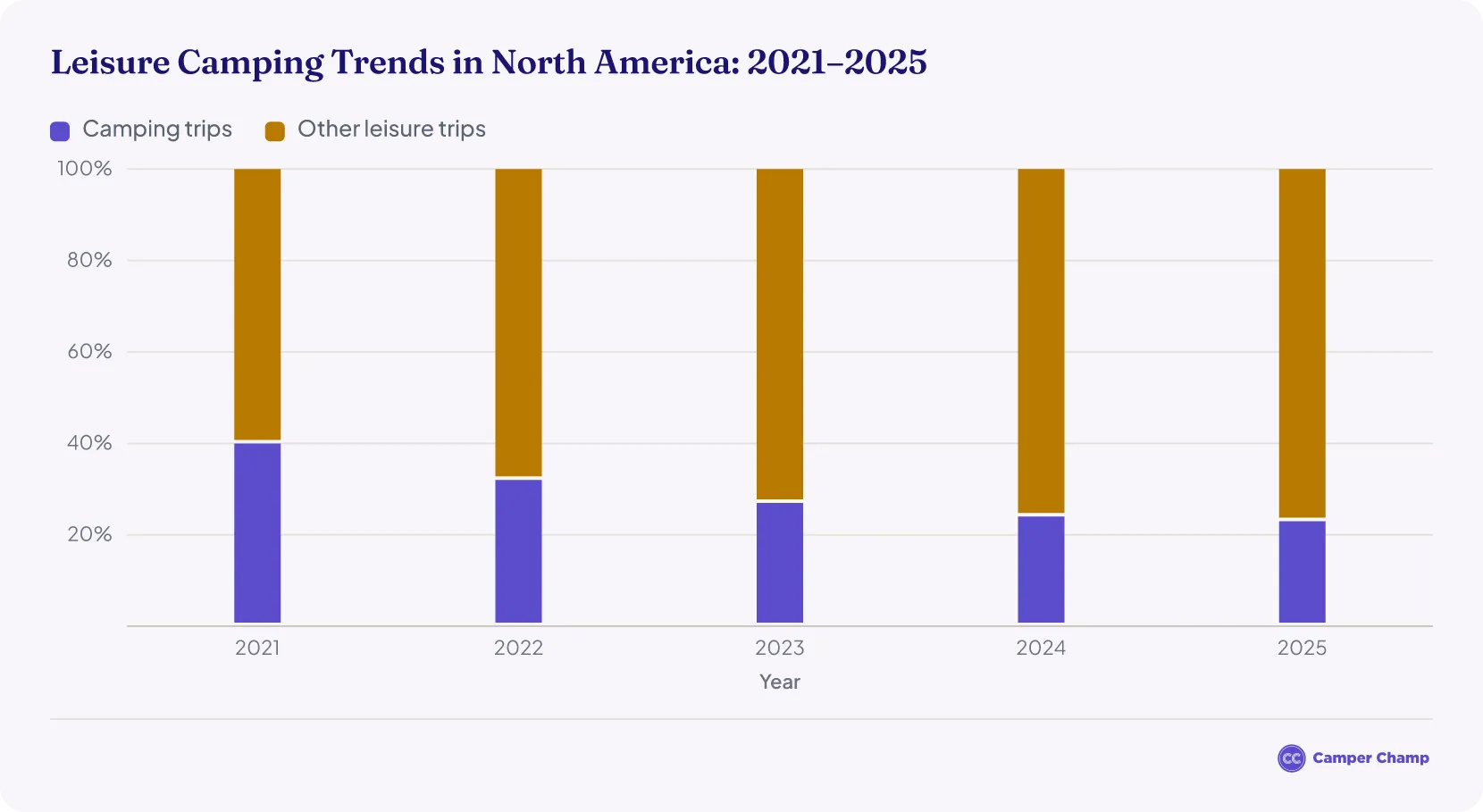
- Camping accounted for 23% of all leisure trips in 2025, down from a 40% peak in 2021.1
How many people go camping every year in North America?
In 2025, 52.16 million North American households took at least one camping trip, almost unchanged from 52.5 million in 2024 and well above the 41.97 million of 2019, and more than 2.2 million households camped for the first time1. In 2023, 87.99 million North American households identified as camping households2, and in the U.S. alone The Dyrt counted 5.5 million new campers3.
In 2023 this included over 53.67 million households that took a camping trip4 (those who started in the past few years and lifelong campers), and other inactive campers (those who camped off and on throughout the years).
How often do people go camping each year in North America?
How much do campers spend on their camping trips in North America?
- Campers spent an average of over $200 per person per day (excluding accommodation) during camping trips in 2025, up from $156 in 2023.5
Camping Demographics: Who camps the most in North America?
In 2025, Gen Z and Millennials together made up 42% of campers1.
- Generational Split: Among new campers in 2023, 21% were Gen Z, 28% were Millennials, 22% were Gen X, and 29% were Baby Boomers or the Silent Generation.4
- 2025 Split: Across all campers in 2025, 13% were Gen Z, 29% Millennials, 29% Gen X, 28% Baby Boomers and 1% the Silent Generation. That was Boomers' highest share since 2015, when they also made up 28%, and a quarter of new campers were Boomers.1
Camping Preferences: Where Did People Camp the Most in North America in 2025?
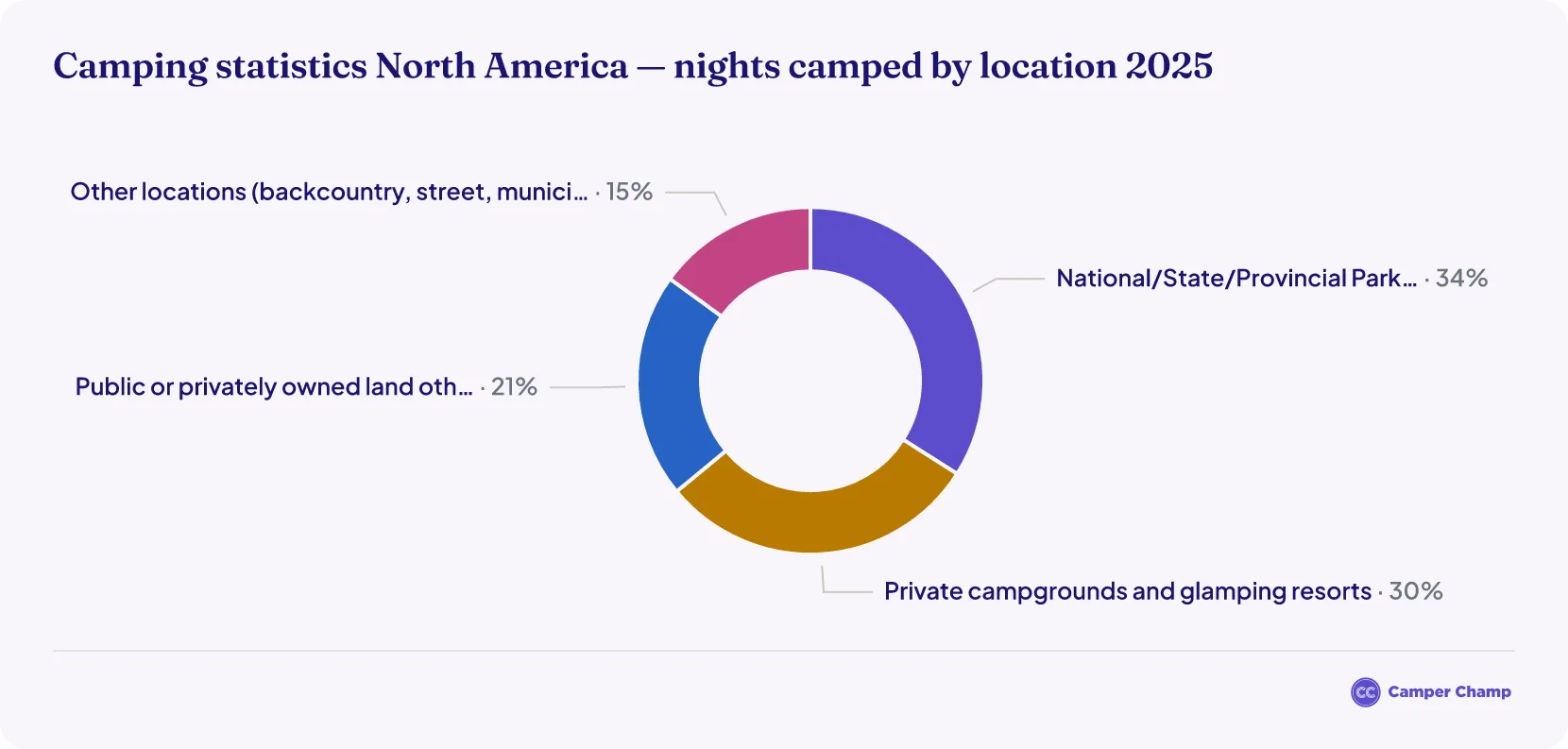
- 34% of camping nights were spent at national, state, or provincial park campgrounds in 2025, up from 33% in 2024.1
- 3 in 10 camping nights were spent at private campgrounds and glamping resorts, and 21% on public or privately owned land other than a campground; the remaining nights were spent at other locations such as backcountry and national forests, street camping and municipal campgrounds.1
Camper Distribution in the U.S. National Parks in 2025
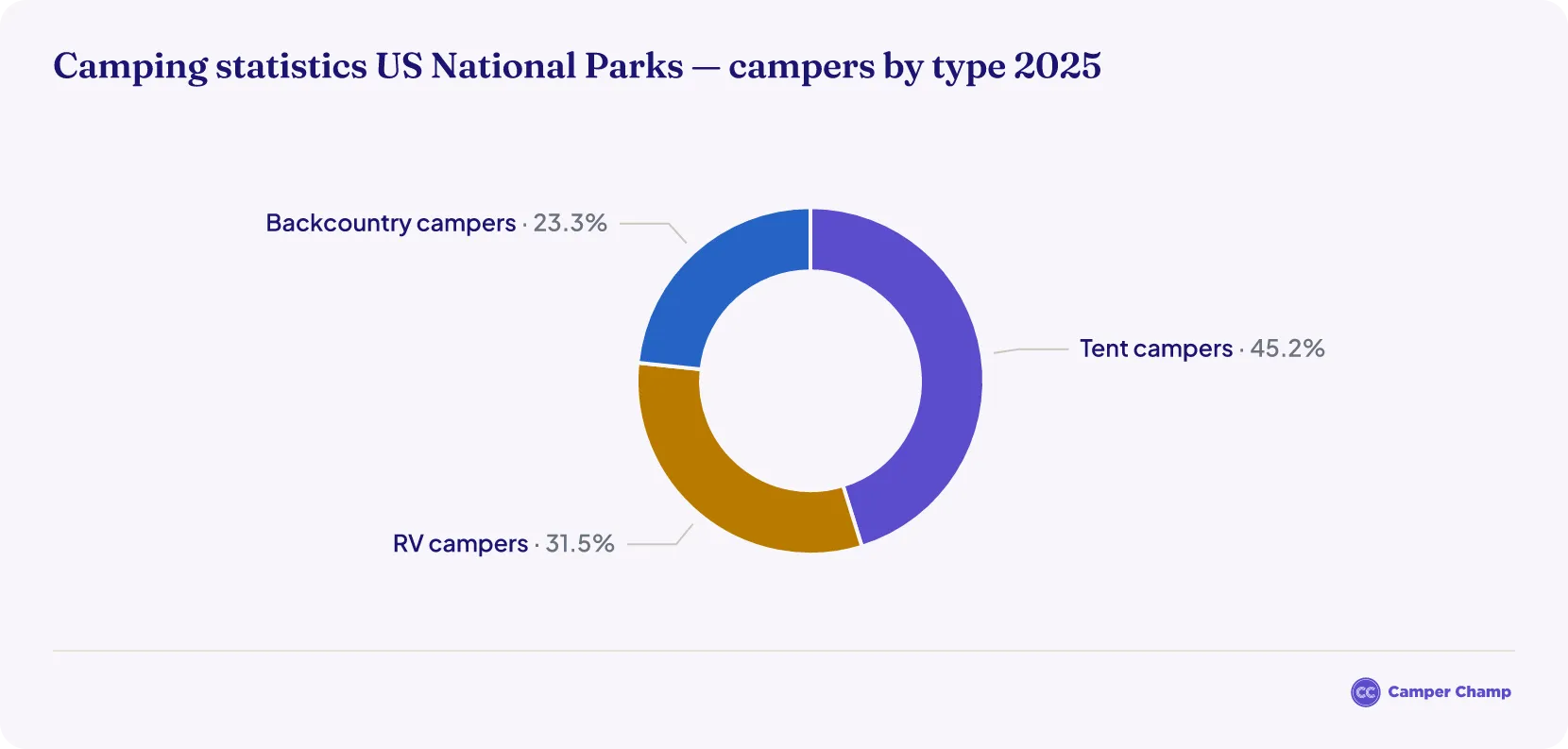
The 63 U.S. National Parks welcomed 93.89 million recreation visits in 20256. Campers accounted for about 5.13 million overnight stays that year, counting tent, RV and backcountry camping combined.
- Tent camping was the most popular type of camping in the U.S. National Parks, followed by RV camping.
- Yosemite National Park led with the highest number of tent and RV campers in 2025, totalling 439,233 tent campers and 264,908 RV campers7.
- A smaller number of visitors choose the more remote and adventurous option of backcountry camping.
What are the most popular types of camping in North America?
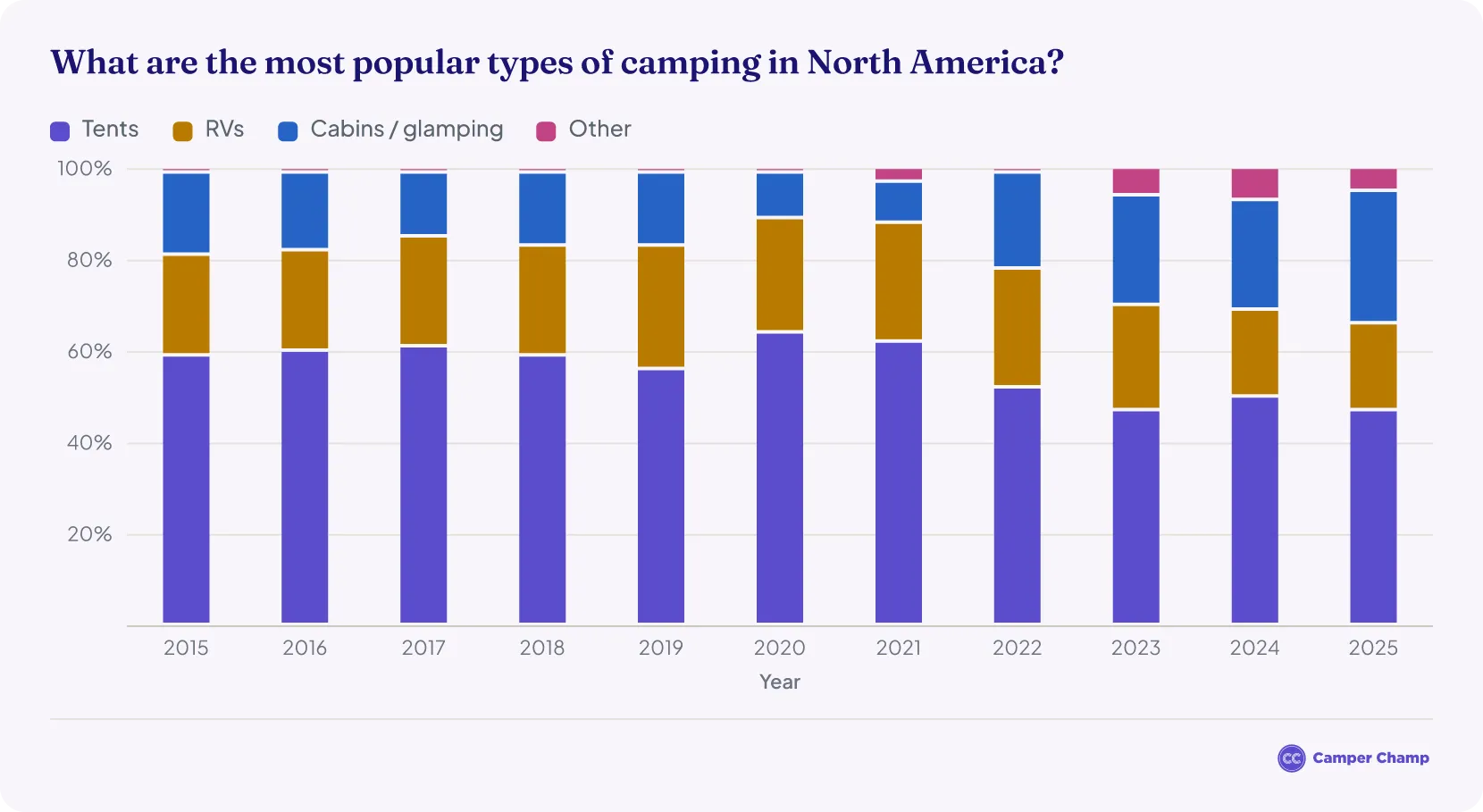
Tents remained the most popular way to camp in 2025, chosen by 47% of camping households, down from 50% in 2024 and 64% in 2020.1
Although it remains the most popular type of accommodation, tent camping now accounts for less than 50% of all camping households, as more people choose cabins and glamping.
- Cabins and Glamping: These options have seen the largest increase in popularity, with over 15 million households glamping in 2025, or 29% of camping households, up from 24% in 2024.1
- 2025 Preferences: Tents accounted for 47% of camping households in 2025, RVs 19% and cabins or glamping 29%, glamping's highest share yet, with over 15 million households glamping that year.1
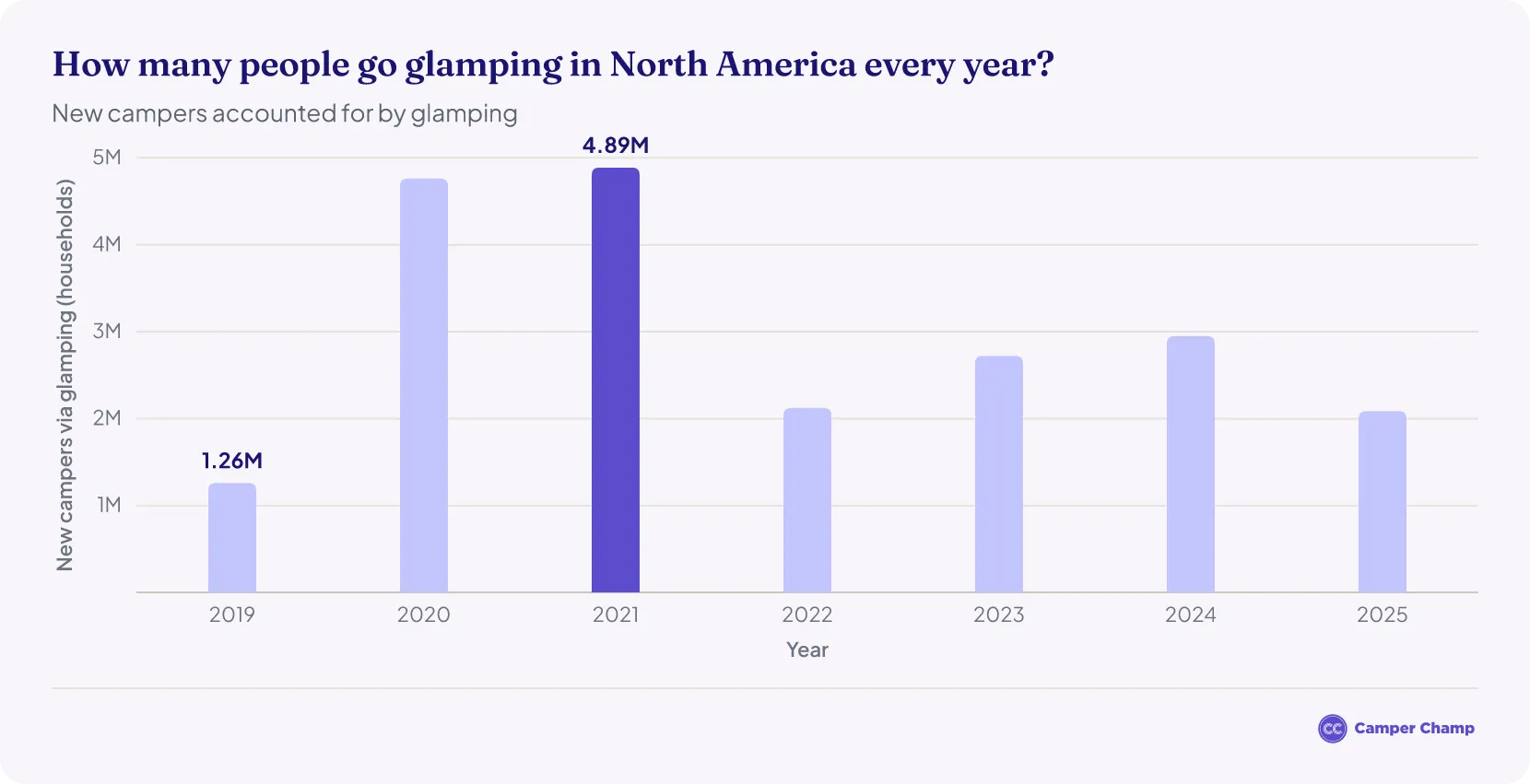
- Glamping in 2025: Glamping accounted for 2.09 million new campers in 2025, down from 2.95 million in 20241, and 31% of new campers identified themselves as glampers.
How common was the use of RVs in camping in North America in 2025?
More than half of U.S. campers (52.2%) took at least one trip in an RV or trailer in 2025, according to The Dyrt.8
- RV Ownership: The popularity of RV camping has increased in recent years, especially in North America, where wholesale RV shipments to dealers reached 342,220 units in 2025, up 2.5% on 2024.9
- RV Households: Just over 9.9 million North American households camped in an RV in 2025 (9.91 million), and 67% of them traveled in an RV they own; the share renting RVs from a rental company doubled from 4% in 2024 to 8% in 2025.1
- Camping Duration: RV campers spent an average of 11.7 nights camping in 2025, up from 7.5 nights in 2024 and the biggest increase of any camper type.1
What types of activities do people enjoy while camping in North America?
- Wellness: Mental wellbeing is now the top reason to camp: in 2025, 49% of campers booked camping trips to improve their mental wellbeing, and 77% of U.S. campers said simply being in nature is enough, without structured programming.1
- Plans for 2026: 31% of campers plan to take more camping trips and nights in 2026, 38% of U.S. campers want to visit historic sites and 27% want to try a road trip that includes camping for the first time.1
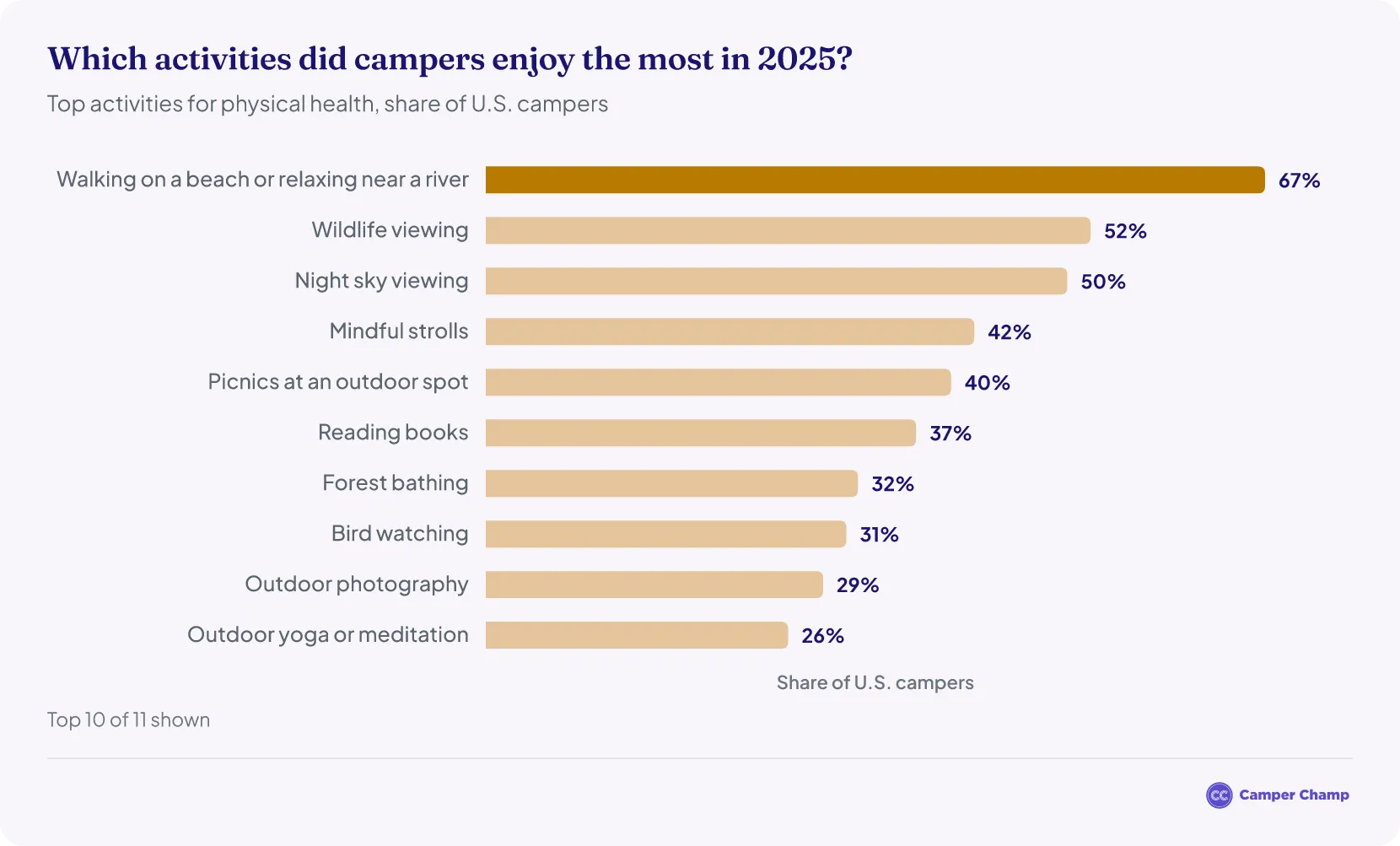
- Popular activities: The top three outdoor activities in 2025 were water-based activities such as paddleboarding, swimming and fishing (54%), hiking or trail running (49%) and canoeing or kayaking (27%). The chart below ranks the activities U.S. campers said benefit their physical health in 2025:
- 67% walked on a beach or relaxed near a river.
- 52% went wildlife viewing.
- 50% went night-sky viewing.
- 42% took mindful strolls.
- 40% had a picnic at an outdoor spot.1
Blended Travel
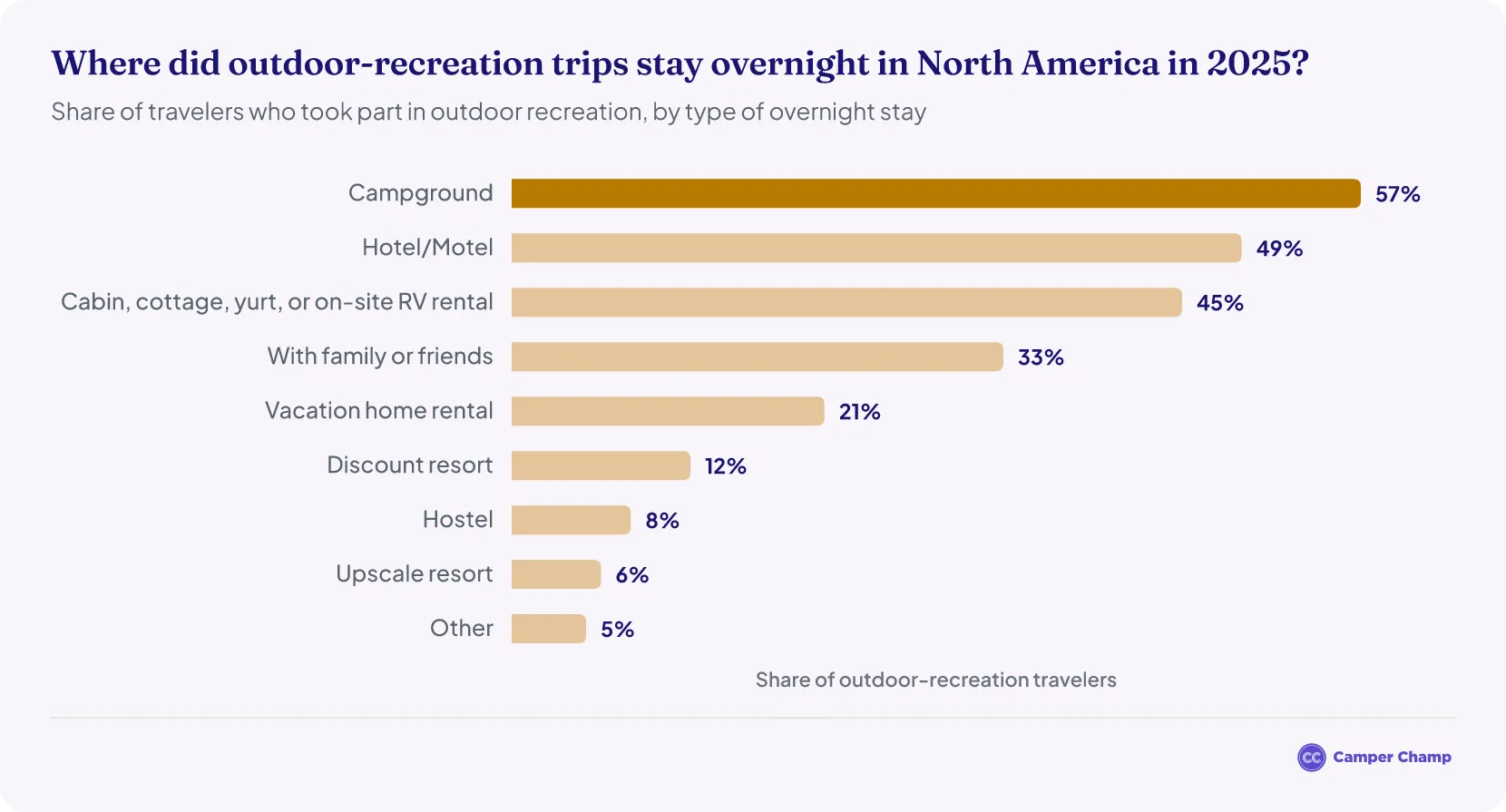
- In 2025, 81% of travelers who took part in outdoor recreation extended those trips into overnight stays at a campground or hotel. Campgrounds were the most common place to stay (57%), followed by hotels or motels (49%), cabins, cottages, yurts or on-site RV rentals (45%), staying with family or friends (33%) and vacation home rentals (21%).1
Road Trips
- KOA calls 2026 the year of the road trip: in 2025, 27% of U.S. campers (21% in Canada) said a road trip that includes camping is a new experience they want to try, 38% want to visit historic sites, 33% want to visit small towns, and 55% of Gen Z said they are likely to rent an RV for a trip. Among those planning to travel Route 66 for its centennial, over half plan to camp along the way.1
Off-Season and Winter Camping
Camping outside the summer peak keeps growing: in 2025, one in five North American campers said the shoulder season is the best time of year to camp, and 76% of Boomers camp in the shoulder seasons to avoid crowds.1
- When campers plan to camp: 43% in June to August, 26% in September and October, 25% in April and May, and 6% in the winter months from November to March.1
- Why camp off-season: avoiding crowds (45%), lower cost (42%) and better weather (41%) lead the reasons, while 35% of campers avoid summer because campgrounds are overcrowded and 30% because it is too expensive.1
Impact of COVID-19 on the Camping Industry in North America
The pandemic pushed camping to the center of leisure travel, and the years since show how much of that shift has lasted. At the 2021 peak, camping accounted for 40% of all leisure trips4 as travelers favored the outdoors over indoor options. That share eased to 32% in 2022 as hotels, flights and cruises reopened, and to 27% in 2023. Since then it has settled rather than slid: 24% of leisure trips in 2024 and 23% in 20251, still roughly one leisure trip in four.
How does technology influence camping experiences in North America?
Connectivity matters more to campers every year, even as fewer of them work while they camp.
- Wi-Fi as an Amenity: In 2025, 47% of campers said Wi-Fi is very important when choosing a campground (50% of new campers versus 43% of experienced ones), and campers stay an average of 5.2 extra nights a year where Wi-Fi is available, rising to 9.3 nights for RVers.1
- Working While Camping: Only 26% of campers always work while camping in 2025, the lowest share since KOA began tracking it, although 46% of Gen Z campers still do; just 7% plan to work more while camping in 2026.1
- Booking Challenges: More than half of campers had difficulty booking a campsite in 2025 because campgrounds were full,10 after 56.1% in 202411 and 45.5% in 20233. Popular parks and campgrounds still sell out quickly, especially on weekends.
Other Resources
USA Camping Statistics 2025
The Dyrt offers detailed insights into campers' preferences and camping destinations in the U.S.
How popular is camping in the U.S.?
- 82.4 million Americans camped at least once in 2025, the second-highest total on record behind only the 84.8 million of 2023, including 2.6 million first-time campers.10
- 85% of U.S. adults have camped at least once in their life, and the median camper took six camping trips in 2025.12
What types of camping are most popular in the U.S.?
- 52.2% of campers took at least one trip in an RV or trailer in 2025, keeping RVs and trailers the most popular way to camp.8
- Tent camping, glamping, van camping and truck camping all grew in popularity in 2025, especially among younger campers.12
- Nearly half of campers camped with a dog, and more than 25% worked from a campsite during the year.12
Who are the primary campers in the U.S.?
RV and trailer camping rises with age: in 2025 only 21% of campers aged 34 and under camped in an RV or trailer, against 64% of those aged 65 and over.8
- The camping population grew more diverse in 2025, with more LGBTQ+ and BIPOC campers than in previous years.12
Looking Ahead
- The global camping and caravanning market reached $81.36 billion in 2025 and is expected to grow to $86.52 billion in 2026 and $114.35 billion by 2030, with North America the largest region.13
- 2026 outlook: 31% of North American campers plan to take more camping trips and nights in 2026 than in 2025, 54% plan to glamp, and 48% say they are very likely to rent an RV. Asked how they plan to camp in 2026, 55% name a tent, 54% a glamping accommodation and 37% an RV.1
- 2026 so far: the RV market is softer. Wholesale RV shipments through July 2026 were 183,592 units, down 13.9% on the same period of 2025,14 and the RV Industry Association's summer forecast now expects 300,000 to 328,100 units for the full year (median 314,000, an 8.2% decrease on 2025).15
Glossary
Baby Boomer - Born 1946-1964
Camping - Any occasion when you spent at least one night outside of your primary residence and stayed in accommodations such as a tent, trailer, RV, or vehicle or cabin/cottage at a campground.
Car camping - Those who travel and sleep in their vehicles (versus other types of accommodation, including RVs).
Camping households - Those who identify as campers.
Dispersed Camping - The term used for camping anywhere in the National Forest outside of a designated campground. Dispersed camping means no services such as trash removal, and little or no facilities which may or may not include tables and firepits.
Generation X (Gen X) - Born 1965-1980
Generation Z (Gen Z) - Born 1997-2012
Glamping - Defined as staying in unique accommodations with enhanced services and amenities.
Incidence - For camping incidence, this figure is calculated by dividing the total number of households with at least one person who camps divided by the total number of eligible households.
Millennial - Born 1981-1996
Overlanding - An "overlanding" experience is where you travel in an off-road vehicle, taking back roads, no services/amenities, you are completely self-sustaining and the purpose is the journey.
Peer-to-Peer RV Rental - A rental that occurs between a private RV owner and a renter. Generally, this is facilitated by a designated marketplace.
Public Land Camping - Staying at a public campground in a national park, state park, municipal campground, national forest campground, national forest land, BLM land, or designated wilderness areas.
RV - Includes type A, B, or C motorhomes, travel trailers, fifth-wheels, pick-up campers, pop-up trailers, and small van campers.
RVing Experience (used in new camping experiences) - Where you travel in an RV from destination to destination.
Silent/Mature - Born prior to 1946
Van Life - Defined as a form of adventure tourism that involves a van that is livable and self-sustained.
RV rental in the USA
- RV rental in Albuquerque
- RV rental in Atlanta
- RV rental in Denver
- RV rental in Florida
- RV rental in Las Vegas
- Los Angeles RV rental
- Pittsburgh RV rental
- RV rental in San Francisco
- Seattle RV rental
- Tampa RV rental
References
- 2026 KOA Camping & Outdoor Hospitality Report (Cairn Consulting Group for Kampgrounds of America) · koa.uberflip.com ↑ b c d e f g h i j k l m n o p q r s t u v w x y z a2 b2 c2 d2 e2 f2 g2 h2 i2
- EXCLUSIVE: A Decade of KOA Report Findings · rvnews.com ↑ b
- The Dyrt 2024 Camping Report · thedyrt.com ↑ b
- KOA North American Camping & Outdoor Hospitality Report 2024 (top-level overview) · woodallscm.com ↑ b c
- KOA's 2026 Camping and Outdoor Hospitality Report reveals the "Open Road Era" (press release) · koapressroom.com ↑
- National Park Annual Visitation · irma.nps.gov ↑
- NPS Visitor Use Statistics — Overnight Stays, Yosemite NP · irma.nps.gov ↑
- The Dyrt Finds RVs and Trailers Are Still the Top Choices for Campers (press release, The Dyrt 2026 Camping Report) · outdoorsportswire.com ↑ b c
- RV Shipments End 2025 with 342,220 Units, Up 2.5% YoY (RVBusiness, citing the RV Industry Association December 2025 survey) · rvbusiness.com ↑
- The Dyrt's 2026 Camping Report Presented by Toyota Trucks (press summary) · thedyrt.com ↑ b
- The Dyrt's 2025 Camping Report Presented by Toyota Trucks Finds Millions of Americans Continue to Discover Camping (press release) · prnewswire.com ↑
- New Camping Trends Revealed in The Dyrt's 2026 Camping Report (Back Road Ramblers) · backroadramblers.com ↑ b c d
- Camping And Caravanning Global Market Report · thebusinessresearchcompany.com ↑
- RVIA: July Wholesale Shipments Down 11.9% Versus 2025 (RVBusiness) · rvbusiness.com ↑
- RVIA's New Wholesale Shipment Outlook Reflects Soft Demand — Summer 2026 RV RoadSigns forecast (RVBusiness) · rvbusiness.com ↑
- 2024 Outdoor Participation Trends Report · outdoorindustry.org
- North American Camping Report · koa.com