
Page last updated: 12 March 2026
Camping in New Zealand is a popular activity for Kiwis and tourists alike, with holiday parks and campgrounds making up about one quarter of all accommodation in the country. It is a mainstream outdoor activity and a big part of the tourism industry.
How many people go camping in New Zealand each year?
Over 1 million people camp in New Zealand every year.
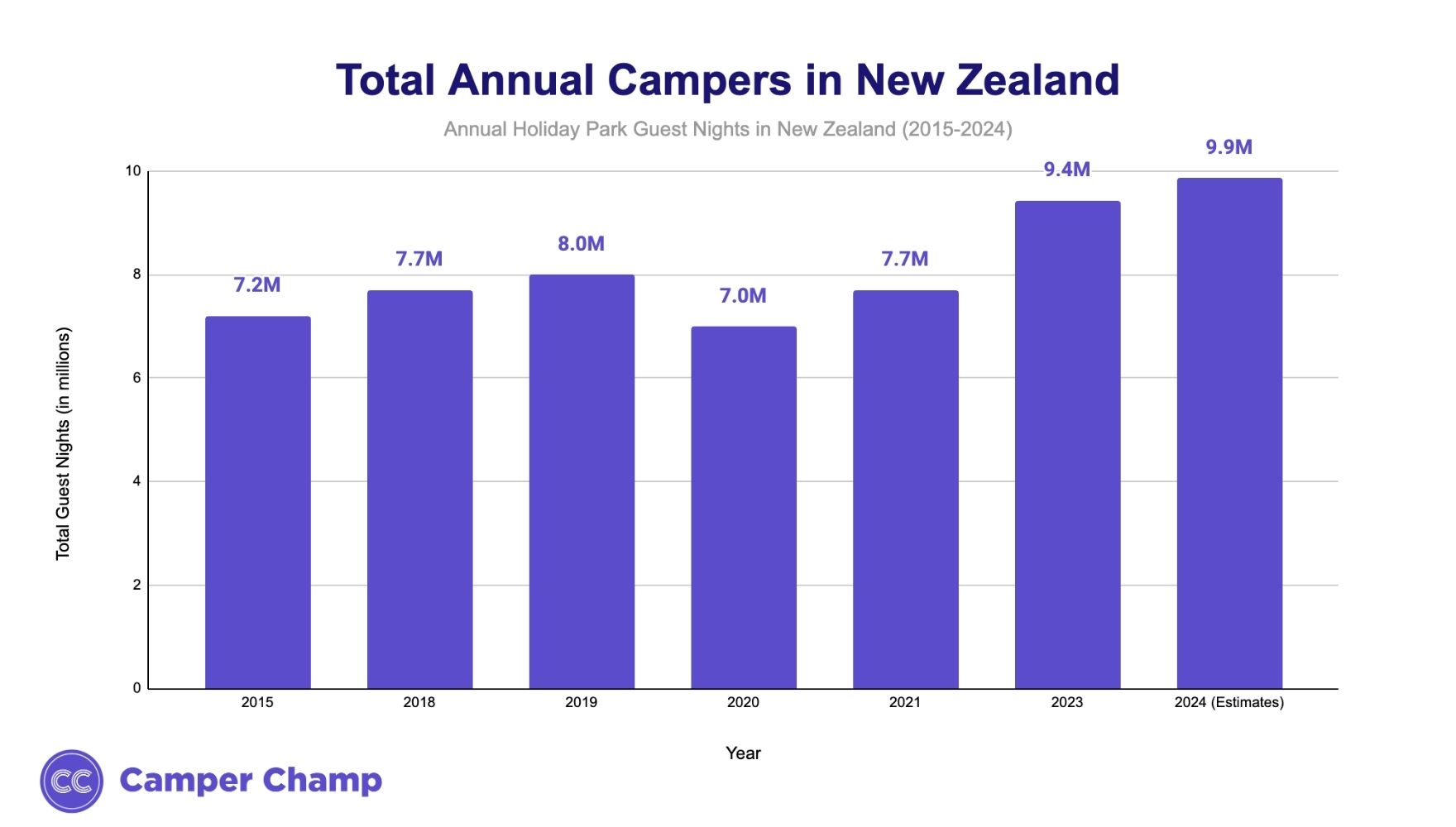
- Over 9 million guest nights were recorded in Holiday Parks in 2023 and 2024 (estimates). Domestic guests stayed for around 7 nights according to 2017 numbers.
How many freedom campers are there in NZ?
There are over 200,000 responsible freedom campers in New Zealand each year (domestic and international).
- International freedom campers grew from around 10,000 in 2000 to 54,000 in 2013, a large increase reflecting the rising popularity of the region for campers.
- 123,000 international freedom campers in 2018 and 154,000 international freedom campers in 2019.
- There were a total of 245,000 freedom campers in 2019 including over 91,000 domestic campers. This is the highest number in recent years.
| Year | Freedom Campers (International Visitors) |
|---|---|
| 2000 | 10,000 |
| 2013 | 54,000 |
| 2018 | 123,000 |
| 2019 | 154,000 |
What types of camping are most popular in New Zealand?
Holiday Parks are the most common type of camping in New Zealand. Freedom camping is also popular.
Freedom Camping
- 245,000 people (154,000 international and 91,000 domestic) in 2019.
- Popular with backpackers and self-contained motorhome owners.
Holiday Parks
- 300-400 holiday parks nationwide with around 9 million guest nights in recent years.
- Accounts for around 85% of domestic guest nights.
Glamping
- Glamping has grown at 9% per year, offering luxury tented and cabin experiences.
Tent vs Campervan
- 69% of international holiday park visitors (2016/17 peak season) stayed in campervans.
- Domestic campers often use tents or caravans especially for extended family holidays.
How much do campers spend on their camping trips in New Zealand?
Campers spread their spending across multiple categories. Holiday park stays and freedom camping trips have different spending profiles.
- Domestic freedom campers spent around NZ$729 per person per trip in 2019.
- International visitors purchasing vehicles spent around NZ$7,900 per person. Campers renting campervans spent between NZ$4,900-NZ$5,900 per person.
- In holiday parks, the average cost is around NZ$145.71 per person per night (domestic spending at NZ$114 and international at NZ$190).
Expenditure Breakdown for Holiday Park Visitors (Annualised 2017)
| Category | Share of Spend | Annual Spend (NZ$) |
|---|---|---|
| Accommodation (camp fees) | 25% | $266 million |
| Activities/Attractions | 15% | $164 million |
| Groceries/Snacks | 15% | $161 million |
| Transport (excluding fuel) | 13% | $139 million |
| Cafés/Restaurants | 10% | $108 million |
| Petrol/Fuel | 10% | $108 million |
| Alcohol (bars, etc.) | 2% | $26 million |
| Other Shopping | 10% | $97 million |
| Total | 100% | $1.068 billion |
How long do campers typically stay at campsites in New Zealand?
Stay times can vary by camper and camping style. There are different stay durations for holiday parks and freedom camping.
- Holiday Parks:
- Domestic guests stay around 7 nights, while international visitors spend about 3 nights per holiday park stay according to the 2017 survey.
- Freedom Camping:
- Freedom campers (domestic and international) spent around 10.9 nights at freedom camping sites in 2019.
- Freedom campers (domestic and international) spent around 10.9 nights at freedom camping sites in 2019.
New Zealand Travel Resources
Which Regions Have the Most Nights Spent at Campsites?
The Tasman region consistently records the most freedom camping nights and holiday park stays. 151,000 responsible camping nights were recorded in 2019.
- Queenstown-Lakes and Christchurch City followed with 137,000 and 128,000 nights, respectively.
- Thames-Coromandel and Tauranga City recorded similar figures with 127,000 and 126,000, respectively.
Top Regions for Freedom Camping Nights (2019)
| Region/District | Freedom Camping Nights |
|---|---|
| Tasman (South Island) | 151,000 |
| Queenstown-Lakes (South Island) | 137,000 |
| Christchurch City (South Island) | 128,000 |
| Thames-Coromandel (North Island) | 127,000 |
| Tauranga City (North Island) | 126,000 |
Camping Demographics: Who camps the most in New Zealand?
37% of New Zealanders are regular campers (2006 survey), across all age groups from young backpackers to retirees.
- Age:
- International freedom campers who bought vehicles were 26 years old and those who hired campervans were between 30-42 years old in 2019.
- Domestic camping is common in families (mainly 30s-40s) and retirees (average age of 63.3 among responsible campers) according to a 2019 survey.
- Gender and Income:
- Participation is equal for men and women across all camping types.
- Camping is equal for lower and higher income. Higher-income people may opt for motorhomes, premium gear and glamping. Budget-conscious travellers choose tent camping.
- Urban vs Rural:
- Urban residents, especially from Auckland, Wellington and Christchurch, make up a large portion of domestic campers while rural communities benefit from the tourism they bring.
- Urban residents, especially from Auckland, Wellington and Christchurch, make up a large portion of domestic campers while rural communities benefit from the tourism they bring.
Camping Preferences: Where Did People Camp the Most in New Zealand?
People prefer camping in the Northland (North Island). The region recorded around 695,000 holiday park guest nights annually (based on 2019 data).
- Coromandel: Around 650,000 guest-nights. Popular for summer weekends.
- Bay of Plenty: Around 500,000 guest-nights (2019 data) including favoured areas like Tauranga.
- Canterbury (South Island): Most visited South Island campgrounds. Around 670,000 guest-nights in 2019. Over 57% of tourist nights are in campgrounds.
Regional Camping in Holiday Park (2019 Estimates)
| Region | Holiday Park Guest-Nights |
|---|---|
| Northland (NI) | 695,000 |
| Coromandel (NI) | 650,000 |
| Bay of Plenty (NI) | 500,000 |
| Canterbury (SI) | 670,000 |
| Nelson-Tasman (SI) | 520,000 |
| Queenstown-Lakes (SI) | 400,000 |
| West Coast (SI) | 300,000 |
How popular is camping in New Zealand?
There is a strong outdoor culture in New Zealand. Around 164,000 people used bookable campsites in 2021-2022 (DOC reports).
- More than a million domestic and international visitors camp annually in New Zealand. According to a 2006 survey, over 37% of New Zealanders were regular campers.
Impact of COVID-19 on New Zealand’s Camping Industry
With near-zero international visitors due to COVID-19, domestic camping remained strong with over 100,000 visitors using bookable Department of Conservation (DOC) campsites in the 2020/21 summer (only a 5% drop from previous years).
- Campgrounds and holiday parks were closed during New Zealand’s Level 4 lockdown from late March 2020.
- International arrivals were down 91% (over 2.2 million visitors) in the year to August 2021.
- Holiday park guest nights reached an estimated 9.4 million by 2023, up 17.5% compared to 2019 pre-pandemic levels.
How Does New Zealand Compare Internationally in Camping Trends?
New Zealand’s camping trends rank well on a per capita basis compared to Australia, the US and European countries.
- 37% of New Zealanders are regular campers, similar to high per capita rates in Australia and Europe.
- Around 84.8 million Americans (25% of the US population) went on camping trips in 2023. Australia had 15.3 million domestic camping trips in the year ending 2023.
- Both New Zealand and Australia offer strong holiday park networks and freedom camping options.
- US camping includes bigger RVs and more hookups. New Zealand is more campervan and tent-focused.
- New Zealand domestic campers spend around NZ$729 per trip on average (2019). Australian data suggests higher overall trip spend when adjusted for longer trip duration.
- The glamping market in New Zealand is growing at the same rate as globally (9% per year).
Camping Statistics by Country
- Camping Statistics in the USA
- Camping Statistics in Canada
- Camping Statistics in Europe
- Camping Statistics in the UK
- Camping Statistics in Australia
- Camping Trends
References
- DOC: Review of Camping Opportunities in NZ (2006) and Visitor Insights Report 2021/22
- MBIE: Responsible Camping Research 2019/20 and Accommodation Survey/Tourism Data
- HPNZ: Economic Benefit Report (2017)
- ANews: Booming Summer for NZ Holiday Parks (January 2024)
- DOC: Fee Update Report 2024
- HPNZ/MBIE Accommodation Data Programme: Accommodation Data (2024)
- HPNZ: Economic Impact Studies on Camping
- NZMCA: Digital Camping Report (2023)
- TRA: Tourism Research Australia (2023)
- PRNews: US Camping Data (2024)
- Eurostat: Camping Overnight Stays in France (2019)
- KOA: North American Camping Data (2023)