

Published
Iceland's campsite sector is an essential component of the country's tourism industry. It attracts domestic travellers seeking nature experiences and international visitors drawn by Iceland's unique landscapes and outdoor recreation opportunities.
How many campsites are there in Iceland?
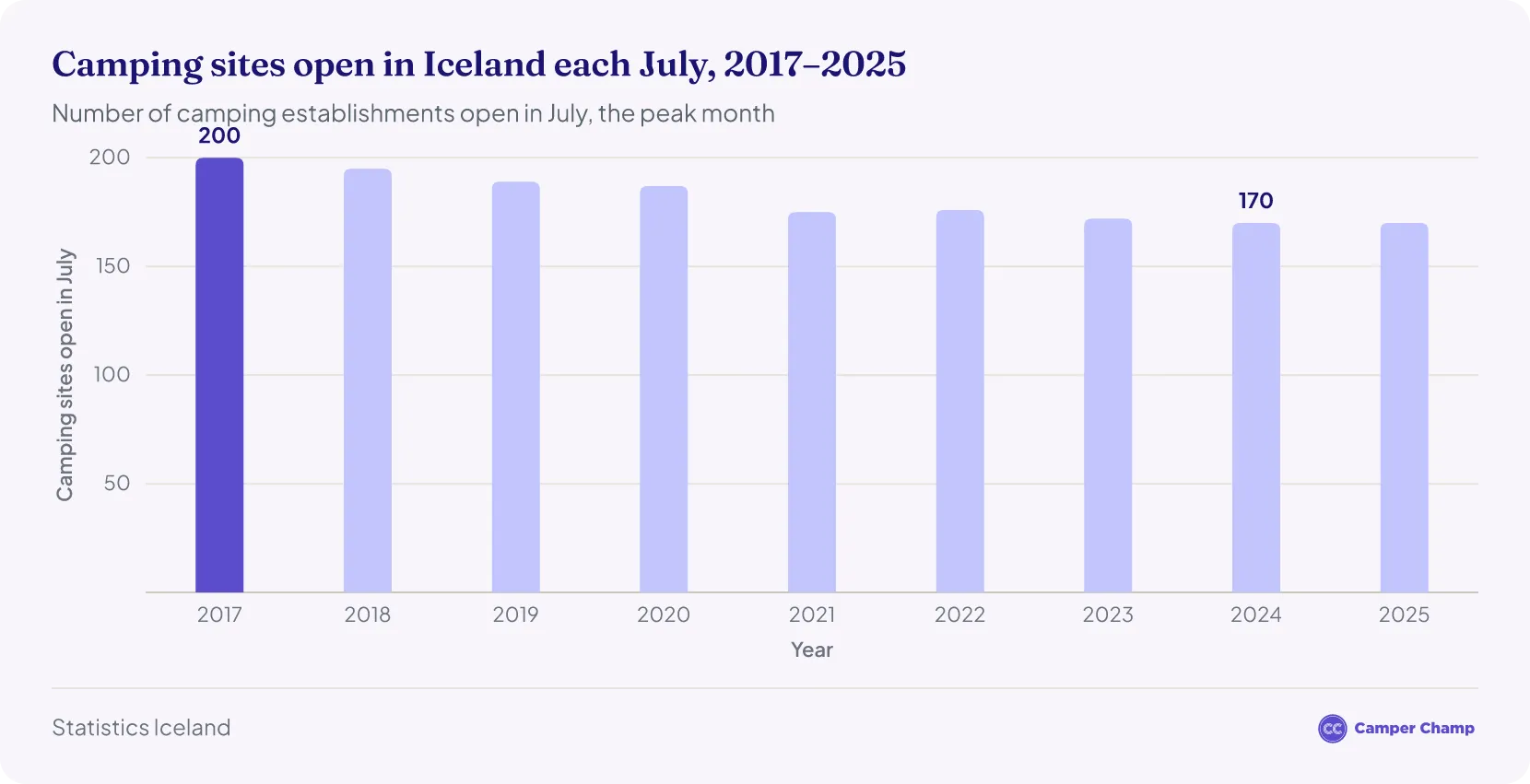
Iceland's campsite network has shrunk steadily since 2017. Statistics Iceland counted 170 camping sites open in July 2025, unchanged from 2024 and down from 200 in July 2017.1
- Between 175 and 176 camping sites were open each July in 2021 and 2022, falling to 172 in 2023 and 170 in 2024 and 2025.1
- That is an average decline of about 0.7% a year since 2021, slower than the 3.3% a year from 2017 to 2021.1
- The steepest drop came between July 2020 and July 2021, when the count fell from 187 to 175 (−6.4%).1
How many people camp in Iceland each year?
How much does camping cost in Iceland?
Campsites in Iceland charge per person per night. At the national parks, an adult pays 1,800 ISK a night at Þingvellir4 and 2,800 ISK at Skaftafell and Ásbyrgi in Vatnajökull National Park.5
- Electricity costs extra: 1,100 ISK per 24 hours at Þingvellir4 and 1,500 ISK in Vatnajökull National Park.5
- Campsites must charge a national accommodation tax of 400 ISK per tent, motorhome or caravan pitch per night.6 Þingvellir adds it to the price,4 while Vatnajökull includes it in the fee.5
- Seniors (67+) and disabled visitors pay less, and children aged 16 and under camp free in Vatnajökull National Park.5
- The Icelandic Camping Card (Útilegukortið) costs €179 for the 2026 season and covers two adults and up to four children under 16 for a maximum of 28 nights at participating campsites.7
What camping costs in Iceland at a glance
Can you camp anywhere in Iceland?
No. Wild camping is not permitted in Iceland: camping in a tent, motorhome or camper van is restricted to campsites, or to private land with the landowner's permission.8
- The one exception is a tent on uncultivated land for a single night, when you are hiking or cycling and there is no campsite nearby.8
- Campfires are prohibited in Iceland.8
- Camper vans still spend many nights outside campsites: Statistics Iceland estimated 84,200 foreign overnight stays in camper vans outside registered campsites in 2023.9
Where is camping most popular in Iceland?
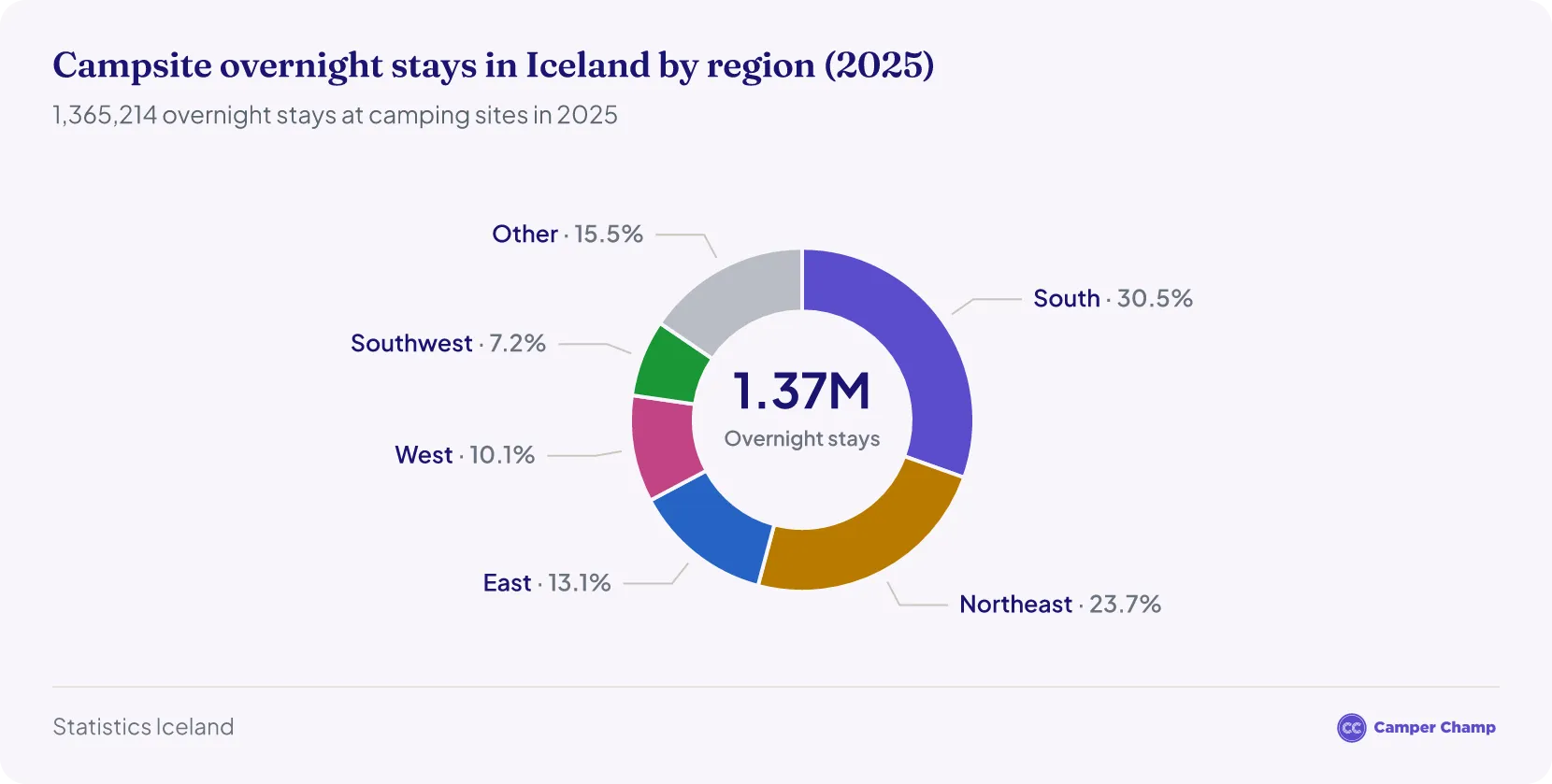
The South region recorded the highest number of campsite overnight stays in Iceland, with 415,875 in 2025.2
- 323,243 overnight stays were recorded in the Northeast region, making it the second most popular area for camping in 2025.2
- Overnight stays in the East region reached 178,545 in 2025, down from 191,161 in 2024.2
- Campers spent 137,343 nights at West region campsites during 2025.2
- The Westfjords attracted 80,664 overnight campsite stays in 2025.2
- The Northwest region recorded the fewest overnight stays at camping facilities in 2025, with 51,200.2
- The Capital region and Southwest recorded 79,623 and 98,721 overnight stays respectively in 2025.2
What types of accommodation are available at campsites in Iceland?
Traditional tent pitches are available at nearly all Icelandic campsites and remain the most common choice for budget travellers and backpackers.
- Campervan and motorhome spaces are provided at most campsites, reflecting the popularity of vehicle-based camping among international visitors.
- Camping pods and basic cabins are offered at some locations, primarily in the South and West regions, providing weather protection in Iceland's variable climate.
- Glamping options have emerged at a small number of Icelandic campsites, including specialised tents and unique structures designed for the Icelandic landscape.
What activities are offered at campsites in Iceland?
Many Icelandic campsites sit close to hiking trails, with the Laugavegur trek attracting 75,000–100,000 hikers a year, according to a 2013 estimate.10
- Geothermal bathing is close at hand at many campsites, in natural hot springs or a local swimming pool.
- Wildlife viewing is possible from many coastal campsites, with about 10,000 pairs of puffins nesting at Borgarfjörður Eystri each summer.11
- Glacier experiences are within reach of campsites in the South region, where guided glacier walks are offered.
- Northern Lights viewing draws winter campers to the sites that stay open through the aurora season.
What facilities and amenities do campsites offer in Iceland?
The level of facilities varies across Iceland's campsites from basic to well-equipped.
- Basic amenities typically found at most sites include toilets, cold running water and waste disposal facilities.
- Common amenities often available for an additional fee include showers, hot water for dishwashing, Wi-Fi access, and electricity hook-ups for campervans.
- Less common amenities include laundry facilities, playgrounds for children, on-site restaurants, or small shops.
- Some privately run farm campsites or larger municipal sites offer access to swimming pools or hot tubs.
- The VAKINN quality criteria for campsites cover aspects from general upkeep to safety features such as adequate lighting, fire prevention measures, and first aid kits.12
How did COVID-19 impact the campsites in Iceland?
Overnight stays at camping sites fell from 901,465 in 2019 to 616,345 in 2020, a 31.6% decrease.2
- This decline was less severe than that experienced by hotels and guesthouses, which saw a 65.1% drop in the same period.13
- Domestic overnight stays across all accommodation types increased by 34.7% to 1.5 million in 2020.13
- The East region of Iceland recorded a 10.9% increase in campsite stays during 2020.13
- By 2021, overnight stays at camping sites rebounded to 909,826, a 47.6% increase from 2020.2
Other Resources
How many campsites are fully booked during peak seasons in Iceland?
No official source publishes how many Icelandic campsites fill up in peak season: Statistics Iceland counts overnight stays at camping sites, but not occupancy or how far ahead campers book.
How has technology changed campsite bookings in Iceland?
The process of finding and booking campsites in Iceland is evolving with technology playing an increasingly important role.
- Parka is an app that allows users to browse, book, and pay for campsites across Iceland with features including real-time availability checks.14
- While many Icelandic campgrounds have historically operated on a first-come, first-served basis, the option to pre-book is becoming more prevalent.
- International platforms like Pitchup.com list Icelandic campsites, offering features such as instant confirmation and user reviews.
- The camping sector appears to be in a transitional phase regarding booking methods, creating a hybrid system that offers flexibility.
What is the economic impact of campsites in Iceland?
The camping and caravanning sector is part of Iceland's tourism economy, though no official figures single out its revenue or jobs.
- Tourism as a whole contributed 8.8% to Iceland's GDP in 2025, up from 8.2% in 202415, with camping forming an important component of this broader industry.
Motorhome rental in Europe
- Iceland motorhome rental
- Reykjavik motorhome rental
- Motorhome rental in Belgium
- Motorhome rental in Berlin
- Germany motorhome rental
- Motorhome rental in Greece
- Munich motorhome rental
- Netherlands motorhome rental
- Motorhome rental in Oslo
- Motorhome rental in Zagreb
References
- Statistics Iceland — Supply in all types of accommodation 1998–2025 (SAM01602) · px.hagstofa.is ↑ b c d
- Statistics Iceland — Overnight stays in camping accommodation 1998– (SAM01501) · px.hagstofa.is ↑ b c d e f g h i j k
- Registered overnight stays increased by 11% in 2023 · statice.is ↑
- Camping — Thingvellir National Park · thingvellir.is ↑ b c d e
- Pricelist — Vatnajökull National Park · vatnajokulsthjodgardur.is ↑ b c d e f
- Gistináttaskattur (accommodation tax) — Skatturinn, Iceland Revenue and Customs · skatturinn.is ↑ b
- Camping Card 2026 — Útilegukortið · utilegukortid.is ↑ b
- Camping — Safetravel (ICE-SAR) · safetravel.is ↑ b c
- Overnight stays in December 2023 · statice.is ↑
- One Hundred Thousand Hike Laugavegur · icelandreview.com ↑
- The puffin capital of Iceland · east.is ↑
- Vakinn — General criteria no. 160: Camping sites · Vakinn (Icelandic Tourist Board) ↑
- 61% decrease in registered overnight stays in 2020 · statice.is ↑ b c
- Pay for Parking and Reserve Your Camping Spot with Parka · icelandreview.com ↑
- Tourism satellite accounts 2025 · statice.is ↑
- Overnight Stays and Tourism Statistics · statice.is
- Caravan & Camping Sites Industry Market Research · ibisworld.com
- Iceland Camping Industry Outlook · reportlinker.com
- Iceland's Campsite Directory and Occupancy Rates · camping.info
- Short-stay Accommodation Statistics · ec.europa.eu
- Tourism Trends and Economic Impact · icelandreview.com