

Published
Germany had 1,046,383 registered motorhomes on 1 January 20261, having first passed 1 million in April 20252, and its campsites recorded a record 44.7 million overnight stays in 20253. Around 17 million people in Germany now count as campers, according to a 2026 ADAC survey4. Below are the latest figures on motorhome and caravan numbers, spending, costs, campers and the most popular camping regions.
At a glance
Motorhome and Caravan Numbers in Germany
How many motorhomes and caravans are in Germany?
Germany had 1,046,383 registered motorhomes on 1 January 2026, up 6.7% from 981,010 a year earlier1.
Germany reached a milestone in April 2025 when the total number of registered motorhomes surpassed 1 million for the first time2.
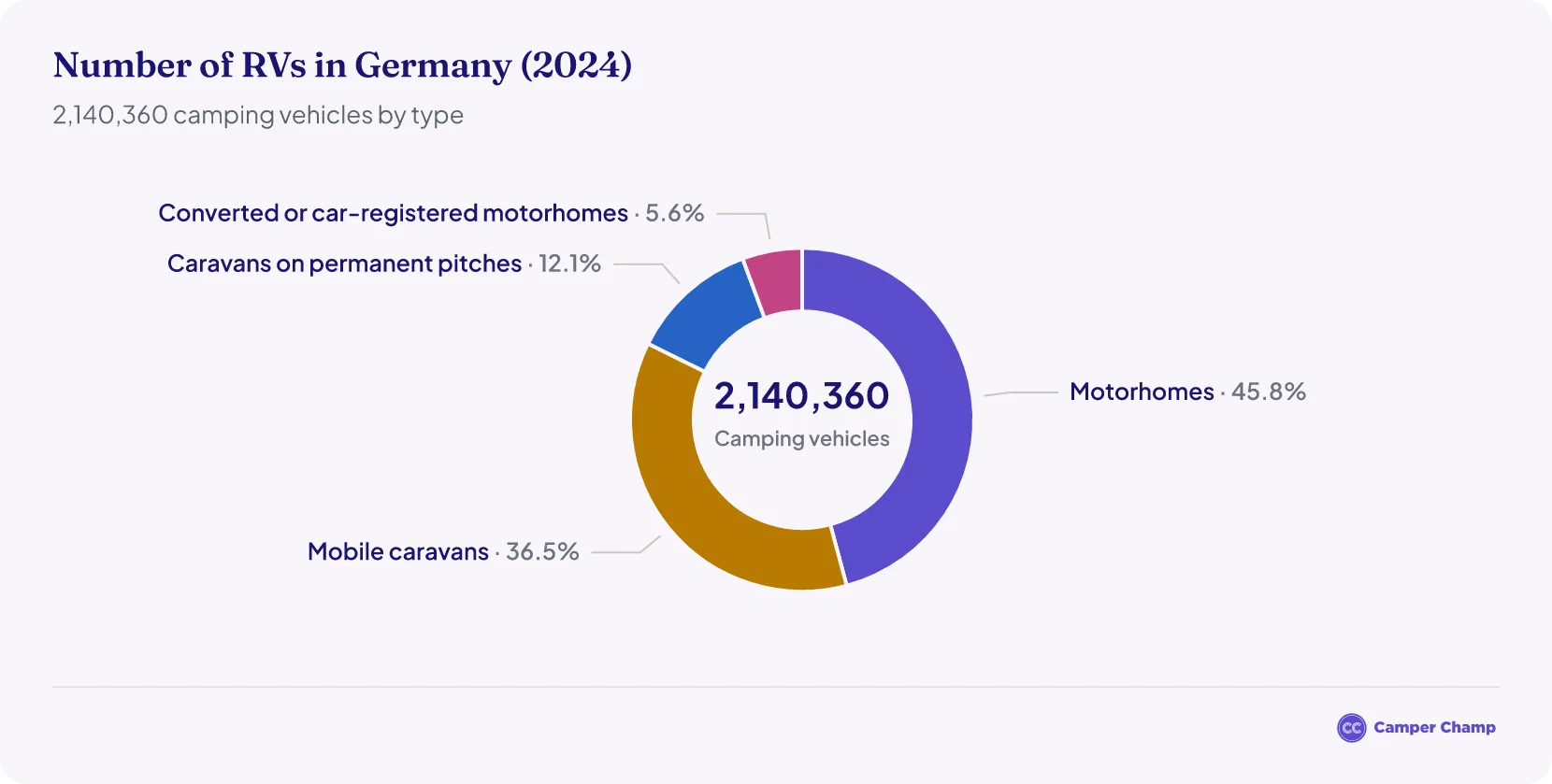
- A comprehensive count in 2024 recorded 2,140,360 camping vehicles in Germany, including 120,500 converted or car-registered motorhomes, according to the German Economic Institute for Tourism (dwif)8.
- Motorhomes specifically numbered 981,010 units in 2024, increasing from 907,879 units in 2023.28
- There were 1,038,850 caravans. Among them, 780,600 were mobile caravans and 258,250 caravans were on permanent pitches.8
How many new motorhomes and caravans are registered each year?
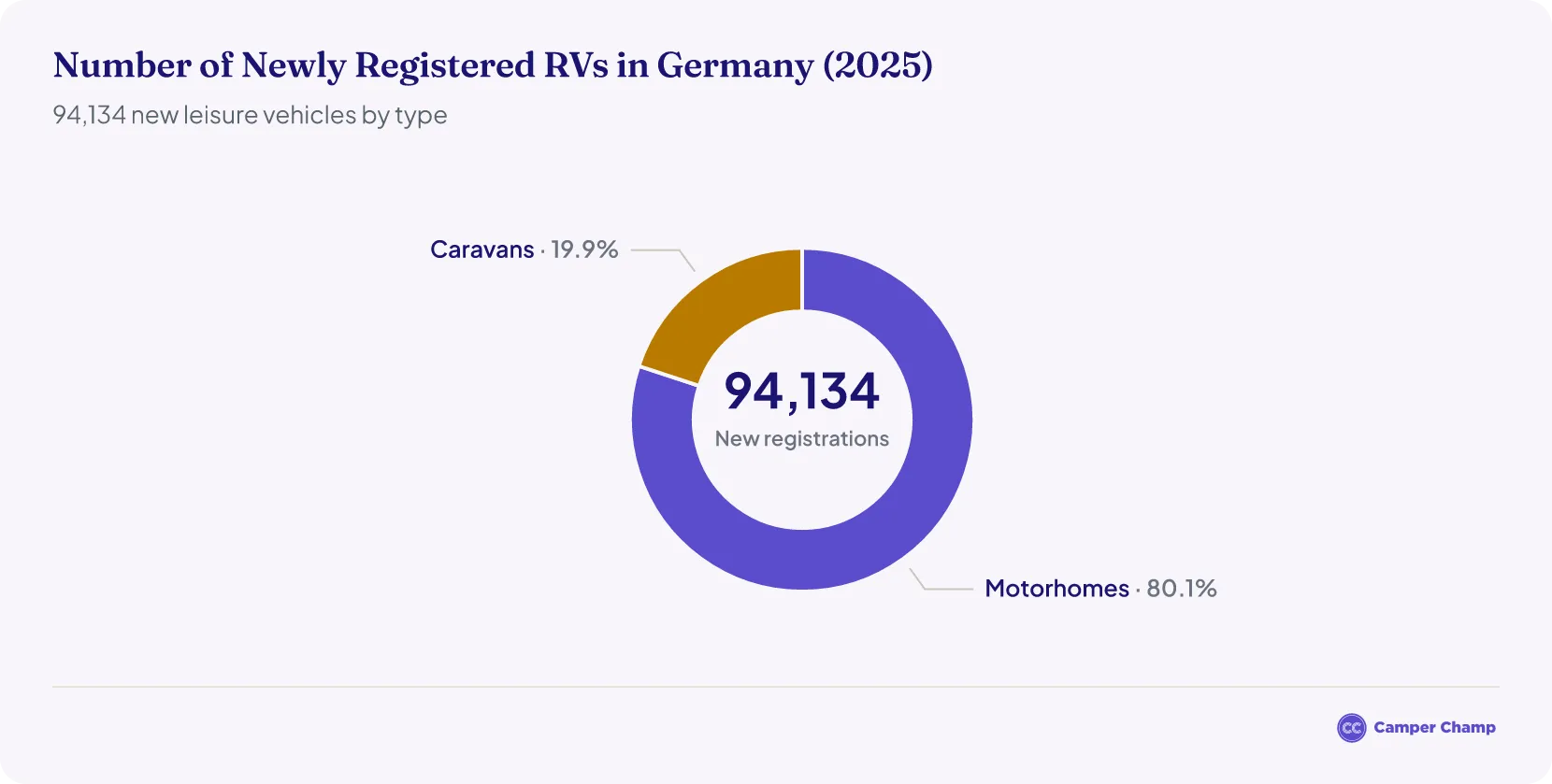
Germany registered 94,134 new leisure vehicles in 2025, representing a slight decrease from 96,392 in 2024.5
How popular is camping in Germany?
- German campsites (often used by RV travellers) recorded approximately 44.7 million overnight stays in 2025, a 4.2% increase from 2024 and a substantial 24.9% rise compared to pre-pandemic 2019.3
- Camping continues to strengthen its position within Germany’s tourism market. Of the 497.4 million overnight stays recorded in 2025, 9% were spent at camping sites, an increase from 8.6% in 2024 and notably higher than the 7.2% share seen in 2019.3
- Counting smaller sites too, dwif puts 2025 campsite stays at about 56 million nights (+13%), plus around 20 million nights on motorhome pitches (Stellplätze) outside campsites, both record highs6.
How much do campers spend in Germany?
How much do campers spend on average in Germany?
- German campers budget an average of €910 per adult for their main camping holiday, up from €850 in 2023 (€410 per child under 14), or about €102 a day per adult, according to ADAC's 2026 survey4.
What is the economic impact of caravanning in Germany?
- The German caravanning industry recorded revenues of approximately €14.1 billion in 2025, a 6.5% decline from 20245.
- Motorhome and caravan travellers generated almost €23 billion in revenue for the German economy in 2025, up from about €21 billion in 2024, and around €7.8 billion of their spending went straight to holiday regions, according to a dwif study for CIVD6.
Who goes motorhome and caravan camping in Germany?
Motorhome and Caravan Camping by Age Group
Today's motorhome owners are mostly over 50: in April 2025 the largest group of motorhome keepers was aged 60 to 69 (318,589 vehicles), followed by 50 to 59-year-olds (265,073), according to the KBA2.
- Keepers aged 50 and over hold almost three-quarters of all motorhomes (734,880 vehicles), while under-40s account for less than 10% (96,201)2.
| RV Camping by Age Group | ||
|---|---|---|
| Age of keeper | Motorhomes | Share in % |
| Under 21 | 733 | 0.1 |
| 21–29 | 16,529 | 1.6 |
| 30–39 | 78,939 | 7.9 |
| 40–49 | 132,005 | 13.2 |
| 50–59 | 265,073 | 26.4 |
| 60–69 | 318,589 | 31.8 |
| 70–79 | 123,614 | 12.3 |
| 80 and over | 27,604 | 2.8 |
| Total | 1,002,562 | 100.0 |
Motorhome and Caravan Ownership by Household Income
Ownership rises with income. In 2023, 2.6% of all households in Germany owned a caravan and 1.6% a motorhome, according to Destatis's official household survey9.
| RV Camping by Household Net Income | ||
|---|---|---|
| Monthly household net income | Households with a caravan in % | Households with a motorhome in % |
| All households | 2.6 | 1.6 |
| €1,500 to under €2,000 | (0.9) | – |
| €2,000 to under €2,600 | (1.2) | (0.7) |
| €2,600 to under €3,600 | 2.1 | 1.3 |
| €3,600 to under €5,000 | 3.2 | 1.9 |
| €5,000 and over | 4.6 | 3.0 |
Motorhome and Caravan Ownership by Employment Status
Self-employed households are the most likely to own a caravan, according to Destatis's 2023 household survey9.
| Main earner's employment status | Households with a caravan in % | Households with a motorhome in % |
|---|---|---|
| All households | 2.6 | 1.6 |
| Self-employed | 4.5 | (2.9) |
| Employees | 3.0 | 1.6 |
| Retired | 2.1 | 1.7 |
What are German campers' travel preferences?
- Being close to nature is the top reason to go camping (84%), followed by spontaneity and flexibility (80%) and adventure (76%), according to ADAC's 2026 survey of 4,371 people4.
- 55% of campers opt to travel within Germany itself, making domestic tourism the dominant segment.4
- Abroad, Italy leads, followed by France and the Netherlands (now third), ahead of Sweden and Croatia4.
- Campsites remain the first choice: 81% stayed on one for their main camping holiday, and 40% of motorhome and caravan travellers now rent their vehicle (35% in 2023)4.
Top Camping Regions in Germany
Where do most people go camping in Germany?
- The Baltic Sea coast of Schleswig-Holstein was again the most popular camping region in 2025, with 3.5 million nights (3.4 million by domestic guests)3.
- The Black Forest (Baden-Württemberg) followed with 2.6 million nights and remained the top choice of foreign campers (735,000 nights)3.
- The North Sea coast of Lower Saxony recorded 2.0 million nights and the Bavarian Allgäu 1.8 million3.
- Lake Constance–Upper Swabia (Bodensee-Oberschwaben) returned to the top five with 1.7 million nights, ahead of the Mecklenburg Baltic coast (1.6 million) and Western Pomerania (1.5 million)3.
- Lake districts have the highest camping intensity: in the Franconian Lake District, 47.1% of all overnight stays were at campsites (national average: 9.0%)3.
Other Resources
How safe is motorhome travel in Germany?
- Motorhome drivers were the main cause of 600 accidents involving personal injury in 2025, in which 840 people were hurt or killed, including 8 deaths, according to Destatis10.
- North Rhine-Westphalia saw 157 accidents involving a motorhome in 2023, with incidents increasing by approximately one-third over the preceding five years11.
How much does motorhome camping cost in Germany?
What are campsite and Stellplatz fees in Germany?
The cost of a motorhome trip in Germany depends mostly on the vehicle, the season and where you stay overnight.
- Campervan rental typically costs €80–€200 a day in July and August and €60–€140 in the shoulder seasons, with winter cheaper still; premium vehicles can reach €250+7.
- A campsite pitch for two adults with a camper usually costs €20–€45 a night, and prime lakeside or coastal sites can charge €50+ in summer7.
- Motorhome pitches (Stellplätze) are cheaper at €0–€15 a night, and some towns offer them free7.
- Extras often include electricity (€3–€5 a day or metered), fresh water (€1–€2 per fill), shower tokens (€0.50–€1) and Wi-Fi (free or €1–€3 a day)7.
- Prices are rising: in 2025 a night on a Stellplatz cost 32.2% more than in 2020 and campsite fees 28.7% more, against 26.9% for all types of accommodation, according to Destatis3.
What are the latest camping trends in Germany?
- Sustainability and nature-centric experiences are growing in importance, with an emphasis on energy efficiency in vehicles and campsite operations.
- Interest in off-road and adventure camping ("overlanding") is increasing.
- Microcamping is booming: 29% of campers used small private pitches on farms, wineries and similar sites, according to ADAC's 2026 survey (16% in 2023), and 56% plan to on their next main holiday4.
- Technology integration is enhancing the camping experience, with online bookability becoming a decisive factor for many campers when choosing a site.
- Electric motorhomes are still rare: only 160 of the 1,002,562 motorhomes registered in April 2025 were battery-electric, and 97.4% ran on diesel2.
Frequently Asked Questions About Camping in Germany
How many motorhomes are there in Germany?
Germany had 1,046,383 registered motorhomes on 1 January 2026, up 6.7% in a year1. The total first passed 1 million in April 2025 and has more than doubled since 20172.
Can you wild camp in a motorhome in Germany?
No. Wild camping, whether in a tent or a vehicle, is generally not allowed in Germany and can lead to fines. Sleeping in a motorhome on public land is only tolerated for a single short stop to restore your fitness to drive, not as a camping stay. Legal alternatives are campsites, Stellplätze and private microcamping pitches used with the landowner's permission4.
When is camping season in Germany?
Most campsites open from late March to October, with peak demand and prices in July and August. A growing number of sites stay open all year7.
Where is the most popular place to camp in Germany?
The Baltic Sea coast of Schleswig-Holstein, with 3.5 million camping nights in 2025, followed by the Black Forest (2.6 million) and the North Sea coast of Lower Saxony (2.0 million)3.
Motorhome rental in Europe
- Germany motorhome rental
- Motorhome rental in Berlin
- Motorhome rental in Frankfurt
- Munich motorhome rental
- Hungary motorhome rental
- Lisbon motorhome rental
- Oslo motorhome rental
- Motorhome rental in Paris
- Scotland campervan rental
- Sweden motorhome rental
References
- Bestand an Personenkraftwagen nach Segmenten und Modellreihen am 1. Januar 2026 gegenüber 1. Januar 2025 (FZ 12) · kba.de ↑ b c d
- Kraftfahrt-Bundesamt: 1 Mio. Wohnmobile in Deutschland (Pressemitteilung Nr. 23/2025) · kba.de ↑ b c d e f g h
- Camping boomt weiter: 44,7 Millionen Übernachtungen im Jahr 2025 (Destatis Pressemitteilung Nr. N020, 30. März 2026) · destatis.de ↑ b c d e f g h i j k l
- Umfrage: Camping-Vorlieben der Deutschen · adac.de ↑ b c d e f g h i j k
- Caravanning market 01/2026 · civd.de ↑ b c d
- CARAVAN SALON 2026: Caravaning gewinnt weiter an Bedeutung für Wirtschaft und Tourismus (CIVD press release, 28 August 2026) · presseportal.de ↑ b c d
- Campervanning in Germany · motorhomeland.com ↑ b c d e f g
- Der Campingplatz- und Reisemobil-Tourismus als Wirtschaftsfaktor in Deutschland 2024 (dwif study) · civd.de ↑ b c
- Statistischer Bericht – Einkommens- und Verbrauchsstichprobe: Hauptprogramm und Geld- und Sachvermögen – 2023 (Destatis, tables 63221-10 and 63221-11) · destatis.de ↑ b c d e f g h
- Verkehrsunfaelle nach Kfz-Segmenten (Destatis tables) · destatis.de ↑
- Korrektur NRW: Zahl der Unfaelle mit Wohnmobilen in den letzten fuenf Jahren um ein Drittel gestiegen · it.nrw ↑
- CIVD - Caravanning industry data · civd.de
- Destatis - Statistical themes index (overnight stays at campsites; accidents involving motorhomes) · destatis.de