

Updated
Joshua Tree National Park key statistics
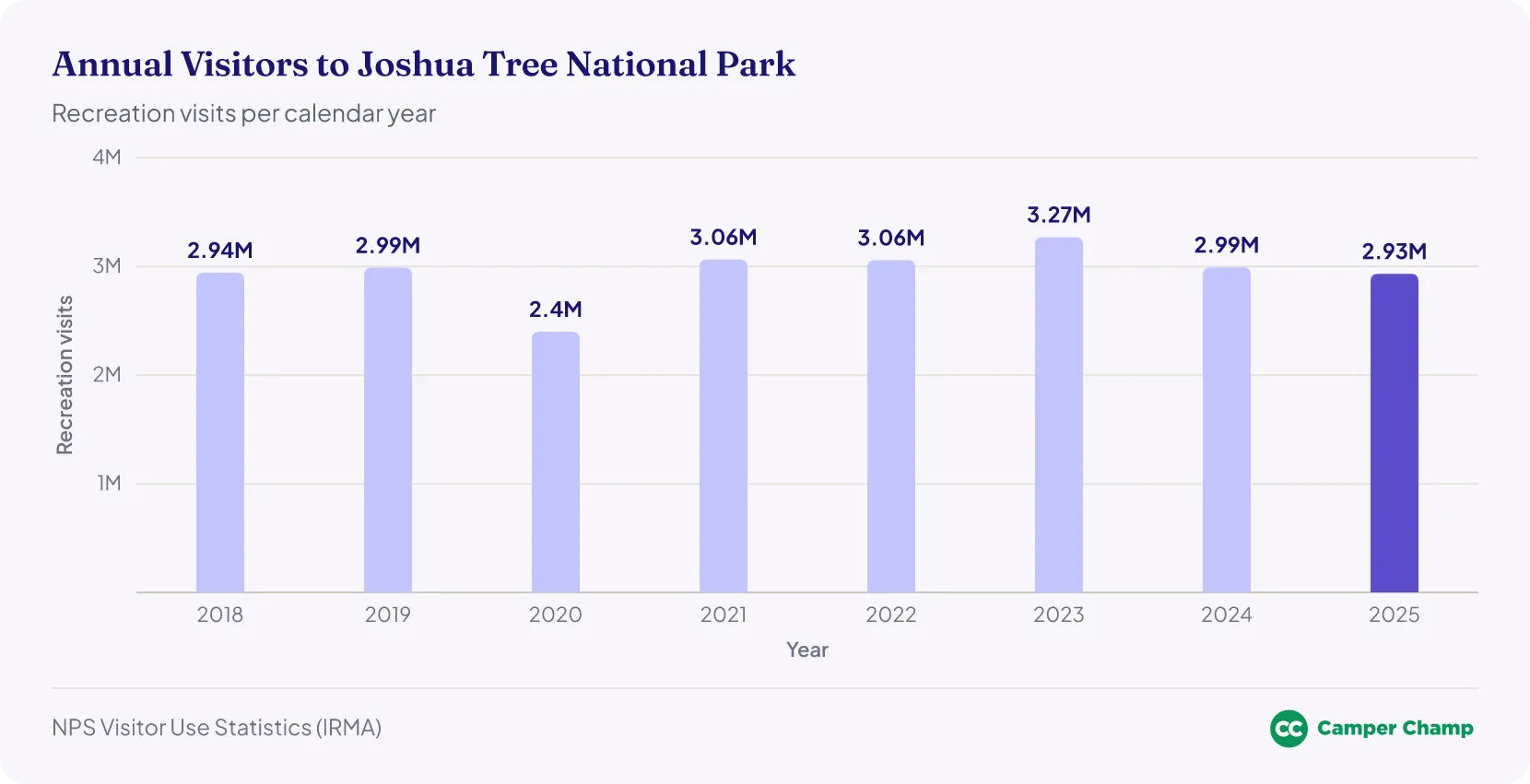
- 2,932,644 recreation visits in 20251
- 1,996,584 recreation visits from January to September 2026 (preliminary), down 7.0% on the same months of 20252
- 12th most visited of the 63 U.S. national parks in 20253
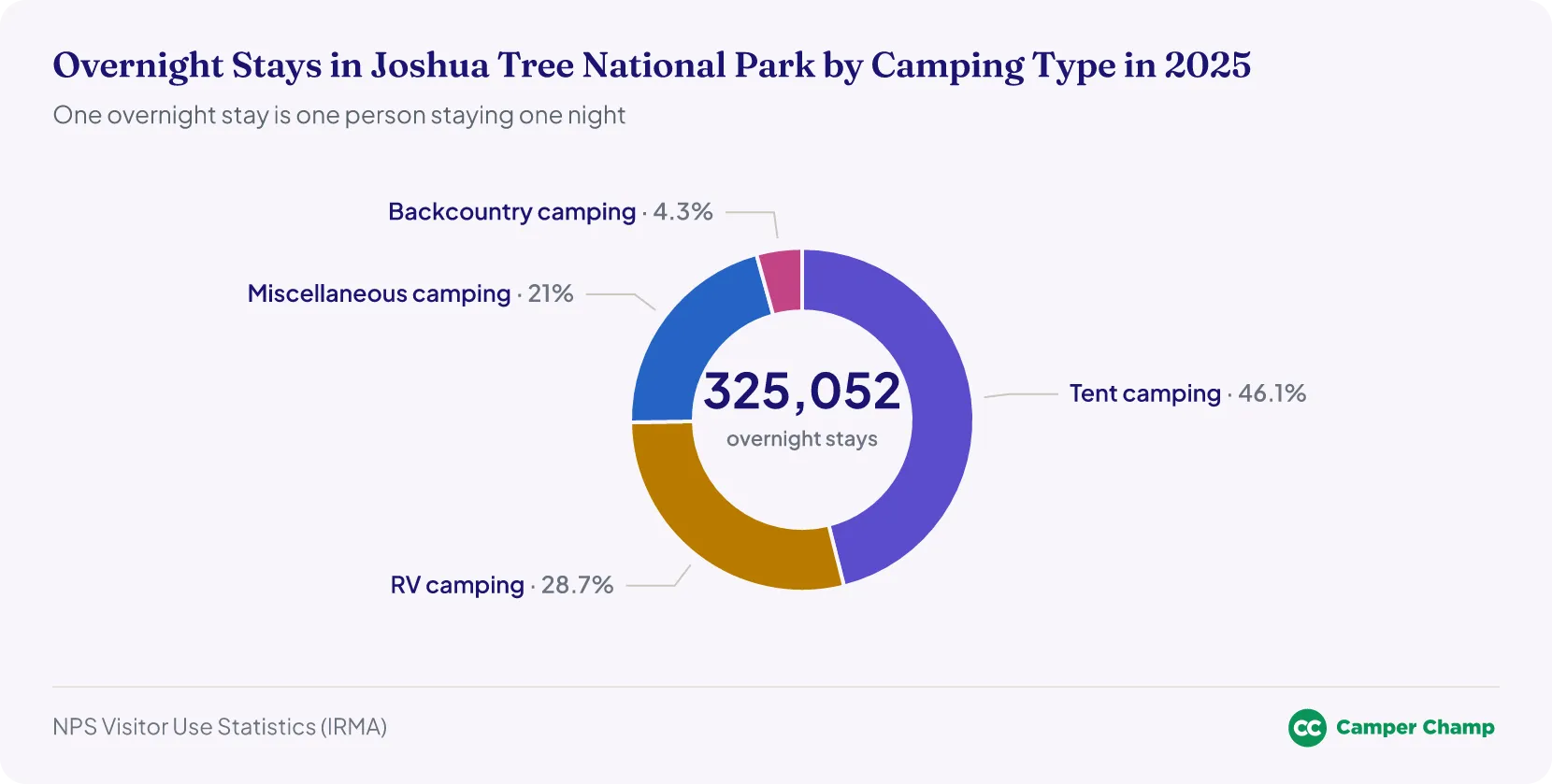
- 325,052 overnight stays in 2025, nearly half of them in tents4
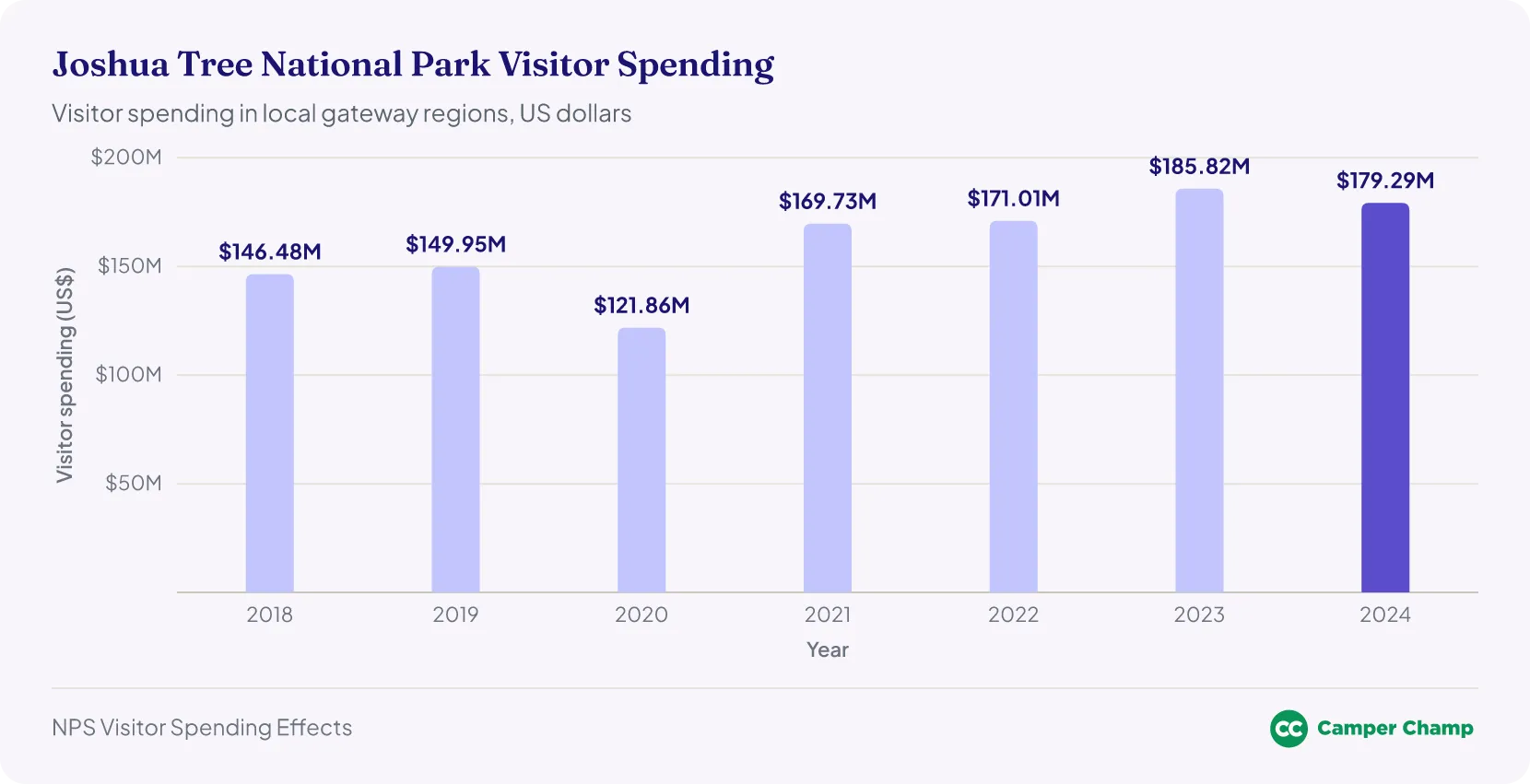
- $179.29 million spent by visitors in 20245
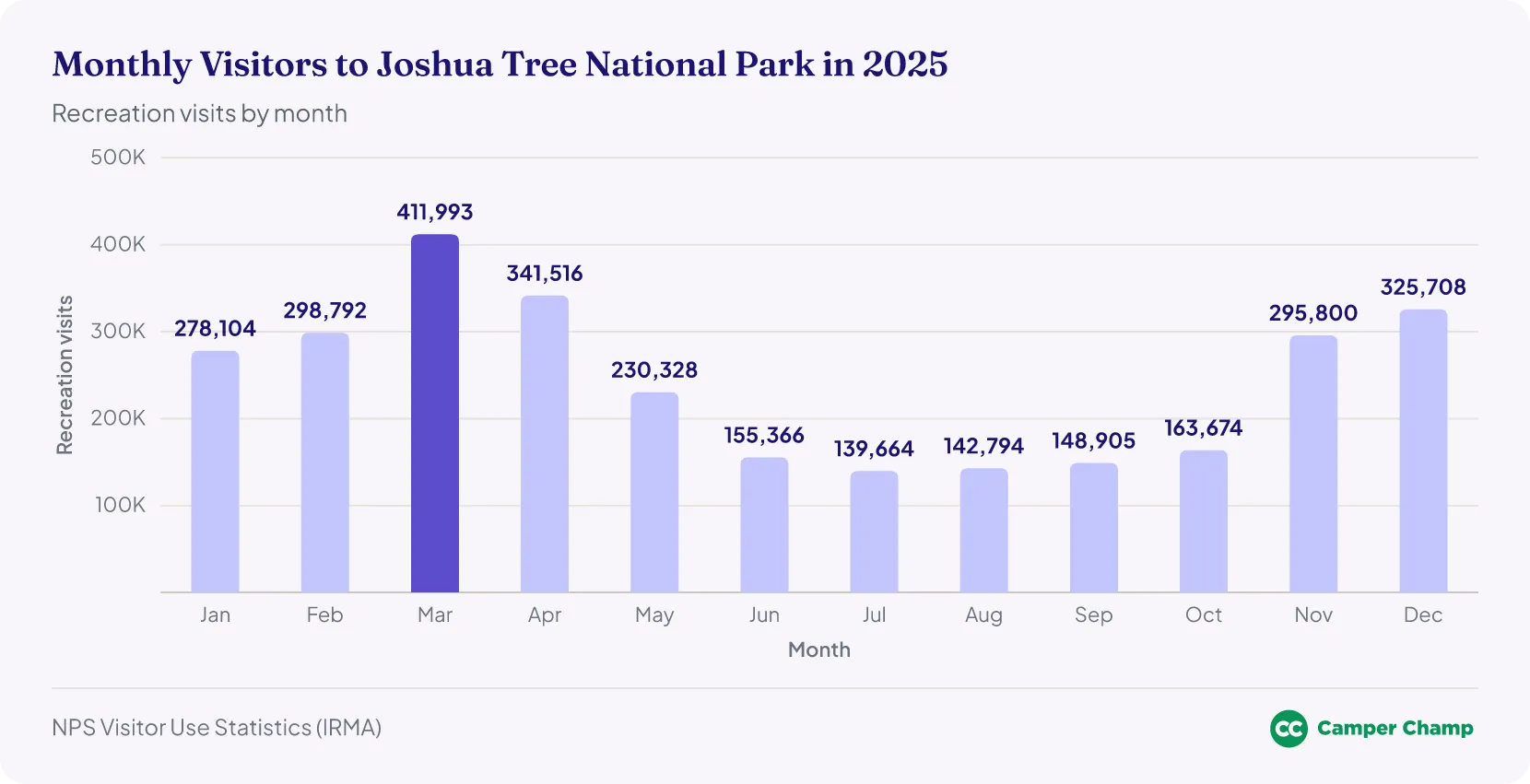
- March was the busiest month of 2025, with 411,993 visitors2
- 795,156 acres, rising to 5,814 feet at the summit of Quail Mountain6
How many people visit Joshua Tree National Park each year?
Around 3 million people visit Joshua Tree National Park each year.1
Year by year:
How much do visitors spend at Joshua Tree National Park each year?
Visitor spending has risen and fallen in recent years:
- $179.29 million in 2024, down 3.5% from $185.82 million in 20235
- $185.82 million in 20237, up 8.7% from $171.01 million in 20228
- $171.01 million in 20228, up slightly from $169.73 million in 20219
- $121.86 million in 202010, down from $149.95 million in 201911
These are the latest figures: the National Park Service's spending data for Joshua Tree currently runs only to 2024.5
How many people have visited Joshua Tree National Park in 2026?
Joshua Tree National Park recorded 1,996,584 recreation visits from January to September 2026, 7.0% fewer than the 2,147,462 recorded over the same months of 2025.2
- March 2026 was the busiest month so far, with 364,250 visits, down 11.6% from 411,993 in March 2025.2
- April 2026 drew 296,899 visits, down 13.1% from 341,516 in April 2025.2
- February (297,755 visits) and June (154,292) came closest to their 2025 totals, each less than 1% lower.2
- September 2026 brought 144,579 visits, down 2.9% from 148,905 in September 2025.2
Every month of 2026 so far has had fewer visits than the same month of 2025.2 The 2026 figures are preliminary; the National Park Service finalizes them by the end of the first quarter of the following year.
| Month | 2025 visits | 2026 visits (preliminary) | Change |
|---|---|---|---|
| January | 278,104 | 271,0542 | −2.5% |
| February | 298,792 | 297,7552 | −0.3% |
| March | 411,993 | 364,2502 | −11.6% |
| April | 341,516 | 296,8992 | −13.1% |
| May | 230,328 | 212,5722 | −7.7% |
| June | 155,366 | 154,2922 | −0.7% |
| July | 139,664 | 123,8572 | −11.3% |
| August | 142,794 | 131,3262 | −8.0% |
| September | 148,905 | 144,5792 | −2.9% |
| October | 163,674 | Not yet released | – |
| November | 295,800 | Not yet released | – |
| December | 325,708 | Not yet released | – |
| January–September | 2,147,462 | 1,996,584 | −7.0% |
Source · National Park Service (NPS) Visitor Use Statistics. 2026 figures are preliminary.
How many people visit Joshua Tree National Park per day?
Joshua Tree National Park averaged about 8,030 recreation visits a day in 2025.1 That is down slightly from about 8,190 a day in 2019.
- March was the busiest month, averaging about 13,290 visits a day.2
- July was the quietest, averaging about 4,510 visits a day.2
How much does it cost to visit Joshua Tree National Park?
Entry fees for Joshua Tree National Park in 2026:
How much time should visitors spend in Joshua Tree National Park?
Plan on one to three days in Joshua Tree National Park, depending on what you want to do.
Day trips:
- 46% of visitor groups spent less than a full day in the park, according to a 2004 National Park Service visitor survey13
- Common activities: short hikes, scenic drives and photography
Two- to three-day visits:
- 54% of visitor groups stayed more than one day; of those, 44% spent two days and 28% spent three13, enough time to explore both the Mojave and Colorado desert ecosystems
- Common activities: long hikes, rock climbing and stargazing
When is Joshua Tree National Park’s peak season?
When is the best time to visit Joshua Tree National Park?
The best time to visit is October to April, when the weather suits hiking, rock climbing and camping. Spring is the most popular season, thanks to the wildflowers.
How does Joshua Tree rank among U.S. national parks?
- Joshua Tree was the 12th most visited U.S. national park in 2025, with 2,932,644 recreation visits.3
- Dark skies: Joshua Tree is a designated International Dark Sky Park, recognized by DarkSky International14, a big draw for stargazers.
| Rank | Park | Recreation visits |
|---|---|---|
| 1 | Great Smoky Mountains NP | 11,527,939 |
| 2 | Zion NP | 4,984,525 |
| 3 | Yellowstone NP | 4,762,988 |
| 4 | Grand Canyon NP | 4,430,653 |
| 5 | Yosemite NP | 4,278,413 |
| 6 | Rocky Mountain NP | 4,171,431 |
| 7 | Acadia NP | 4,079,318 |
| 8 | Grand Teton NP | 3,800,648 |
| 9 | Olympic NP | 3,584,187 |
| 10 | Glacier NP | 3,136,557 |
| 11 | Cuyahoga Valley NP | 3,025,325 |
| 12 | Joshua Tree NP | 2,932,6441 |
| 13 | Indiana Dunes NP | 2,629,497 |
| 14 | Hot Springs NP | 2,494,611 |
| 15 | Gateway Arch NP | 2,209,028 |
Source · Public Lands Data, from National Park Service (NPS) Visitor Use Statistics
Why do people visit Joshua Tree National Park?
Visitors come to Joshua Tree for hiking, rock climbing, photography and stargazing. Other highlights include:
- Hidden Valley – known for its striking rock formations.
- Keys View – a viewpoint overlooking the Coachella Valley.
- Cholla Cactus Garden – a dense stand of cholla cacti.
- Arch Rock – a natural rock arch popular with photographers.
- Barker Dam – a reservoir that attracts desert wildlife.
How many people camp in Joshua Tree National Park each year?
Joshua Tree National Park recorded 325,052 overnight stays in 2025, 18% fewer than the 394,357 in 2024 and 17% below the 389,673 of 2019.4 The National Park Service counts overnight stays (one person for one night), not individual campers, so one person camping for three nights counts three times.
In 2025, the stays broke down as:
- Tent camping: 149,792 overnight stays4
- RV camping: 93,213 overnight stays4
- Backcountry camping: 13,942 overnight stays4
- Miscellaneous camping: 68,105 overnight stays4
How do people camp in Joshua Tree National Park?
Joshua Tree National Park has about 500 campsites, and most of them can be reserved.15 In 2025, tent campers made up about 46% of the park's 325,052 overnight stays and RV campers about 29%.4
- Reservation campgrounds: Black Rock (99 sites), Cottonwood (62 sites) and Indian Cove (101 sites) cost $35 a night; Jumbo Rocks (124 sites) and Ryan (31 sites) cost $30.15 Only Black Rock and Cottonwood have water, flush toilets and a dump station.
- First-come, first-served: Hidden Valley (44 sites), Belle (18 sites) and White Tank (15 sites) cost $25 a night. They are full nearly every weekend from September to May.15
- Booking: Reservation sites can be booked on Recreation.gov up to six months ahead, or on the same day.15
- RVs: White Tank and Hidden Valley take RVs up to 25 feet in combined length. Belle takes up to 35 feet, though most of its sites fit 25 to 30 feet.16
- Backpacking: Overnight trips into the backcountry need a permit, and you can stay out up to 14 nights in a row.17
- No roadside sleeping: You may sleep in your vehicle only at a designated campsite, never at trailheads, roadsides or parking lots.16 If the campgrounds are full, the Park Service points campers to Bureau of Land Management land outside the park.15
RV rental in the USA
- Los Angeles RV rental
- Albuquerque RV rental
- Austin RV rental
- RV rental in Boston
- Dallas RV rental
- RV rental in Las Vegas
- RV rental in New York
- Phoenix RV rental
- Pittsburgh RV rental
- RV rental in Tampa
Joshua Tree National Park facts: size, history and landscape
- Location: Southern California, where the Mojave and Colorado deserts meet.
- Establishment: Designated a national monument in 1936 by President Franklin D. Roosevelt, it became a national park in 1994.18
- Size: Covers 795,156 gross acres, or about 3,218 square kilometers, including private and state inholdings.6
- Elevation: From 536 feet at the park's southeastern boundary to 5,814 feet at the summit of Quail Mountain.6
- Visitor milestones: Visits first passed 1 million a year in 1990, 2 million in 2015 and 3 million in 2021.6
- Services: There are no gas stations, restaurants, grocery stores or hotels in the park, and no water in its interior.19
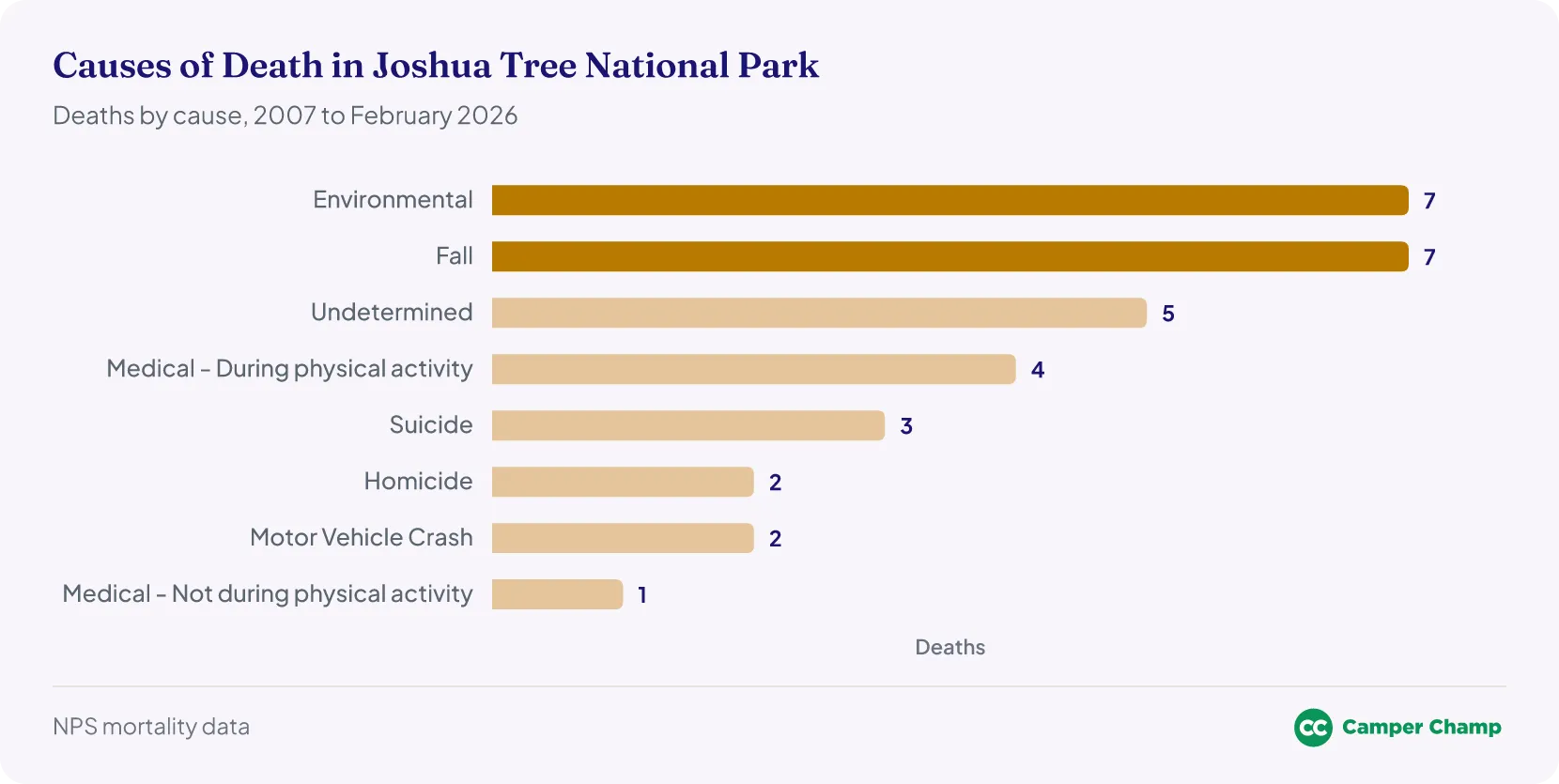
What are the most common causes of visitor deaths in Joshua Tree National Park?
Between 2007 and February 2026, 31 people died in Joshua Tree.20 By cause:
Is Joshua Tree National Park dangerous?
Deaths in Joshua Tree National Park are rare for a park with about 3 million visits a year, but desert heat, a lack of water and limited phone signal all call for care. In summer, the extreme heat is a serious danger.19 A few precautions help keep you safe:
- Drinking water to avoid dehydration
- Wearing sun protection like hats, sunglasses and sunscreen
- Staying on trails to avoid getting lost
- Watching out for wildlife, especially snakes and other desert animals
- Preparing for desert temperatures, which vary greatly between day and night
- Hiking or climbing with a partner and wearing safety gear
Joshua Tree National Park FAQs
Do you need a reservation to enter Joshua Tree National Park?
No. You don't need a reservation to enter, and the park is open 24 hours a day, every day of the year.16 You still need an entrance pass, even if you only drive straight through on the way somewhere else.
Can you take an RV to Joshua Tree National Park?
Yes. Black Rock and Cottonwood campgrounds have water fill stations and RV dump stations ($5 per use).16 Generators may run only from 7 to 9 am, noon to 2 pm and 5 to 7 pm. White Tank and Hidden Valley campgrounds take RVs up to 25 feet in combined length.
More national park statistics
- Acadia National Park Tourism Statistics
- Badlands National Park Tourism Statistics
- Big Bend National Park Tourism Statistics
- Biscayne National Park Tourism Statistics
- Everglades National Park Tourism Statistics
- Gateway Arch National Park Tourism Statistics
- Great Smoky Mountains National Park Tourism Statistics
- US National Parks Ranking
- US National Parks Statistics
- Wildlife Statistics in the USA
- Yosemite National Park Tourism Statistics
- Zion National Park Tourism Statistics
References
- NPS IRMA Visitor Use Statistics — Annual Park Recreation Visitation (1904 – Last Calendar Year), Joshua Tree NP · irma.nps.gov ↑ b c d e f g h
- NPS IRMA Visitor Use Statistics — Recreation Visitors By Month (1979 – Last Calendar Year), Joshua Tree NP · irma.nps.gov ↑ b c d e f g h i j k l m n o p q r s t u v
- Most Visited National Parks in 2025 — Ranked by Visitation · publiclandsdata.com ↑ b c
- NPS IRMA Visitor Use Statistics — Overnight Stays (1979 – Last Calendar Year), Joshua Tree NP · irma.nps.gov ↑ b c d e f g
- NPS Visitor Spending Effects — park results, Joshua Tree National Park (JOTR), 2012–2024 · irmaservices.nps.gov ↑ b c
- Park Statistics — Joshua Tree National Park (U.S. National Park Service) · nps.gov ↑ b c d
- 2023 National Park Visitor Spending Effects: Economic Contributions to Local Communities, States, and the Nation (NPS Science Report NPS/SR—2024/174) · nps.gov ↑
- 2022 National Park Visitor Spending Effects: Economic Contributions to Local Communities, States, and the Nation · nps.gov ↑ b
- 2021 National Park Visitor Spending Effects: Economic Contributions to Local Communities, States, and the Nation · nps.gov ↑
- 2020 National Park Visitor Spending Effects: Economic Contributions to Local Communities, States, and the Nation · nps.gov ↑
- 2019 National Park Visitor Spending Effects: Economic Contributions to Local Communities, States, and the Nation · nps.gov ↑
- Entrance Fees — Joshua Tree National Park (NPS) · nps.gov ↑ b c d
- Joshua Tree National Park Visitor Study, Spring 2004 (Visitor Services Project Report 152) · s3.wp.wsu.edu ↑ b
- Stargazing — Joshua Tree National Park (U.S. National Park Service) · nps.gov ↑
- Camping — Joshua Tree National Park (U.S. National Park Service) · nps.gov ↑ b c d e
- Frequently Asked Questions — Joshua Tree National Park (U.S. National Park Service) · nps.gov ↑ b c d e f
- Backpacking — Joshua Tree National Park (U.S. National Park Service) · nps.gov ↑ b
- History & Culture — Joshua Tree National Park (U.S. National Park Service) · nps.gov ↑
- Basic Information — Joshua Tree National Park (U.S. National Park Service) · nps.gov ↑ b c d
- NPS Mortality Data, CY2007 onward (Prevention and Response Branch FOIA release) · nps.gov ↑ b c d e f g h i