

Updated
Big Bend National Park key statistics
- 568,104 recreation visits in 2025, up 1.2% on 20241
- 398,410 recreation visits from January to September 2026 (preliminary), down 1.2% on the same months of 20251
- 38th most visited of the 63 U.S. national parks in 20252
- 178,082 overnight stays in 2025, about 40% of them in tents3
- $56.82 million spent by visitors in 20244
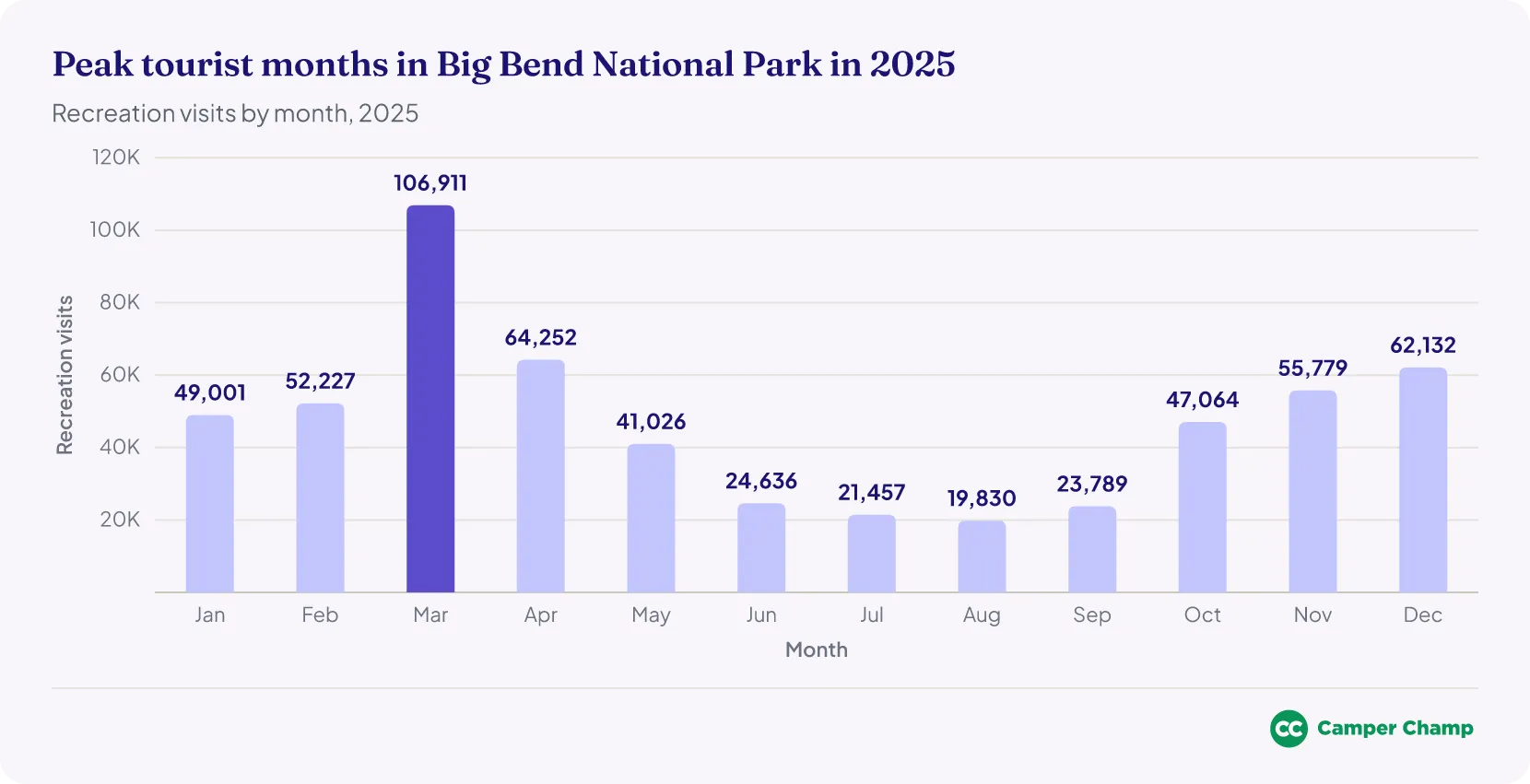
- March was the busiest month of 2025, with 106,911 visits1
- 801,163 acres, with 118 miles of border along the Rio Grande5
How many people visit Big Bend National Park each year?
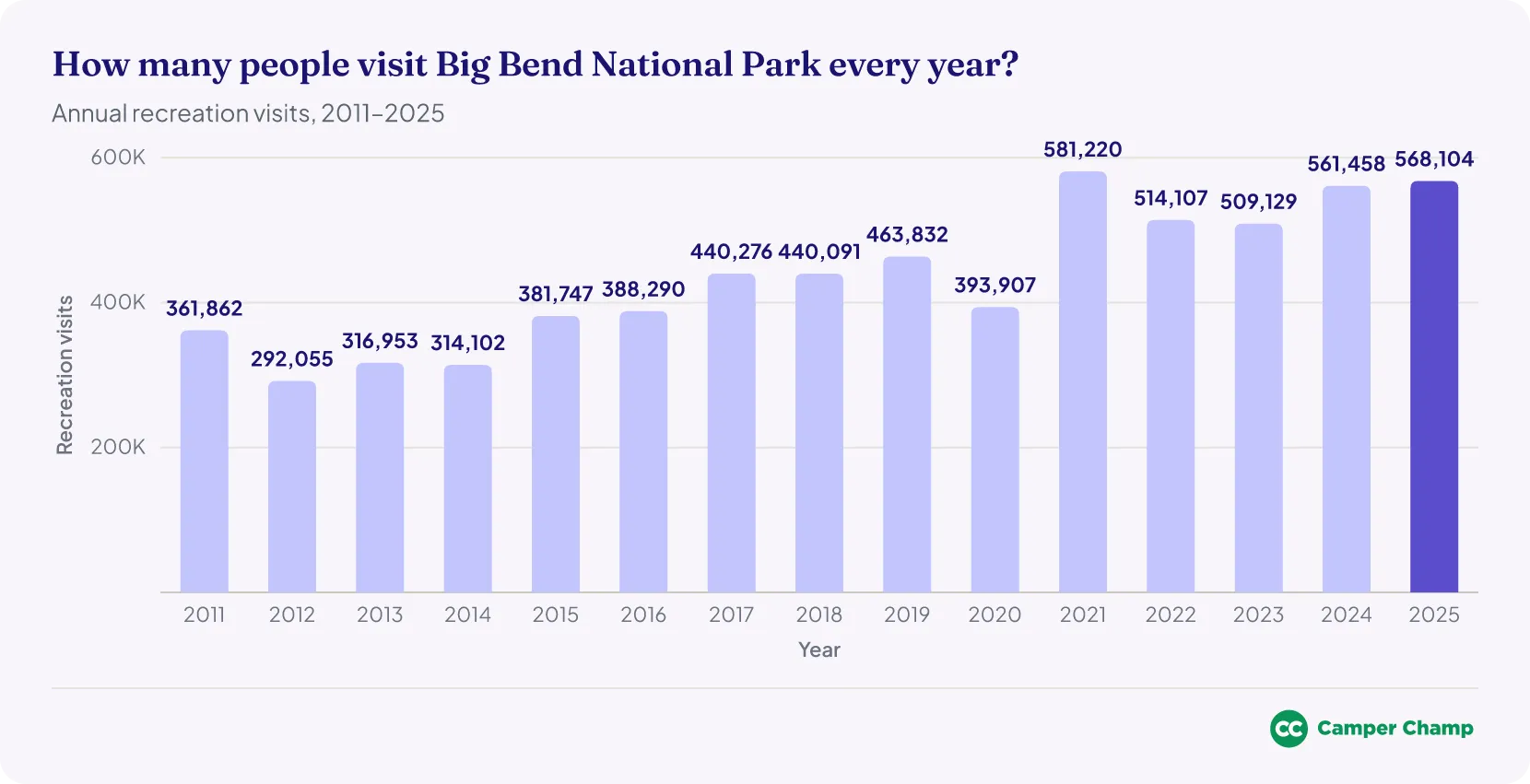
Big Bend National Park had 568,104 recreation visits in 20256, its second-busiest year since at least 19797.
Year by year:
- 568,104 visits in 2025, up 1.2% from 20247. That is 22.5% more than in 2019.
- 561,458 in 2024, up 10.3% from 20237.
- 509,129 in 2023, down 1.0% from 20227.
- 514,107 in 2022, down 11.5% from 20217.
- 581,220 in 2021, the most in any year since at least 19797.
- 463,832 in 2019 (pre-pandemic)7. In 2020, the pandemic year, visits fell 15.1% to 393,907.
How much do visitors spend at Big Bend National Park each year?
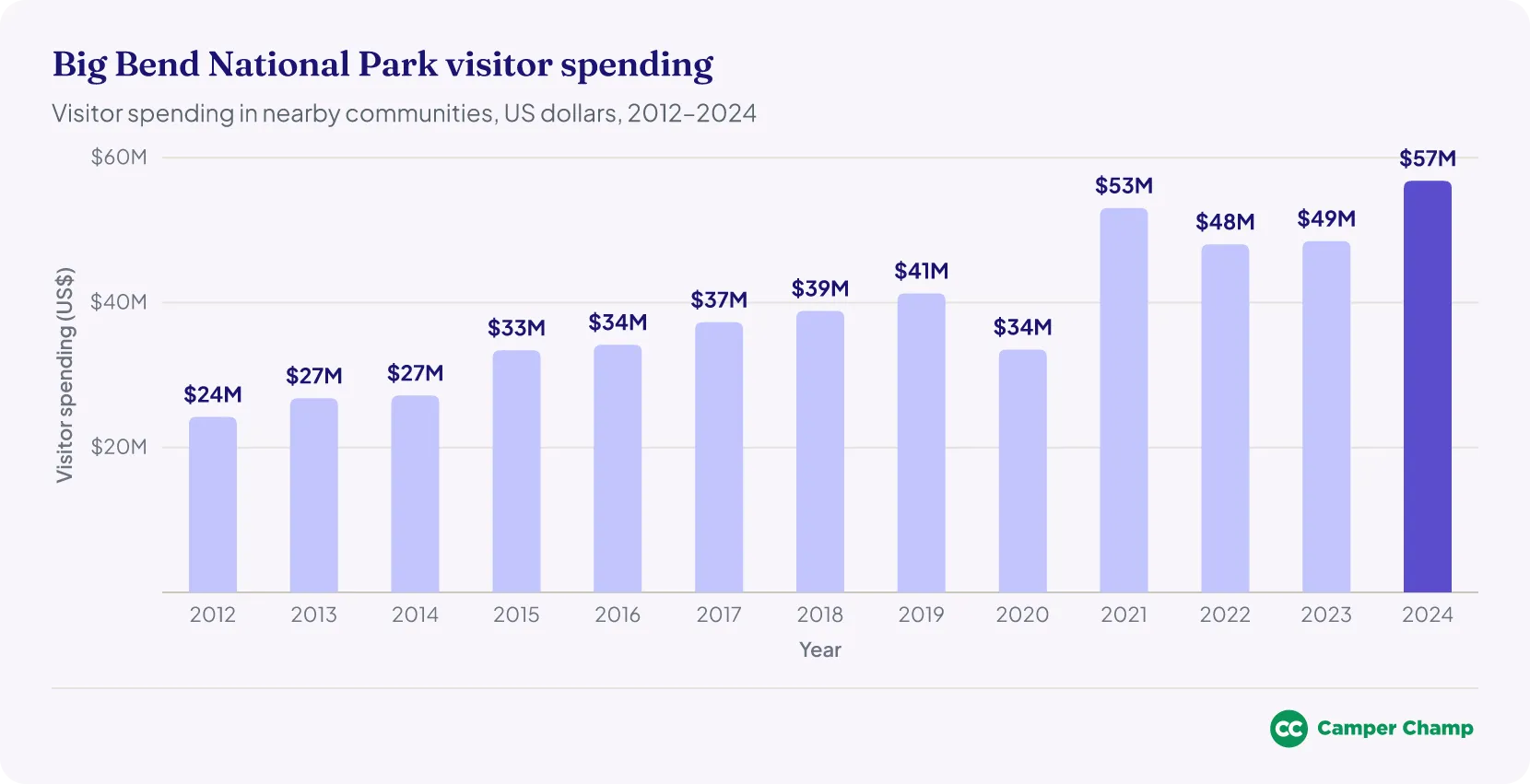
Visitors spent $56.82 million in communities near Big Bend National Park in 20244.
- $56.82 million in 2024, up 17.1% from $48.51 million in 20234, and 37.6% more than in 2019
- $48.51 million in 2023, up 0.9% from $48.06 million in 20224
- $48.06 million in 2022, down 9.5% from $53.08 million in 20214
- $33.54 million in 2020, down from $41.29 million in 20194
In 2024, that spending supported 585 local jobs4 and $63.71 million in economic output.
The latest National Park Service spending figures for Big Bend are for 20244.
Big Bend National Park recorded 398,410 recreation visits from January to September 2026, 1.2% fewer than the 403,129 recorded over the same months of 20251.
- March 2026 was the busiest month so far, with 94,879 visits, 11.3% fewer than in March 20251.
- January (51,858 visits, up 5.8%) and February (56,005, up 7.2%) were busier than a year earlier1.
- August 2026 brought 23,270 visits, up 17.3% from 19,830 in August 20251.
- April, May and June were each below their 2025 totals1.
Figures for October 2026 onward have not been released yet. The 2026 figures are preliminary; the National Park Service finalizes them by the end of the first quarter of the following year1.
| Month | 2025 visits | 2026 visits (preliminary) | Change |
|---|---|---|---|
| January | 49,001 | 51,858 | +5.8% |
| February | 52,227 | 56,005 | +7.2% |
| March | 106,911 | 94,879 | −11.3% |
| April | 64,252 | 63,728 | −0.8% |
| May | 41,026 | 38,193 | −6.9% |
| June | 24,636 | 23,476 | −4.7% |
| July | 21,457 | 22,771 | +6.1% |
| August | 19,830 | 23,270 | +17.3% |
| September | 23,789 | 24,230 | +1.9% |
| October | 47,064 | Not yet released | – |
| November | 55,779 | Not yet released | – |
| December | 62,132 | Not yet released | – |
| January–September | 403,129 | 398,410 | −1.2% |
Source · National Park Service (NPS) Visitor Use Statistics. 2026 figures are preliminary.
How many people visit Big Bend National Park per day?
Big Bend National Park averaged about 1,560 recreation visits a day in 20257. That is up from about 1,270 a day in 2019.
- March was the busiest month, averaging about 3,450 visits a day7.
- August was the quietest, averaging about 640 visits a day7.
How much does it cost to visit Big Bend National Park?
Entry fees for Big Bend National Park in 2026:
- $30 per vehicle (valid for 7 days)8
- $15 per person (walk-in or bicycle, valid for 7 days)8
- $25 per motorcycle (valid for 7 days)8
- $55 for an annual park pass8
Children under 16 entering on foot or by bicycle get in free. The park does not accept cash8.
How does Big Bend rank among U.S. national parks?
- Big Bend was the 38th most visited U.S. national park in 2025, with 568,104 recreation visits2. Counting every National Park Service site, including monuments, memorials and recreation areas, it ranked 116th6.
- Size: At 801,163 acres, Big Bend is the 15th largest U.S. national park and the 8th largest in the lower 48 states9.
- UNESCO: Big Bend was designated an International Biosphere Reserve in 19765.
- See how every park compares in our U.S. national park rankings.
| Rank | Park | Recreation visits |
|---|---|---|
| 1 | Great Smoky Mountains NP | 11,527,939 |
| 2 | Zion NP | 4,984,525 |
| 3 | Yellowstone NP | 4,762,988 |
| 4 | Grand Canyon NP | 4,430,653 |
| 5 | Yosemite NP | 4,278,413 |
| 6 | Rocky Mountain NP | 4,171,431 |
| 7 | Acadia NP | 4,079,318 |
| 8 | Grand Teton NP | 3,800,648 |
| 9 | Olympic NP | 3,584,187 |
| 10 | Glacier NP | 3,136,557 |
| 11 | Cuyahoga Valley NP | 3,025,325 |
| 12 | Joshua Tree NP | 2,932,644 |
| 13 | Indiana Dunes NP | 2,629,497 |
| 14 | Hot Springs NP | 2,494,611 |
| 15 | Gateway Arch NP | 2,209,028 |
| 38 | Big Bend NP | 568,104 |
Source · National Park Service (NPS) Visitor Use Statistics
How does Big Bend compare with Guadalupe Mountains National Park?
Big Bend is the busier of Texas's two national parks. In 2025, it had more than 2.7 times as many recreation visits as Guadalupe Mountains, and about 73% of all visits to the state's national parks2.
When is the best time to visit Big Bend National Park?
Big Bend National Park is open all year10, but its busy season is generally November through April11, when the weather is mild. Spring is the busiest time of all12.
- Spring (March and April): warm, pleasant days and the biggest crowds, especially over Spring Break.
- Fall and winter (October to February): mild and usually sunny, though cold snaps and light snow are possible. Thanksgiving, Christmas to New Year's and holiday weekends are especially busy13.
- Summer (May to September): the quietest season. It is extremely hot, so hike early in the day. The rainy season, from July to September, brings afternoon storms that often cool the desert12.
From November through April, the Chisos Mountains Lodge and all of the park's developed campgrounds are full every night13, so book ahead.
When is Big Bend National Park busiest?
In 2025, the park's busiest months were:
- March: 106,911 visits7, helped by Spring Break and mild weather.
- April: 64,252 visits7, as warm spring days drew hikers.
- December: 62,132 visits7 over the holiday season.
- November: 55,779 visits7, with cooler fall weather and Thanksgiving.
- February: 52,227 visits7, as early spring weather arrived.
The quietest month was August, with 19,830 visits7, in the heat of summer.
Which parts of Big Bend National Park are busiest?
The Park Service counts vehicles, not people, on the two main roads into the park. In 2025, the counts were:
- Maverick entrance: 137,359 vehicles on Route 13, about the same as in 202414.
- Persimmon Gap, the northern entrance11: 65,483 vehicles on Route 11, 3.8% more than in 202414.
That means more than twice as many vehicles entered at Maverick as at Persimmon Gap14.
At the busiest times, parking fills at the park's most popular spots: the Lost Mine Trail, the Chisos Basin, the Hot Springs, the Boquillas Port of Entry, Boquillas Canyon and the Santa Elena Canyon Trail13. When all parking is full, rangers let one car in for each car that leaves.
The Park Service's 1992 survey of spring visitors points the same way: the most visited spots were the Panther Junction Visitor Center (87% of visitors), the Chisos Basin (80%), Santa Elena Canyon (68%) and Rio Grande Village (62%)15.
| Entrance | Where counted | 2025 vehicles | 2024 vehicles | Change |
|---|---|---|---|---|
| Maverick | Route 13 | 137,359 | 137,449 | −0.1% |
| Persimmon Gap | Route 11 | 65,483 | 63,085 | +3.8% |
Source · National Park Service (NPS) Visitor Use Statistics, traffic counts.
How hot does Big Bend National Park get?
Big Bend sits in the Chihuahuan Desert, and its summers are extremely hot. At Rio Grande Village, by the river, average highs reach 107°F in June12. The desert floor is usually well above 100°F by late morning, while the Chisos Mountains can be 10 to 15 degrees cooler.
- Hottest months: May through August12.
- Park headquarters: At Panther Junction (3,750 feet), average highs reach 95°F in June and July. In January, they average 62°F, with lows of 38°F12.
- Rain: Panther Junction averages about 12.5 inches of rain a year, and the Chisos Basin about 17.2 inches12. The rainy season runs from July to September, with heavy thunderstorms and some flash flooding possible.
- Winter: Mild and usually sunny, though temperatures can drop below freezing. Snow is rare and generally light12.
- Elevation matters: Forecasts for the park are for Panther Junction. Most of the desert and the Rio Grande run about 10 degrees hotter than that12.
How many people camp in Big Bend National Park each year?
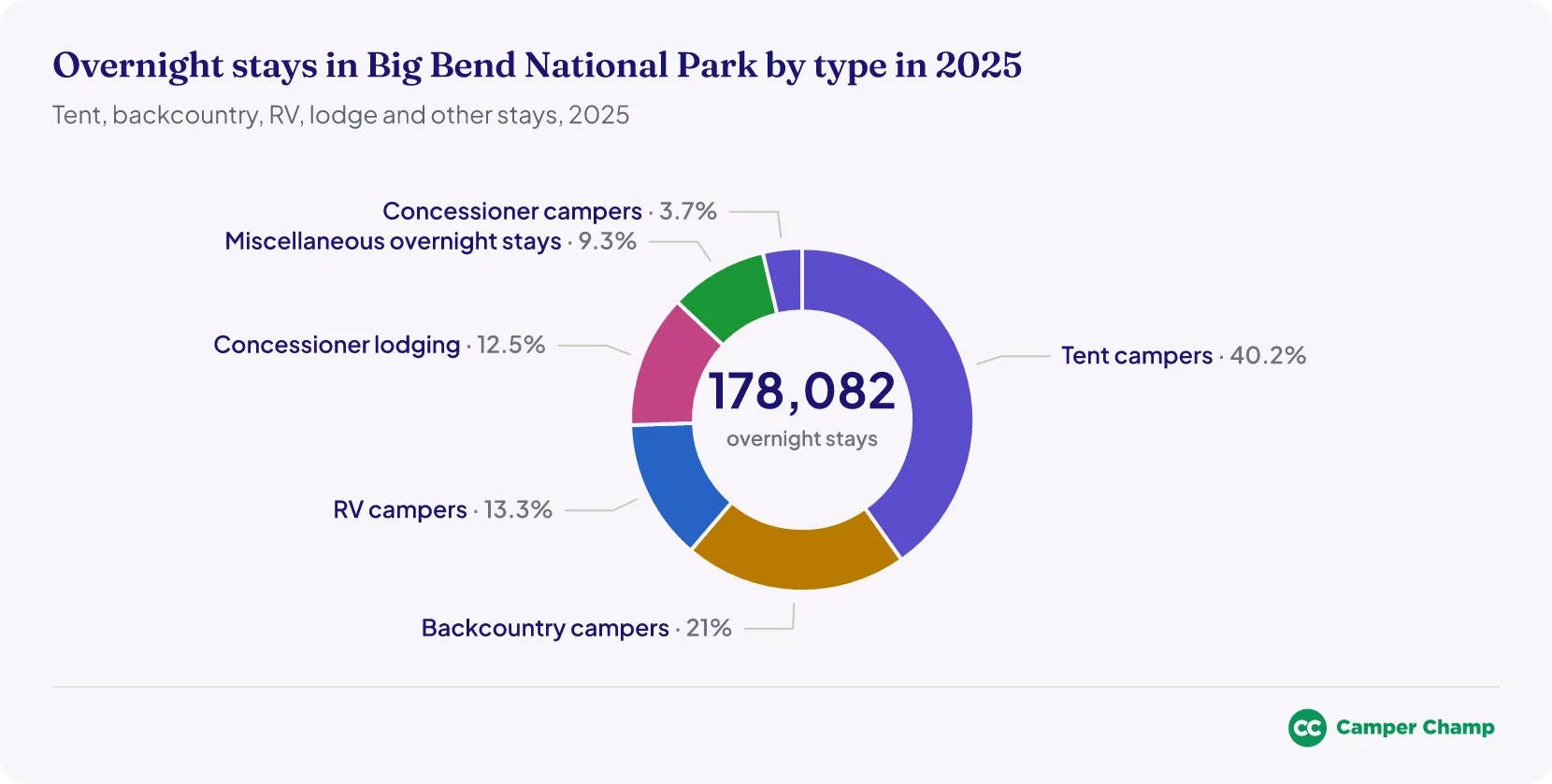
Big Bend National Park recorded 178,082 overnight stays in 2025, 7.2% fewer than the 191,822 in 2024 and 13.3% fewer than the 205,432 in 20193. The National Park Service counts overnight stays (one person for one night), not individual campers, so one person camping for three nights counts three times.
In 2025, the stays broke down as:
- Tent camping: 71,565 overnight stays, about 40% of the total3
- Backcountry camping: 37,472 overnight stays3
- RV camping: 23,639 overnight stays3
- Chisos Mountains Lodge: 22,336 overnight stays3
- Concessioner-run camping: 6,559 overnight stays3
- Other: 16,511 overnight stays3
For the national picture, see our U.S. camping statistics.
How do people camp in Big Bend National Park?
Big Bend National Park has three developed campgrounds run by the Park Service, plus a full-hookup RV park run by the park's concessioner, Aramark16. Every campsite needs a reservation: there is no first-come, first-served camping13.
- Chisos Basin Campground: 56 sites at 5,400 feet in the Chisos Mountains, for $16 a night17. Trailers over 20 feet and RVs over 24 feet are not recommended on the narrow, winding road to the Basin.
- Rio Grande Village Campground: 93 sites near the river, for $16 a night18. Only 25 sites are open from May 1 to October 31, because of the summer heat.
- Cottonwood Campground: a dry campground near the river on the park's west side, for $16 a night, with no hookups, no dump station and no generators19.
- Rio Grande Village RV Park: the only full hookups in the park, with 25 back-in sites for $36 a night for two people20. A few sites may not fit RVs of 38 feet or longer.
- Booking: Campsites can be reserved online up to six months ahead, and a limited number up to 14 days ahead13.
- Dump stations: at the Rio Grande Village and Chisos Basin campgrounds9.
- Stay limits: You can stay up to 14 consecutive nights, and 28 nights a year in the park. From January 1 to April 15, the limit is 14 nights in total16.
- Backcountry: A backcountry permit is required for all backcountry camping, and dispersed camping ("boondocking") is not allowed16.
- No campfires: Wood and ground fires are banned throughout the park; a charcoal fire in an above-ground grill is allowed16.
RV rental in the USA
- RV rental in Albuquerque
- Austin RV rental
- California RV rental
- Chicago RV rental
- Colorado RV rental
- Denver RV rental
- Las Vegas RV rental
- Miami RV rental
- Portland RV rental
- RV rental in Washington Dc
Big Bend National Park facts: size, history and landscape
- Location: Southwest Texas, on the big bend of the Rio Grande, which forms the border between the U.S. and Mexico5.
- Founded: Congress authorized Big Bend in 1935, and it became a national park on June 12, 19445.
- Size: 801,163 acres (1,252 square miles)5.
- Border: The park shares 118 miles of the U.S.–Mexico border5.
- Elevation: From 1,850 feet at Rio Grande Village to 7,832 feet at Emory Peak, the park's highest point5.
- Canyons: Santa Elena (20 miles), Mariscal (10 miles) and Boquillas (33 miles) canyons cut through the park5.
- Trails and roads: 201 miles of hiking trails and 304 miles of paved and gravel roads5.
- Wildlife and plants: More than 450 bird species, 75 mammal species, 56 reptile species and 1,295 plant species5.
- History: Evidence of nearly 12,000 years of human occupation5.
- Night skies: The Park Service says the park's remoteness gives it the best night-sky viewing in the United States5.
- Lodging: The Chisos Mountains Lodge, with 72 rooms and four historic cottages, is the only lodging in the park5.
- Recreation: Hiking, camping, river trips, birdwatching and stargazing.
Is Big Bend National Park dangerous?
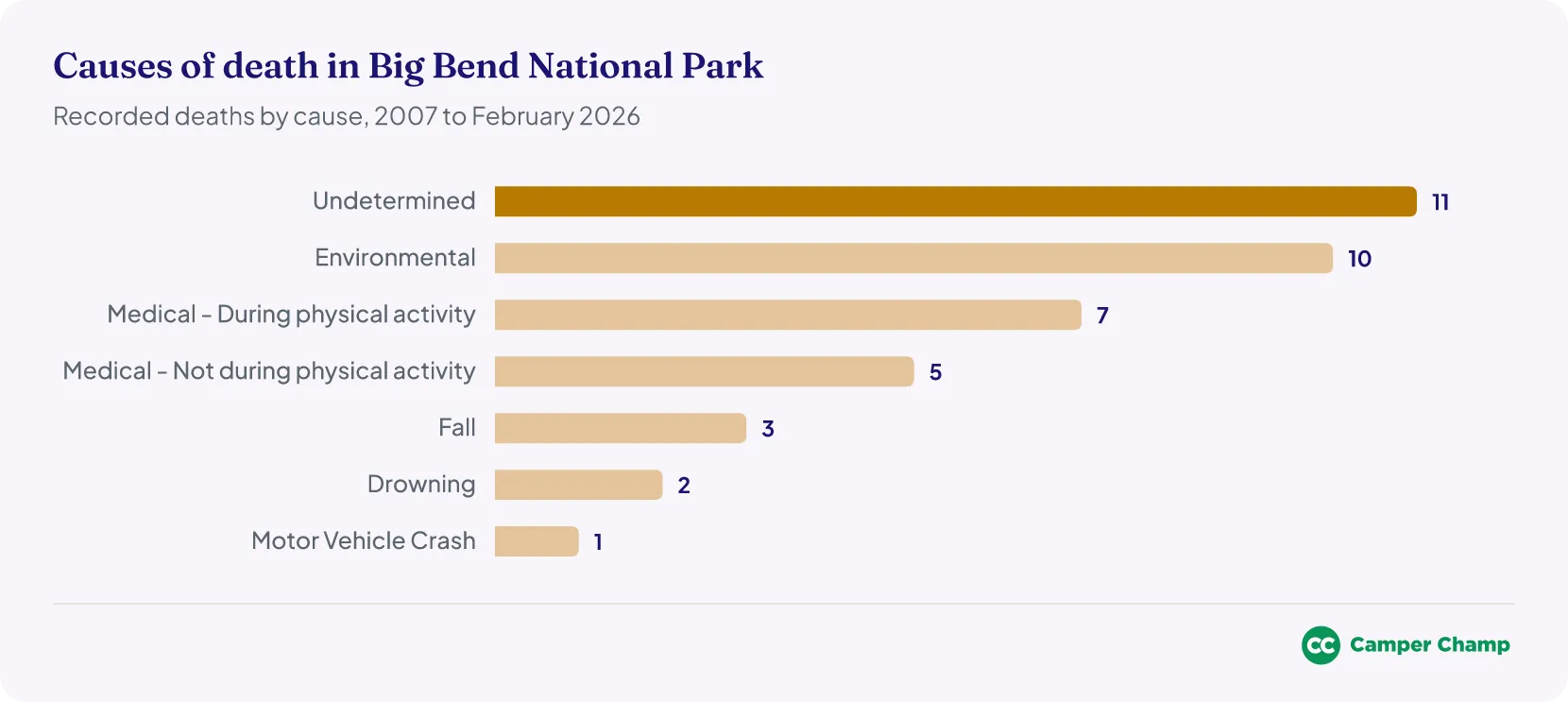
Deaths in Big Bend National Park are rare for a park with more than half a million visits a year, but its heat and remoteness call for care. Heat is one of the leading recorded causes of death: 10 of the 39 deaths since 2007 were from hyperthermia (heat illness), all between June and August21. Cell service is very spotty throughout the Big Bend area11, so don't count on your phone. To stay safe:
- Carry plenty of water: At least one gallon per person per day. Springs are unreliable, whatever maps show22.
- Cover up: Wear a hat, long pants, a long-sleeved shirt and sunscreen when hiking22.
- Avoid midday hikes in summer: Plan hikes for the cooler parts of the day22.
- Know your limits: Plan hikes within your ability, and tell someone where you're going and when you expect to return22.
- Watch for flash floods: Avoid narrow canyons and dry washes during thunderstorms22.
- Drive slowly: The speed limit is 45 mph at most in the park. Watch for javelina, deer and rabbits on the road shoulders, especially at night22.
- Wildlife safety: If you meet a bear or mountain lion, do not run. Stand tall, make noise, and report sightings to a ranger22.
What are the most common causes of visitor deaths in Big Bend National Park?
There were 39 recorded deaths in Big Bend National Park between 2007 and February 202621. The causes were:
Big Bend National Park FAQs
How many days do you need in Big Bend National Park?
At least a full day, and most visitors stay longer. In a Park Service survey of Big Bend's spring visitors in 1992, 73% of visitor groups stayed one day or more, and most (55%) stayed two to four days.23 Of the groups who spent nights in the park, 67% stayed one or two nights.
Is there cell service in Big Bend National Park?
Only in places. Cell service is very spotty, with long stretches of none. Areas with fairly reliable service include the Chisos Basin (Verizon only) and near Panther Junction11. Free public Wi-Fi is available at all park visitor centers, the Chisos Mountains Lodge and the Rio Grande Village Store.
How big is Big Bend National Park?
Big Bend covers 801,163 acres (1,252 square miles), making it the 15th largest U.S. national park5. It shares 118 miles of border with Mexico along the Rio Grande.
More national park statistics
- Biscayne National Park Tourism Statistics
- Everglades National Park Tourism Statistics
- Grand Teton National Park Tourism Statistics
- Great Smoky Mountains National Park Tourism Statistics
- Joshua Tree National Park Tourism Statistics
- US National Parks Ranking
- Olympic National Park Tourism Statistics
- Rocky Mountain National Park Tourism Statistics
- US National Parks Statistics
- Hawai’i Volcanoes National Park Tourism Statistics
- Wildlife Statistics in the USA
- Yosemite National Park Tourism Statistics
References
- Recreation Visitors By Month (1979 – Last Calendar Year) — Big Bend NP, report viewer (NPS Visitor Use Statistics) · irma.nps.gov ↑ b c d e f g h i j
- Recreation visits by month, 2025 — all 63 U.S. national parks (NPS Visitor Use Statistics data service) · irmaservices.nps.gov ↑ b c d e f
- Overnight Stays (1979 – Last Calendar Year) — Big Bend NP, report viewer (NPS Visitor Use Statistics) · irma.nps.gov ↑ b c d e f g h
- NPS Visitor Spending Effects — park results, Big Bend National Park (BIBE), 2012–2024 · irmaservices.nps.gov ↑ b c d e f g h
- Park Statistics (Just the Facts) — Big Bend National Park (U.S. National Park Service) · nps.gov ↑ b c d e f g h i j k l m n o
- NPS Visitor Use Statistics — Annual Park Ranking Report for Recreation Visits, 2025 · irma.nps.gov ↑ b
- Recreation Visitors By Month (1979 – Last Calendar Year) — Big Bend NP (NPS Visitor Use Statistics) · irma.nps.gov ↑ b c d e f g h i j k l m n o p q
- Fees & Passes — Big Bend National Park (U.S. National Park Service) · nps.gov ↑ b c d e f
- Frequently Asked Questions — Big Bend National Park (U.S. National Park Service) · nps.gov ↑ b c d
- Operating Hours & Seasons — Big Bend National Park (U.S. National Park Service) · nps.gov ↑ b c
- Basic Information — Big Bend National Park (U.S. National Park Service) · nps.gov ↑ b c d
- Weather — Big Bend National Park (U.S. National Park Service) · nps.gov ↑ b c d e f g h
- Advice for Busy Times — Big Bend National Park (U.S. National Park Service) · nps.gov ↑ b c d e f
- NPS Visitor Use Statistics — Traffic Counts, Big Bend NP · irma.nps.gov ↑ b c d
- Big Bend National Park Visitor Study, April 1992 (Visitor Services Project report summary) · wpcdn.web.wsu.edu ↑
- Camping — Big Bend National Park (U.S. National Park Service) · nps.gov ↑ b c d e f
- Chisos Basin Campground — Big Bend National Park (U.S. National Park Service) · nps.gov ↑ b
- Rio Grande Village Campground — Big Bend National Park (U.S. National Park Service) · nps.gov ↑
- Cottonwood Campground — Big Bend National Park (U.S. National Park Service) · nps.gov ↑
- Rio Grande Village RV Campground — Big Bend National Park (U.S. National Park Service) · nps.gov ↑ b
- NPS Mortality Data, CY2007 onward (Prevention and Response Branch FOIA release) · nps.gov ↑ b c d e f g h i
- Safety — Big Bend National Park (U.S. National Park Service) · nps.gov ↑ b c d e f g
- Big Bend National Park Visitor Study, April 1992 (Visitor Services Project Report 45) · wpcdn.web.wsu.edu ↑
- Lodging — Big Bend National Park (U.S. National Park Service) · nps.gov ↑
- NPS: Facts and Figures – Visitations, Spending, Ranking, and Park Reports · nps.gov