

Updated
How many people visit Badlands National Park each year?
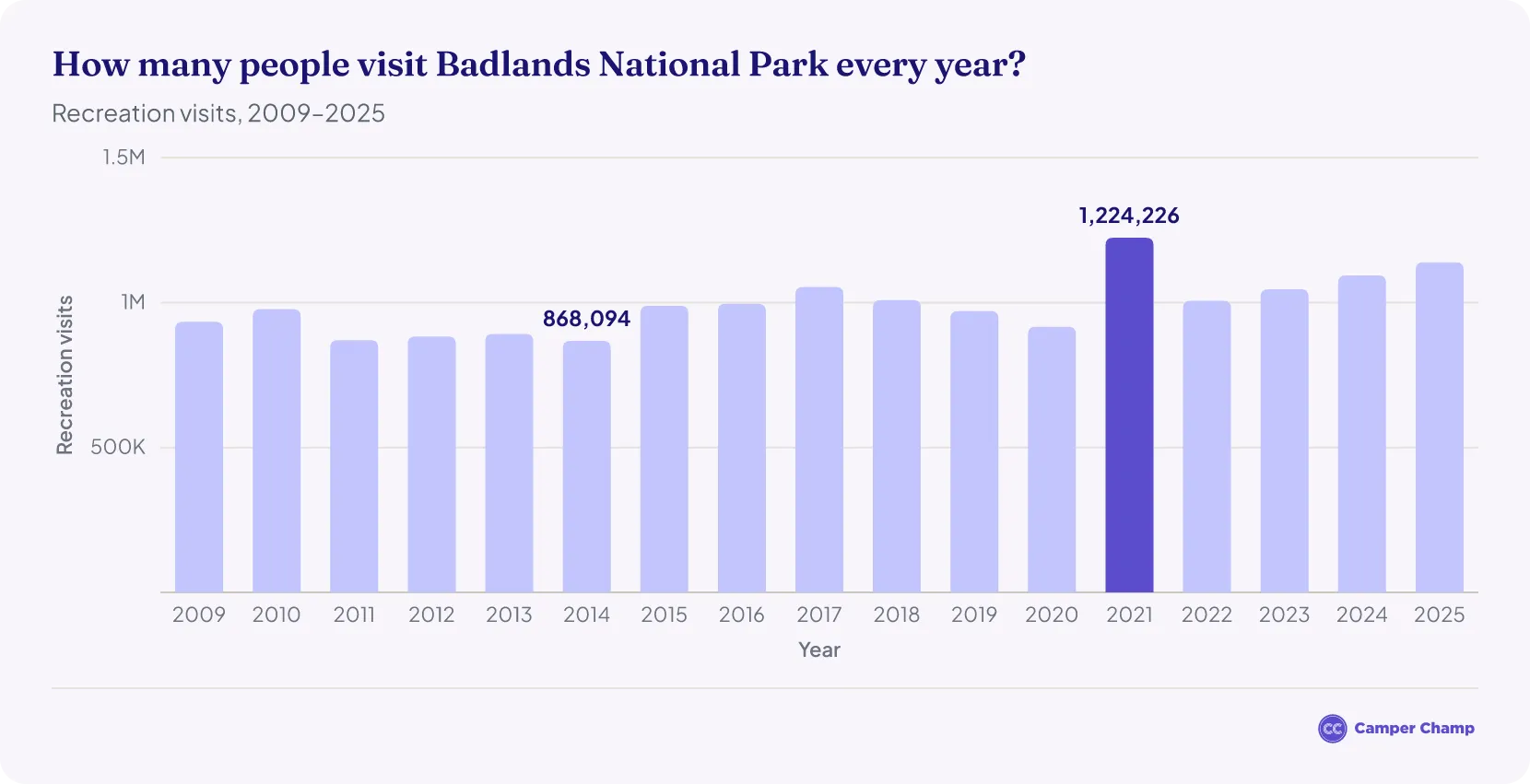
Over 1.14 million tourists visited Badlands National Park in 20251.
- Badlands National Park welcomed 970,998 visitors in 20191. However, when the pandemic hit in 2020, this number dropped by 6% to 916,932.2
- By 2021, visitor numbers reached 1.22 million,1 exceeding the pre-pandemic figures by 26%.
- Numbers fell back to 1.01 million in 2022, then climbed to 1.05 million in 2023, 1.09 million in 2024 and 1.14 million in 2025.1
How many people visited Badlands National Park in 2025?
- In 2025, Badlands National Park welcomed 1.14 million visitors and recorded 48,375 overnight stays3. This was 17% more than the visitors recorded in 2019. That works out to about 3,100 visitors a day across the year, rising to about 7,500 a day in July.
How much do visitors spend at Badlands National Park every year?
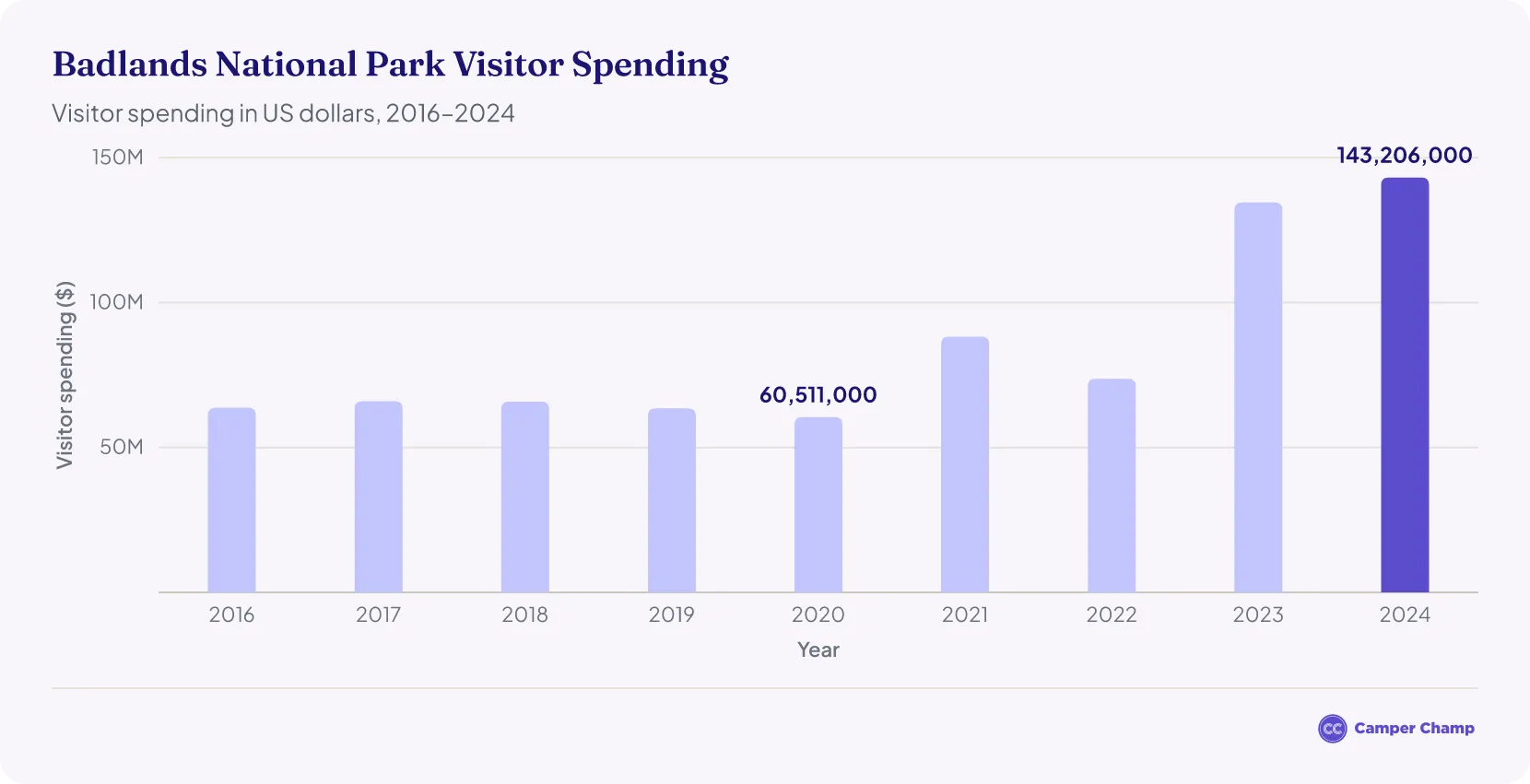
In 2024, visitor spending at Badlands National Park amounted to $143 million.4
- In 2019, visitors to Badlands National Park generated $63.5 million in expenditure5. However, in 2020, visitor spending dropped by 5% to $60.5 million.2
- Badlands National Park recovered in 2021, with $88 million spent by tourists6.
- In 2022, tourist spending amounted to $74 million7, and in 2023 the estimate rose by 82% to $134.6 million.8 Most of that jump reflects a change in how NPS makes the estimate, not real growth: 2023 was the first year it used spending survey data collected at Badlands itself instead of a generic profile, and that switch alone raises the estimate by 73% at unchanged visitor numbers. Spending rose again in 2024, to $143 million.4
How much did tourists spend in Badlands National Park?
- Visitors to Badlands National Park spent more than $143 million in 20244.
How much does it cost to visit Badlands National Park?
A 7-day pass to Badlands National Park costs $30 per private vehicle, $25 per motorcycle and $15 per person on foot or by bicycle.9 Children under 16 enter free.
- Annual Badlands pass: $55, covering one private vehicle for a year.9
- America the Beautiful pass: $80 for U.S. residents, covering entrance at every national park for a year.9
- No cash: the three entrance stations (Northeast, Pinnacles and Interior) take credit and debit cards only, and private passes can also be bought on Recreation.gov.9
How did COVID-19 affect visits to Badlands National Park?
Badlands National Park Tourism Statistics 2020 and 2021
- In 2020, Badlands National Park visitor numbers fell to 916,932 due to the coronavirus pandemic.2 This marked a 6% decrease from the 2019 figure of 970,998.5 In 2021, tourist visitation exceeded 2019’s figure with 1.22 million visits.6
- Tourist spending followed a similar trend. After 2019’s expenditure figure of $63.5 million5, tourist spending dropped to $60.5 million in 2020.2 Recovery was evident in 2021 with visitor spending increasing to $88 million.6
What was Badlands National Park's busiest year?
Since 1979, Badlands National Park's busiest year was 1991, with 1,518,396 visits.1 The quietest was 2006, with 840,118.
How popular is Badlands National Park?
- The park is recognized for having one of the world's richest fossil beds10, which includes fossils from the Oligocene epoch.11 This aspect has garnered attention from both scientists and tourists alike.
- Badlands National Park ranked 26th as the most visited national park among U.S. national parks in 2025.12
- Read more about the U.S. National Park Ranking.
How does Badlands compare with other parks in South Dakota?
Badlands National Park drew 1.14 million visits in 2025, the second most of the five National Park Service sites in western South Dakota after Mount Rushmore.12 It drew almost twice as many visits as Wind Cave, the state's only other national park.
- Mount Rushmore National Memorial: 1,905,649 visits, 3% fewer than in 2019.12
- Badlands National Park: 1,139,361 visits, 17% more than in 2019.12
- Wind Cave National Park: 606,258 visits, 1% fewer than in 2019.12
- Jewel Cave National Monument: 110,553 visits, 10% fewer than in 2019.12
- Minuteman Missile National Historic Site: 102,146 visits, 19% fewer than in 2019.12
Badlands was the only one of the five with more visits in 2025 than before the pandemic.12
When is the best time to visit Badlands National Park?
- The best time to visit Badlands National Park is in Spring (April to May): Mild temperatures (60°F-80°F), fewer crowds, active wildlife, but occasional rainstorms.
- Fall (September to October) is also a good choice with comfortable temperatures (60°F-70°F), fall colors and fewer visitors, ideal for outdoor activities and photography.
What were Badlands National Park’s peak tourist months in 2025?
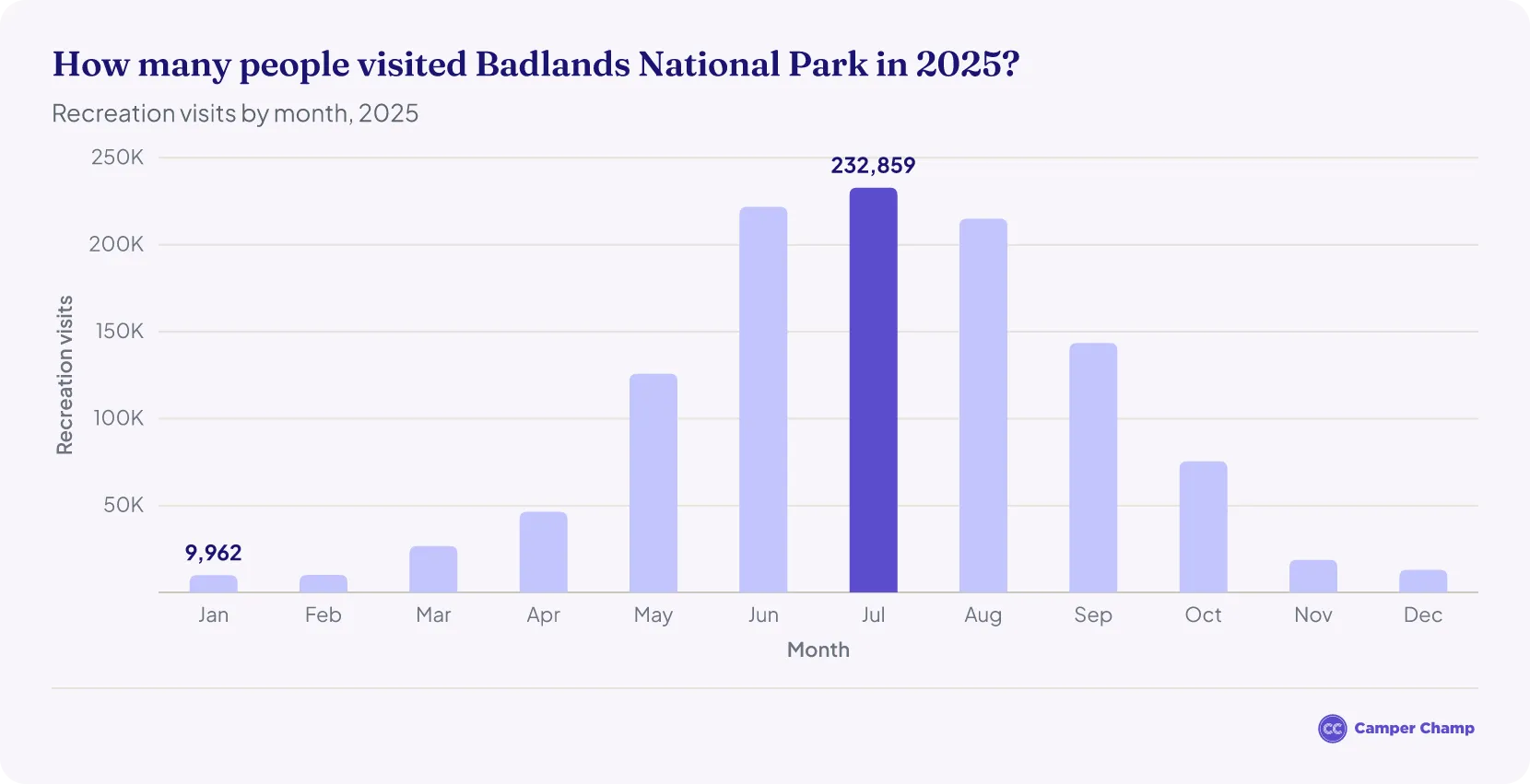
Here are the top 5 most visited months in Badlands National Park for 2025, highlighting the seasonal attractions and reasons for the high number of visitors during each month:
- July: 232,859 visits1, the busiest month, driven by summer vacations and optimal weather for outdoor activities.
- June: 221,824 visits1, marking the start of peak summer travel as families begin vacations.
- August: 214,978 visits1, continuing the high summer tourism season.
- September: 143,478 visits1, maintaining strong visitation with pleasant early fall weather and fewer crowds.
- May: 125,814 visits1, signaling the beginning of increased tourism as spring transitions into summer.
What is the nearest airport to Badlands National Park?
The nearest commercial airport is Rapid City Regional Airport (RAP), about 60 miles by car from the park.13
- The airport sits nine miles southeast of Rapid City14 and has nonstop flights on American, Delta, United, Allegiant and Sun Country.15
- From Interstate 90, drivers heading east take Exit 110 at Wall and follow the signs about seven miles south to the Pinnacles Entrance. Drivers heading west take Exit 131 and follow the signs about three miles south to the Northeast Entrance.16
How many people camp at Badlands National Park?
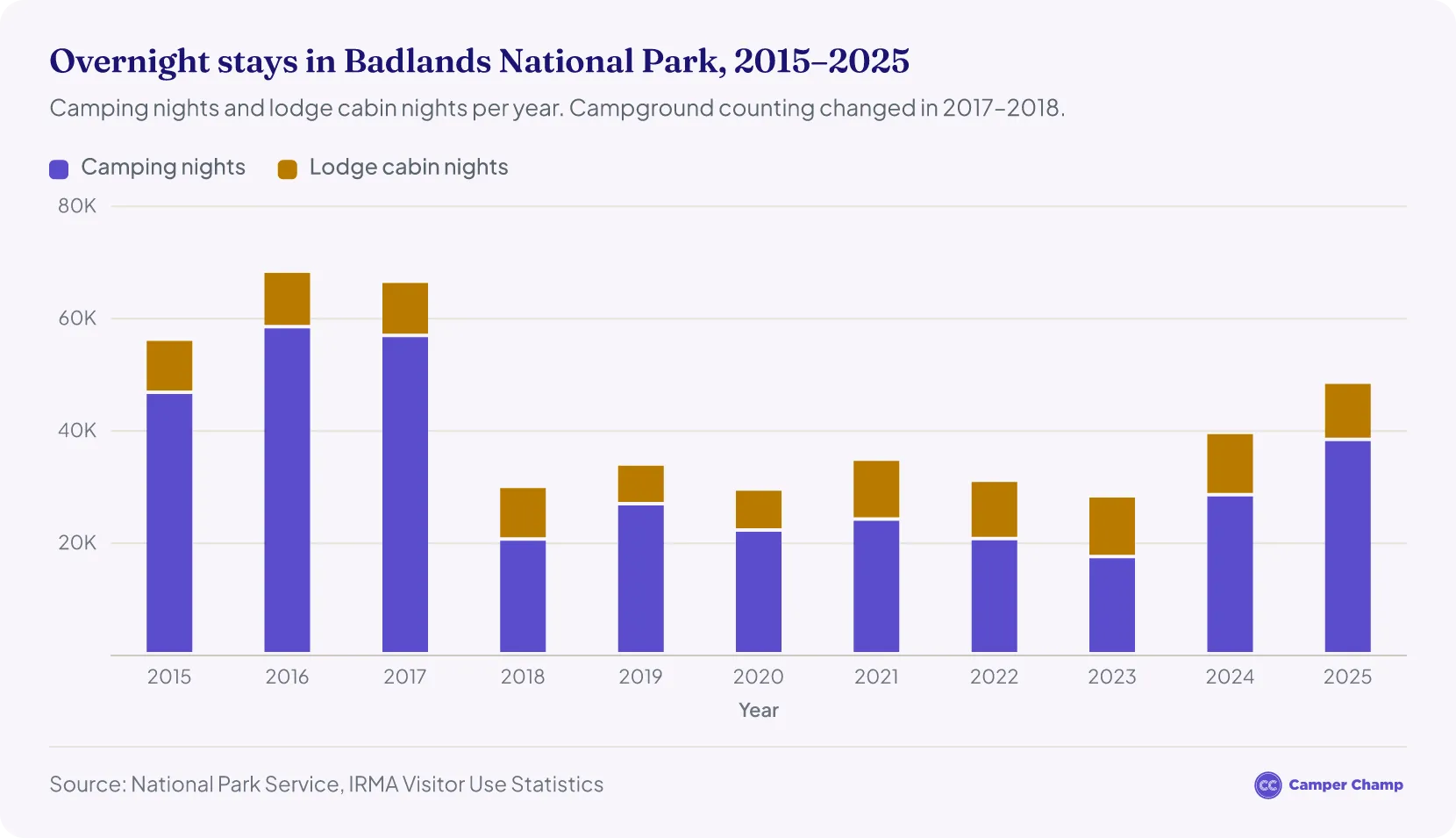
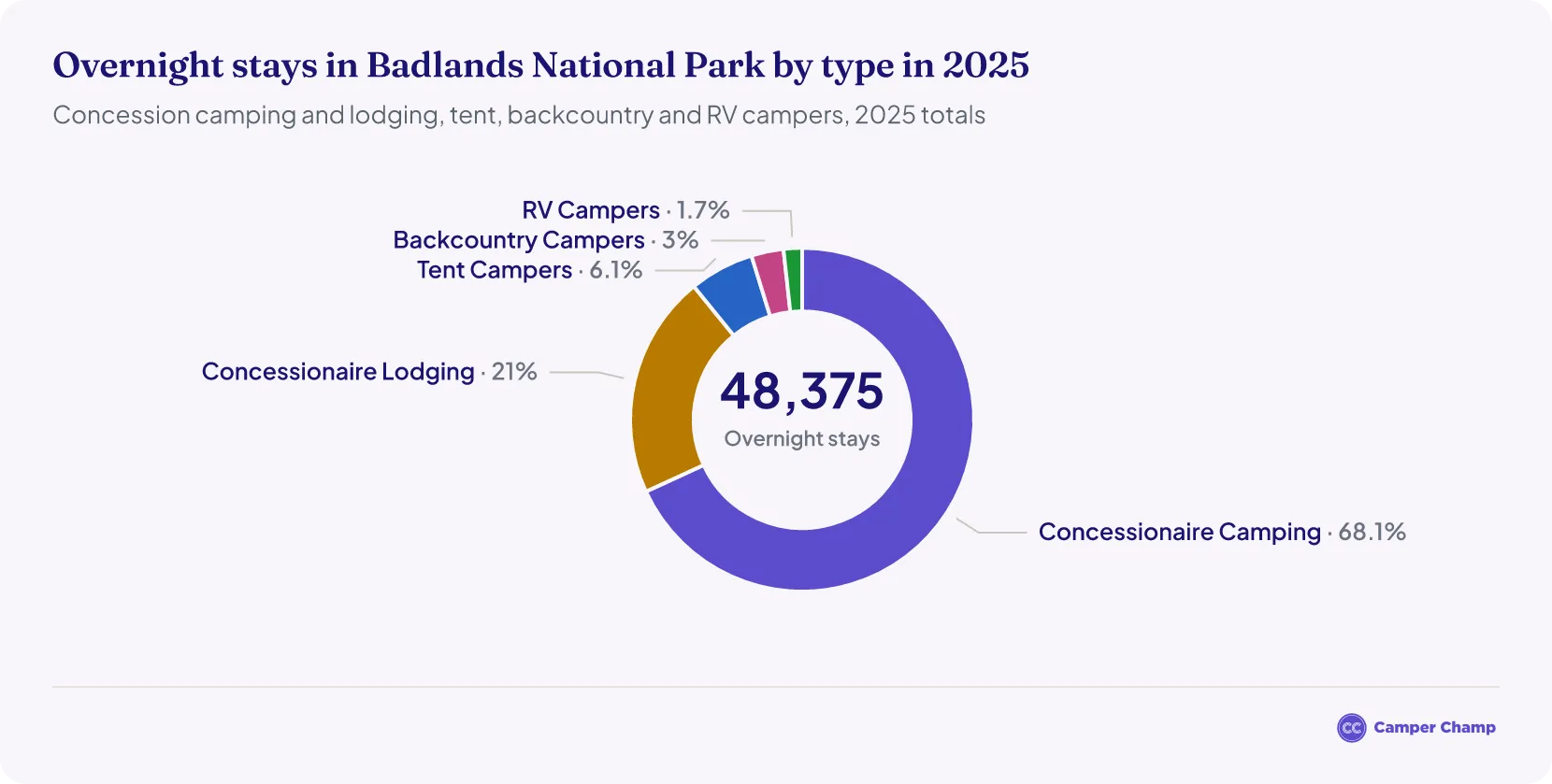
Badlands National Park recorded 48,375 overnight stays in 2025, and 38,209 of them, or about 79%, were nights spent camping.3
- Overnight stays are a small part of the picture next to the 1.14 million recreation visits the park recorded in 2025.3
- Cedar Pass Campground, run by the park's concessioner, accounted for 32,960 camping nights, more than four in five.3
- The other 10,166 overnight stays were in the lodge cabins at Cedar Pass.3
How do people camp at Badlands National Park?
Most people who camp at Badlands National Park stay at Cedar Pass Campground, the paid campground run by the park's concessioner. It accounted for 32,960 of the park's 38,209 camping nights in 2025.3 Far fewer campers pitch a tent at a park-run site, bring an RV or hike into the backcountry.
- Cedar Pass Campground: 32,960 overnight stays, in paid sites3 that can be booked ahead, some with electric hookups for RVs.19
- Tent camping: 2,942 overnight stays by campers sleeping in tents3 at the park's own free campground, Sage Creek, for a more traditional, outdoor camping experience.
- Backcountry camping: 1,466 overnight stays by campers who hike in3 and set up at least half a mile from any road or trail.19
- RV camping: 841 overnight stays in RVs at Sage Creek3, where vehicles longer than 18 feet are not allowed.19
- Lodge cabins: another 10,166 overnight stays were in the cabins at Cedar Pass Lodge3, for visitors who stay the night without camping.
Where can you camp at Badlands National Park?
Visitors can camp in two campgrounds or in the backcountry, and the park's only other place to stay is the cabins at Cedar Pass Lodge.19
- Cedar Pass Campground: a paid campground with 96 sites, some of them RV sites with electric hookups. Sites can be reserved on Recreation.gov.19
- Sage Creek Campground: a free, first-come, first-served campground with 22 sites. RVs, motorhomes and trailers longer than 18 feet are not allowed.19
- Backcountry camping: allowed anywhere in the park, as long as the camp is at least 0.5 miles from a road or trail and cannot be seen from either.19
RV rental in the USA
- RV rental in Austin
- Boston RV rental
- Las Vegas RV rental
- RV rental in Los Angeles
- RV rental in Miami
- New York RV rental
- RV rental in Orlando
- Portland RV rental
- RV rental in San Diego
- San Jose RV rental
Key facts about Badlands National Park
- Size: Approximately 244,000 acres (381 square miles).20
- Location: East of the Black Hills, 75 miles east of Rapid City, South Dakota.16
- Badlands Peak: Eroded buttes and pinnacles formed through erosion and sedimentation.
- Rock Layers: Sedimentary rock deposits, including sandstone, claystone, and shale with distinct banding.
- Highest Point: Red Shirt Table at 3,340 feet (1,020 meters) elevation.11
- Geography: Sharply eroded buttes, pinnacles and spires surrounded by a mixed-grass prairie ecosystem.20
- Mixed Grass Prairie: Largest intact mixed-grass prairie in the U.S.11
- Wildlife: Includes bison, bighorn sheep, pronghorn antelope, coyotes, jackrabbits, and black-footed ferrets.
- Prairie Dogs: Commonly seen in the grasslands.
How many bison live in Badlands National Park?
About 1,200 bison live in Badlands National Park, according to the park service's latest estimate.21 The herd descends from bison brought from Theodore Roosevelt National Park in 1963.
- Black-footed ferrets: about 120 live in the park.22 The species was declared extinct in 1980, and 147 ferrets were released in the park's Conata Basin between 1996 and 1999. The Badlands population is now one of the only self-sustaining ones in the world.
- Bighorn sheep: about 250 live in the park, out of roughly 80,000 in the U.S.23 The first 22 arrived from Pikes Peak, Colorado, in 1964, and a second group came from Wheeler Peak, New Mexico, in 2004.
Other Resources
- Biscayne National Park Tourism Statistics
- Denali National Park Tourism Statistics
- Everglades National Park Tourism Statistics
- Grand Teton National Park Tourism Statistics
- Great Smoky Mountains National Park Tourism Statistics
- US National Parks Ranking
- Olympic National Park Tourism Statistics
- US National Parks Statistics
- Hawai’i Volcanoes National Park Tourism Statistics
- White Sands National Park Tourism Statistics
- Wildlife Statistics in the USA
- Yosemite National Park Tourism Statistics
How many people have died in Badlands National Park?
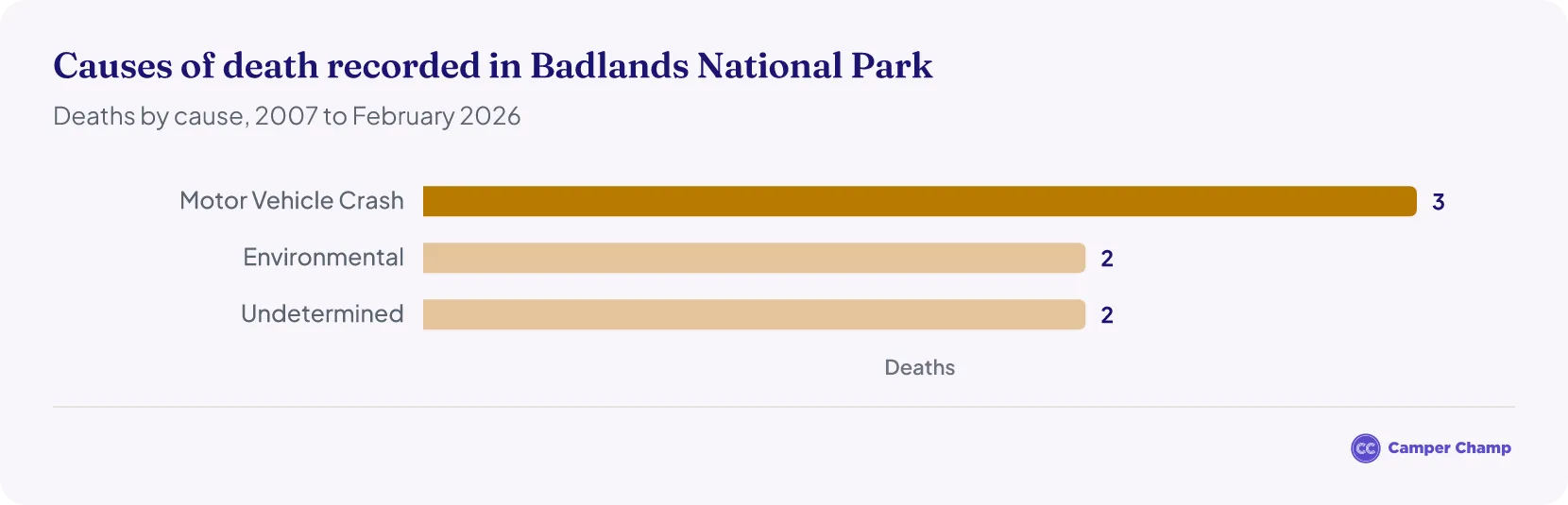
There were 7 recorded deaths in Badlands National Park between 2007 and February 2026.24 Here are the main causes of death in the park:
- Motor Vehicle Crash (3 deaths)
- Environmental (2 deaths)
- Undetermined (2 deaths)
How can you stay safe in Badlands National Park?
When visiting Badlands National Park, it's essential to be mindful of safety precautions due to the park's remote location and harsh conditions. Follow these guidelines:
- Plan Ahead: Always have a plan before visiting. Inform someone of your route and return time. Familiarize yourself with the park layout and hazards, and carry a fully charged phone.
- Stay Hydrated: Bring at least one gallon (4 liters) of water per person daily, especially in warmer months, to avoid dehydration.
- Dress Properly: Wear layered clothing for changing weather and sturdy, closed-toe shoes with ankle support for rugged terrain.
- Stay on Trails: Stick to designated trails, especially if you're new. Only venture off-trail if experienced and prepared.
- Wildlife Safety: Keep a safe distance—at least 100 feet (30 meters) from large animals like bison and sheep. Watch out for rattlesnakes in shaded or grassy areas.
- Monitor Weather: Watch for sudden weather changes. Avoid hiking during thunderstorms due to lightning risks, and be cautious of high winds.
- Sun Protection: Use sunscreen (SPF 15+), wear sunglasses, and a wide-brimmed hat to protect from intense sun.
- Emergency Contacts: In an emergency, call 911, as some calls may go through even with weak signals.
- Know Your Limits: The park's elevation (around 3,000 feet) can affect visitors from lower altitudes. Pace yourself and monitor how you feel.
- Watch Your Step: Wear sturdy boots to avoid ankle injuries on uneven terrain.
- Avoid Climbing Buttes: Climbing geological formations can be dangerous and contribute to erosion.
References
- NPS IRMA Visitor Use Statistics — Recreation Visits by Month, Badlands NP (1979 – last calendar year) · irma.nps.gov ↑ b c d e f g h i j k l m
- 2020 National Park Visitor Spending Effects: Economic Contributions to Local Communities, States, and the Nation · nps.gov ↑ b c d
- NPS IRMA Visitor Use Statistics — Summary of Visitor Use By Month and Year, Badlands NP (1979 – last calendar year) · irma.nps.gov ↑ b c d e f g h i j k
- 2024 National Park Visitor Spending Effects: Economic Contributions to Local Communities, States, and the Nation (NPS Visitor Spending Effects report series) · nps.gov ↑ b c
- 2019 National Park Visitor Spending Effects: Economic Contributions to Local Communities, States, and the Nation · nps.gov ↑ b c
- 2021 National Park Visitor Spending Effects: Economic Contributions to Local Communities, States, and the Nation · nps.gov ↑ b c
- 2022 National Park Visitor Spending Effects: Economic Contributions to Local Communities, States, and the Nation · nps.gov ↑
- 2023 National Park Visitor Spending Effects: Economic Contributions to Local Communities, States, and the Nation (NPS Science Report NPS/SR—2024/174) · nps.gov ↑
- Entrance Passes – Badlands National Park · nps.gov ↑ b c d
- Badlands National Park (U.S. National Park Service) · nps.gov ↑
- Badlands National Park – Wikipedia · en.wikipedia.org ↑ b c
- NPS IRMA Visitor Use Statistics — Annual Park Ranking Report for Recreation Visits (1979 – last calendar year) · irma.nps.gov ↑ b c d e f g h
- Getting to Badlands National Park – National Parked · nationalparked.com ↑
- Rapid City Regional Airport – Wikipedia · en.wikipedia.org ↑
- Rapid City Regional Airport (RAP) · flyrapidcity.com ↑
- Directions – Badlands National Park · nps.gov ↑ b
- NPS IRMA Visitor Use Statistics — Overnight Stays (1979 – last calendar year), Badlands NP · irma.nps.gov ↑
- NPS IRMA Visitor Use Statistics — Park Visitor Use and Count Procedure Changes, Badlands NP · irma.nps.gov ↑
- Eating & Sleeping – Badlands National Park · nps.gov ↑ b c d e f g
- Nature & Science – Badlands National Park · nps.gov ↑ b
- Bison – Badlands National Park (NPS) · nps.gov ↑
- Black-footed Ferret: Rebounding in the Badlands (NPS) · nps.gov ↑
- Bighorn Sheep – Badlands National Park (NPS) · nps.gov ↑
- NPS Mortality Data, CY2007 onward (Prevention and Response Branch FOIA release) · nps.gov ↑
- NPS: Facts and Figures – Visitations, Spending, Ranking, and Park Reports · nps.gov