

Updated
Yosemite National Park Key Statistics
- 4.28 million people visited Yosemite National Park in 2025.2
- Yosemite was the 5th most visited U.S. national park in 2025.3
- From January to August 2026, 3.16 million people visited, 6.9% more than in the same months of 2025.4
- Yosemite's busiest year on record was 2016, with 5.03 million visits.2
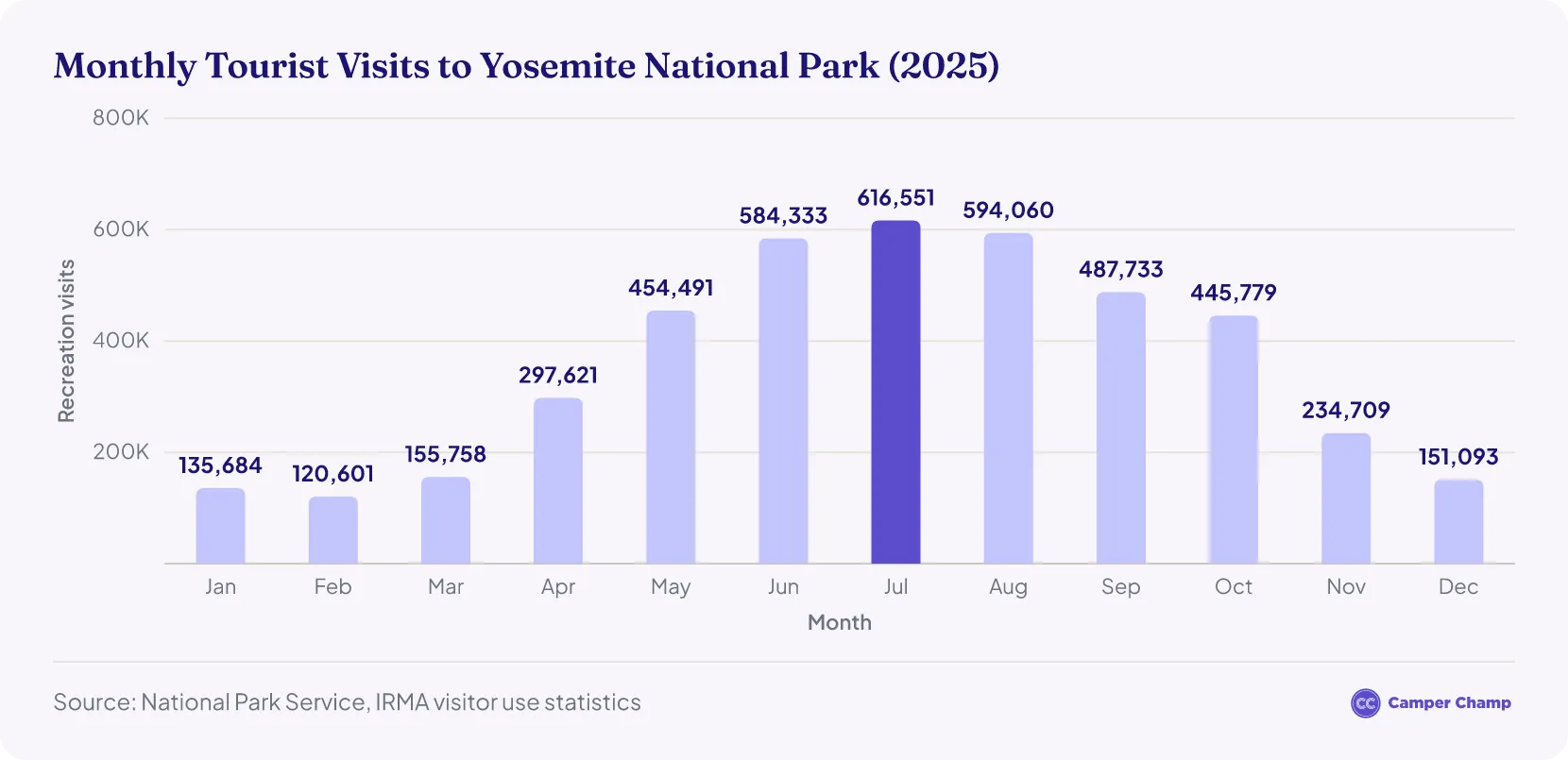
- July is the busiest month, with 617,000 visitors in 2025.4
- Visitors spent $629 million on trips to Yosemite in 2024.5
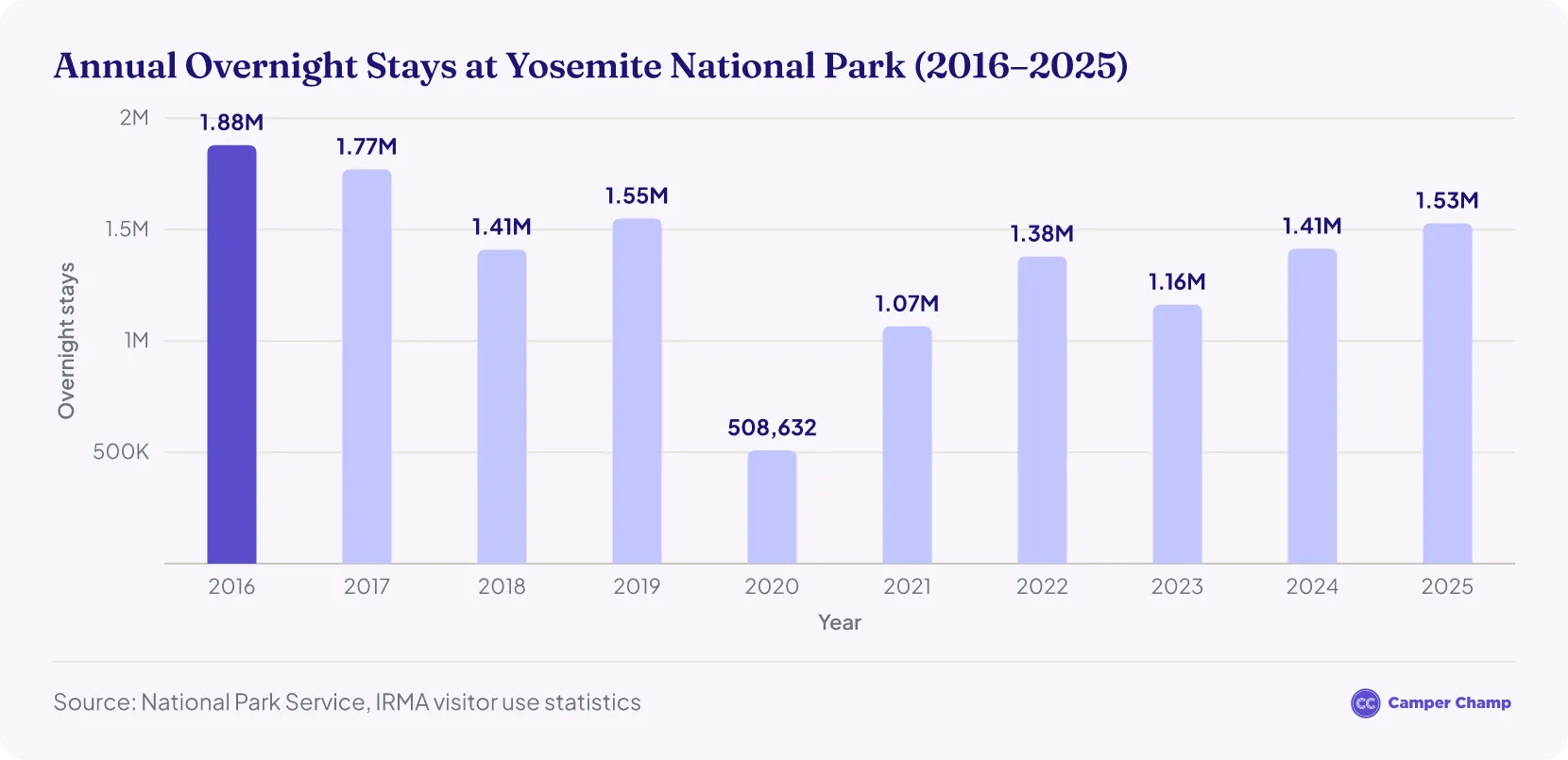
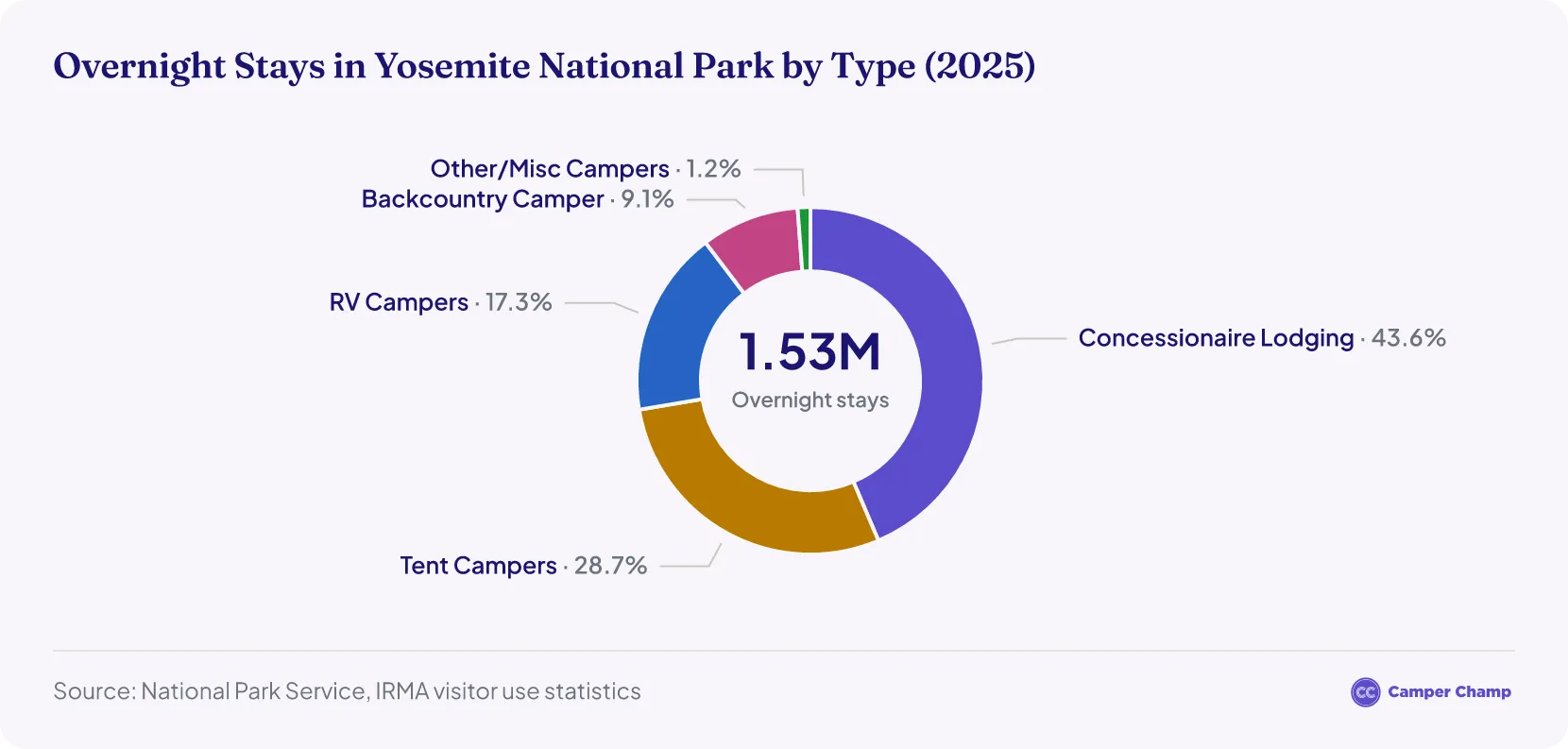
- Yosemite recorded nearly 1.53 million overnight stays in 2025.6
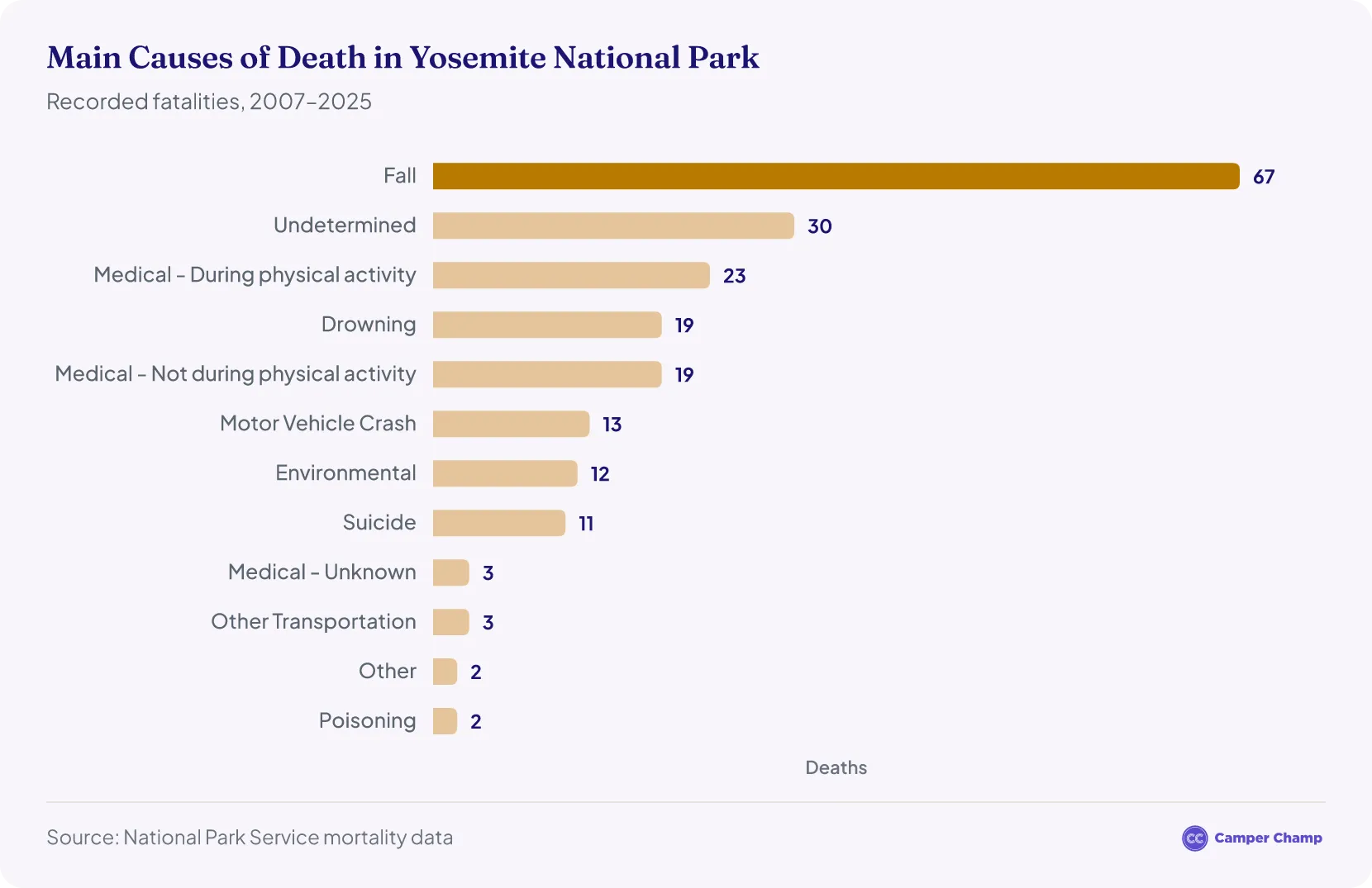
- 204 people died in Yosemite National Park from 2007 to 2025.7
How many people visit Yosemite National Park each year?
Nearly 4.28 million tourists visited Yosemite National Park in 2025.2
- Yosemite National Park welcomed 4.42 million visitors in 2019.2 However, when the pandemic hit in 2020, this number dropped by 49% to 2.27 million.
- By 2021, Yosemite National Park’s tourism began to recover, reaching 3.29 million visitors.2
- Tourist numbers continued to rise in 2022 with 3.67 million visits, and in 2023, the figure climbed to 3.9 million.2
- In 2025, Yosemite visitation reached 4.28 million, up 3.8% from 2024's 4.12 million visits.2
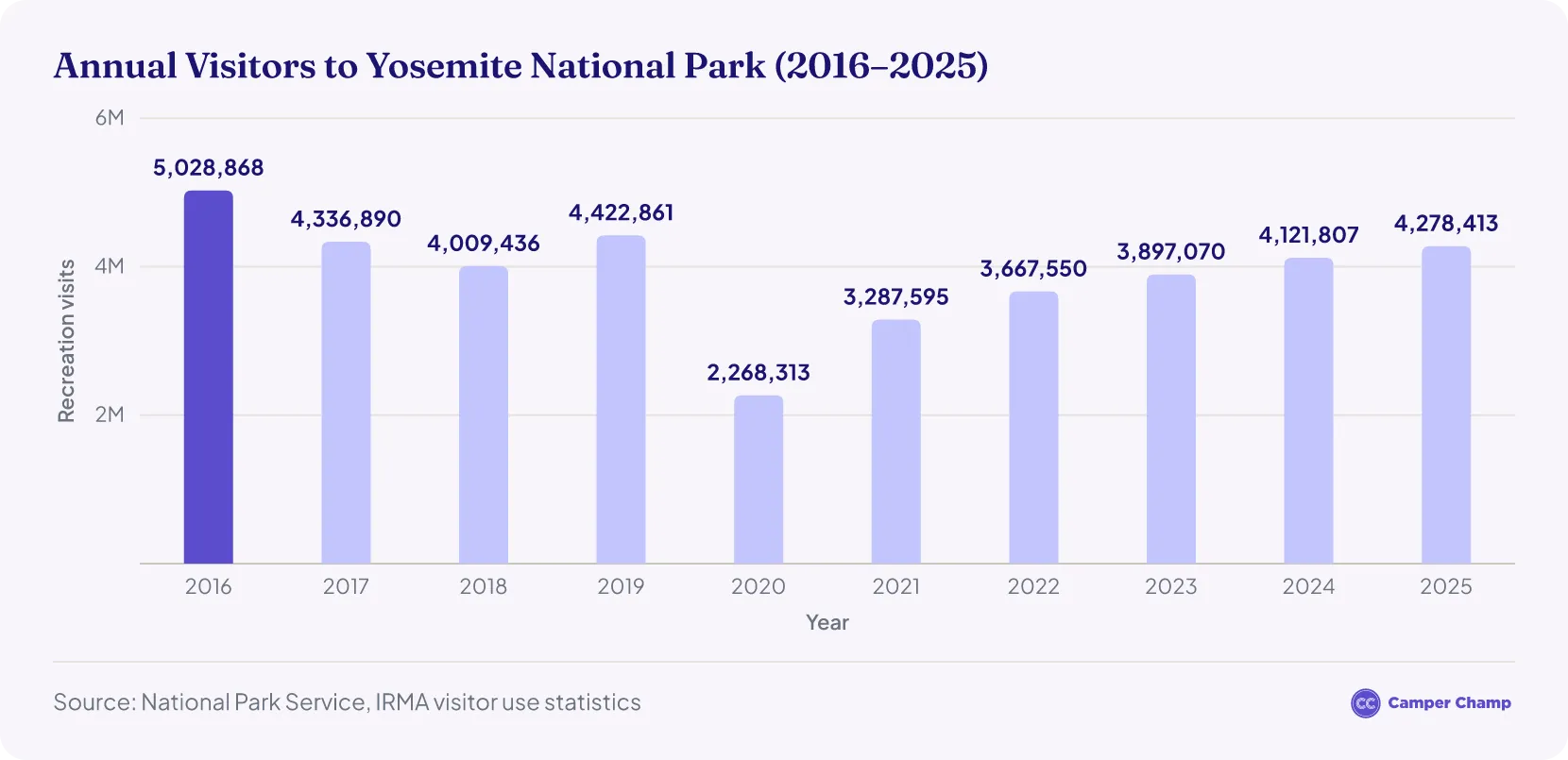
Yosemite National Park visitors by year (2006–2025)
Yosemite's busiest year on record was 2016, with 5,028,868 recreation visits — the only year the park has passed 5 million.2 Visits have risen every year since the 2020 low, and 2025 was the fourth-busiest year in the park's history.
| Yosemite National Park annual recreation visits, 2006–2025 | ||
|---|---|---|
| Year | Recreation visits | Change on previous year |
| 2025 | 4,278,4132 | +3.8% |
| 2024 | 4,121,8072 | +5.8% |
| 2023 | 3,897,0702 | +6.3% |
| 2022 | 3,667,5502 | +11.6% |
| 2021 | 3,287,5952 | +44.9% |
| 2020 | 2,268,3132 | -48.7% |
| 2019 | 4,422,8612 | +10.3% |
| 2018 | 4,009,4362 | -7.6% |
| 2017 | 4,336,8902 | -13.8% |
| 2016 | 5,028,8682 | +21.2% |
| 2015 | 4,150,2172 | +6.9% |
| 2014 | 3,882,6422 | +5.2% |
| 2013 | 3,691,1912 | -4.2% |
| 2012 | 3,853,4042 | -2.5% |
| 2011 | 3,951,3932 | +1.3% |
| 2010 | 3,901,4082 | +4.4% |
| 2009 | 3,737,4722 | +8.9% |
| 2008 | 3,431,5142 | -2.1% |
| 2007 | 3,503,4282 | +8.0% |
| 2006 | 3,242,6442 | -1.9% |
Source · National Park Service, Annual Park Recreation Visitation report
How many people visited Yosemite National Park in 2025?
- In 2025, Yosemite National Park welcomed a total of 4.28 million visitors.2 This marked a 3.3% decrease from the 4.42 million visitors recorded in 2019.
How did COVID-19 affect visits to Yosemite National Park?
- Yosemite National Park visitor numbers fell to 2.27 million in 2020, marking a severe decrease of 49% from the 2019 figure of 4.42 million.2 Although there was a rebound to 3.29 million visitors in 2021, this was still far below pre-pandemic levels.
- Tourist spending followed a similar trend. After reaching $547 million in 20198, expenditure dropped to $274 million in 2020, showcasing a drop of 50%.9 However, in 2021, visitor spending increased to $437 million.10
How much do visitors spend at Yosemite National Park every year?
In 2024, visitor spending at Yosemite National Park amounted to $629 million.5
Note: 2024 is the latest year available. The National Park Service has not yet published 2025 visitor spending figures.
- In 2019, visitors to Yosemite National Park generated $547 million in expenditure.8 Visitor spending dropped by 50% in 2020 ($274 million) due to the pandemic.9
- Yosemite National Park began to recover in 2021, with visitor spending rising to $437 million.10 Although this was a strong rebound from 2020, it still remained 20.0% below the 2019 level.
- Tourist spending reached $498 million in 2022,11 with a further increase of 6% to $527 million in 2023.12 This showed that tourism activity was steadily improving, but spending in 2023 was still slightly below the pre-pandemic figure recorded in 2019.
- In 2024, the figure reached $629 million, up $102 million (19.4%) from 2023’s $527 million, and $82 million (15.1%) above 2019’s $547 million.5
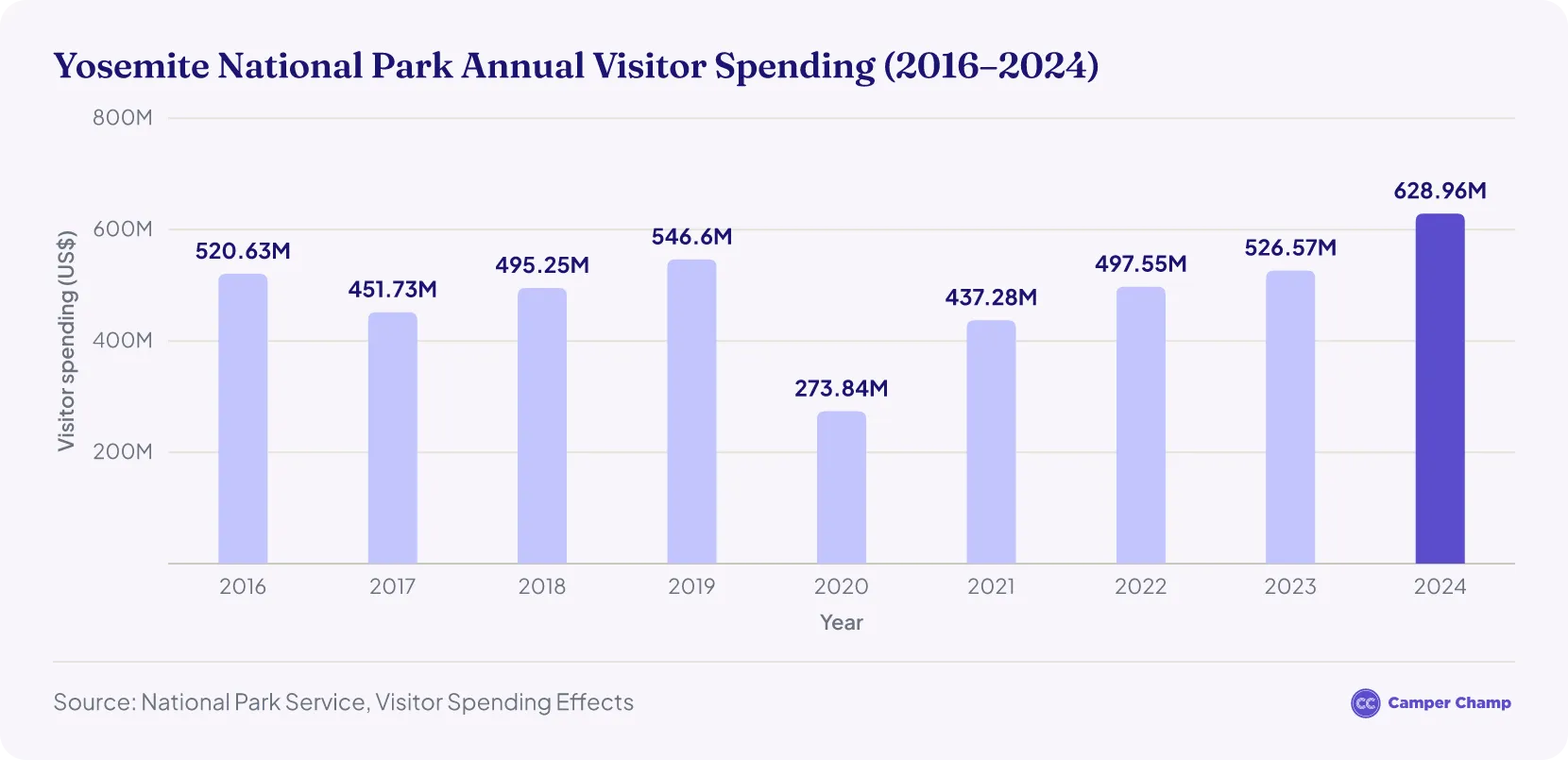
How much did tourists spend in Yosemite National Park?
- Visitors to Yosemite National Park spent $629 million in 2024, exceeding pre-pandemic spending levels by 15%.5
Note: 2024 is the latest visitor spending data available. The National Park Service has not yet published 2025 figures.
How much does it cost to visit Yosemite National Park?
The standard entrance fee is $35 per private vehicle, valid for seven consecutive days and covering everyone inside.13 Motorcycles pay $30, and visitors arriving on foot or by bike pay $20 per person aged 16 and over. Non-U.S. residents aged 16 and over pay an extra $100 per person, and a Yosemite Annual Pass costs $70.
Beyond the entrance fee, visitors to Yosemite National Park spent about $153 per visit in 2024.5
Note: This is an estimated average visitor spending amount, not the official Yosemite entrance fee.
Do you need a reservation to visit Yosemite in 2026?
No. Yosemite National Park is not using a timed entry reservation system in 2026. The park dropped it after finding that most weekdays in 2025 had parking available and traffic within the park's capacity.14
Instead, the park is managing busy days with real-time traffic monitoring, active parking management in Yosemite Valley and extra staff at key intersections.14 It recommends planning weekend and holiday trips early, visiting on weekdays when parking is easier, and exploring beyond Yosemite Valley, in areas such as Tuolumne Meadows, Wawona and Hetch Hetchy.
How does Yosemite rank among the most visited national parks?
- Yosemite ranked 5th among the most visited national parks in the U.S. in 2025.3 It is known for its iconic waterfalls like Vernal and Bridalveil Falls, and famous granite landmarks such as Half Dome and El Capitan. See how every park compares in our U.S. national parks ranking.
| Top 10 Most Visited National Parks in 2025 | ||
|---|---|---|
| Rank | National Park | Recreation Visits |
| 1 | Great Smoky Mountains NP | 11,527,9393 |
| 2 | Zion NP | 4,984,5253 |
| 3 | Yellowstone NP | 4,762,9883 |
| 4 | Grand Canyon NP | 4,430,6533 |
| 5 | Yosemite NP | 4,278,4133 |
| 6 | Rocky Mountain NP | 4,171,4313 |
| 7 | Acadia NP | 4,079,3183 |
| 8 | Grand Teton NP | 3,800,6483 |
| 9 | Olympic NP | 3,584,1873 |
| 10 | Glacier NP | 3,136,5573 |
When is the best time to visit Yosemite National Park?
- Late spring and early fall are the best times to visit if you would like to experience Yosemite with fewer crowds, vibrant wildflowers, and waterfalls at their peak flow.
- Arriving before 9 a.m. or after 5 p.m. helps avoid traffic congestion and long delays, especially during busier months.
- Summer, from late May to early September, is the park's busiest season, with large crowds as visitors flock to enjoy outdoor activities and the iconic scenery.
What were Yosemite National Park’s peak tourist months in 2025?
- July had the highest number of visitors, with 617,000 people visiting the national park.4 This was due to the peak of the summer season and perfect weather conditions.
- With 594,000 visitors, August was also a very active month.4 The height of summer brought ideal conditions for hiking, rock climbing, and camping.
- In September, 488,000 visitors flocked to the park, drawn by the cooler temperature and slightly less crowded conditions than the summer peak.4
- October 2025 had 446,000 visitors, mainly attracted by Yosemite’s spectacular fall foliage.4
How many people stay overnight in Yosemite?
- Yosemite National Park recorded nearly 1.53 million overnight stays in 2025, marking an 8.1% rise compared with 2024’s 1.41 million.6
Yosemite overnight stays by type: lodges, tents, RVs and backcountry
- Concessionaire lodging is the most popular way to stay overnight at Yosemite National Park, with 666,400 stays.6 It includes stays in park lodges, cabins, and other concessionaire-operated accommodations, making it a popular choice for visitors who want a more comfortable outdoor experience.
- Tent camping is the second most popular option, with 439,200 stays.6 This is a classic choice for visitors who want to stay close to nature in designated campgrounds.
- RV camping recorded 264,900 stays,6 offering a balance of comfort and convenience while still allowing visitors to enjoy the park’s natural surroundings.
- Backcountry camping attracted 139,700 stays,6 appealing to more adventurous visitors looking for a remote and rugged wilderness experience.
- Other or miscellaneous camping accounted for 18,100 stays.6
How hard is it to get a Half Dome permit?
Up to 300 hikers a day may go beyond the base of the subdome on the Half Dome Trail when the cables are up: about 225 day hikers and 75 backpackers.15 Day hikers get their permits by lottery, and the odds are long.
- The 2024 preseason lottery drew 35,289 applications, and 22% of them won a permit.16
- Individual date choices had much lower odds: 1.0% for weekdays and 0.8% for weekends.16
- The daily lottery drew 35,561 applications in 2024, up from 29,292 in 2023, and 19% were successful.16
- Daily lottery odds were better on weekdays (22%) than on weekends (14%).16
Applying costs $10, and winners pay another $10 per person.15 Latest available: the 2024 season.
RV rental in the USA
Yosemite National Park Facts: Wildlife, Waterfalls and Climate
- Wildlife: Yosemite is home to:
- Flora: The park features around 1,500 species of flowering plants, 35 tree species, and 36,620 acres of meadows.17
- Waterfalls: Yosemite Falls is the tallest waterfall in North America at 2,425 feet.17 Other notable waterfalls are Bridalveil Fall (620 feet) and Vernal Fall (317 feet).
- Climate: The average precipitation is 37.2 inches, with average snowfall at 29 inches.17
More national park statistics
- Acadia National Park Tourism Statistics
- Big Bend National Park Tourism Statistics
- Biscayne National Park Tourism Statistics
- Denali National Park Tourism Statistics
- Everglades National Park Tourism Statistics
- Grand Teton National Park Tourism Statistics
- Joshua Tree National Park Tourism Statistics
- Olympic National Park Tourism Statistics
- Rocky Mountain National Park Tourism Statistics
- Voyageurs National Park Tourism Statistics
- White Sands National Park Tourism Statistics
- Wildlife Statistics in the USA
How many people have died in Yosemite National Park?
There were 204 deaths in Yosemite National Park from 2007 to 2025.7 Falls are the most common cause. The total undercounts 2007 to 2013, because the NPS only recorded unintentional deaths before 2014: those years show no medical deaths and just 3 of undetermined cause. From 2014 to 2025, when every death was counted, there were 152, or about 13 a year.
How many bear incidents happen in Yosemite?
Yosemite recorded 34 bear incidents in 2026 as of July 4, the park's latest update.18 That is 26% more than at the same point in 2025, but 91% fewer than at the same point in 1998, the worst year on record.
- 19 incidents happened in campgrounds.18
- 6 happened in other areas of the park.18
- 5 happened in the wilderness.18
- 3 happened in residential areas.18
- 1 happened in a parking lot or along a road.18
The park counts an incident when a bear damages property, gets human food or injures someone, and injuries are rare.18 Many recent incidents involved food lockers left open or unlatched in Yosemite Valley campgrounds and hotel areas. Cars are a danger to bears too: six bears had been hit by vehicles in 2026 by early July.
How to Stay Safe in Yosemite National Park
Visitors are key in protecting Yosemite's wildlife, natural resources, and historical sites. To ensure safety and preserve the park's environment, follow these guidelines:
- Respect Wildlife: Never feed or approach animals, and store food properly to prevent attracting wildlife. Violations can result in fines.
- Camping & Biking: Camp only in designated campgrounds and keep bicycles on paved trails to protect meadows and ecosystems.
- Road Safety: Drive carefully, obey speed limits, and use turnouts to avoid disrupting traffic and wildlife.
- Water Activities: Swim only in safe areas, avoid whitewater, and never swim near waterfalls. Cross rivers carefully and follow rafting regulations.
- Environmental Hazards: Be mindful of rockfalls, hazardous trees, and sudden weather changes like lightning. Awareness of surroundings can prevent injuries.
- Prohibited Activities: BASE jumping, the use of drones, and possessing marijuana are banned to maintain park safety and natural tranquility. Firearms are allowed only for people who can legally carry them under federal, state and local law, are banned in federal buildings marked with signs, and may never be fired.19
Yosemite National Park FAQs
How many people visit Yosemite each year?
About 4.28 million people visited Yosemite National Park in 2025, up 3.8% from 4.12 million in 2024.2
What is the busiest month in Yosemite?
July. In 2025, 617,000 people visited Yosemite in July, followed by 594,000 in August.4
What was Yosemite's busiest year?
2016, with 5,028,868 visits. It is the only year Yosemite has topped 5 million visitors.2
How much does it cost to enter Yosemite?
$35 per private vehicle for seven days, $30 per motorcycle and $20 per person on foot or by bike. Non-U.S. residents aged 16 and over pay an extra $100 per person.13
How many people die in Yosemite each year?
About 13 a year: 152 people died from 2014 to 2025, the years the park service counted every death. 204 people died in the park from 2007 to 2025, a count that leaves out medical deaths before 2014, and falls were the most common cause.7
Is Yosemite the most visited national park?
No. Yosemite ranked 5th in 2025. Great Smoky Mountains was the most visited national park, with 11.5 million visits.3
Do you need a reservation for Yosemite in 2026?
No. Yosemite is not using a timed entry reservation system in 2026, after the park found that most weekdays in 2025 had parking available and traffic within its capacity.14
How hard is it to get a Half Dome permit?
Hard. In the 2024 preseason lottery, 22% of the 35,289 applications won a permit, and individual weekend dates had a 0.8% success rate.16
References
- Park Statistics — Yosemite National Park (NPS) · nps.gov ↑
- USA and AU National Parks Statistics — Yosemite#recreation-visit-year-recreation-visit-no-16ef18 · irma.nps.gov ↑ b c d e f g h i j k l m n o p q r s t u v w x y z a2 b2 c2 d2 e2 f2
- National Park Annual Visitation · irma.nps.gov ↑ b c d e f g h i j k l m
- NPS IRMA Stats — Recreation Visitors By Month, Yosemite National Park · irma.nps.gov ↑ b c d e f g h i j k l m n o p q
- 2024 National Park Visitor Spending Effects: Economic Contributions to Local Communities, States, and the Nation (NPS Visitor Spending Effects report series) · nps.gov ↑ b c d e
- NPS Visitor Use Statistics — Overnight Stays, Yosemite NP · irma.nps.gov ↑ b c d e f g
- NPS Mortality Data, CY2007 onward (Prevention and Response Branch FOIA release) · nps.gov ↑ b c d e f g h i
- 2019 National Park Visitor Spending Effects: Economic Contributions to Local Communities, States, and the Nation · nps.gov ↑ b
- 2020 National Park Visitor Spending Effects: Economic Contributions to Local Communities, States, and the Nation · nps.gov ↑ b
- 2021 National Park Visitor Spending Effects: Economic Contributions to Local Communities, States, and the Nation · nps.gov ↑ b
- 2022 National Park Visitor Spending Effects: Economic Contributions to Local Communities, States, and the Nation · nps.gov ↑
- 2023 National Park Visitor Spending Effects: Economic Contributions to Local Communities, States, and the Nation (NPS Science Report NPS/SR—2024/174) · nps.gov ↑
- Entrance Fees — Yosemite National Park (NPS) · nps.gov ↑ b
- Yosemite National Park Will Not Use a Reservation System in 2026 (NPS) · nps.gov ↑ b c
- Half Dome Permits — Yosemite National Park (NPS) · nps.gov ↑ b
- Half Dome Permit Lottery Statistics — Yosemite National Park (NPS) · nps.gov ↑ b c d e
- Natural Resource Statistics — Yosemite National Park (NPS) · nps.gov ↑ b c d e f g
- Bear Facts — Yosemite National Park (NPS) · nps.gov ↑ b c d e f g
- Laws & Policies — Yosemite National Park (NPS) · nps.gov ↑
- National Parks Key Tourism Trends and Mortality Statistics · irma.nps.gov