

Updated
Everglades National Park key statistics
- 778,198 recreation visits in 20251
- 496,220 recreation visits from January to August 2026 (preliminary), down 17.6% on the same months of 20252
- 31st most visited of the 63 U.S. national parks in 20253
- 79,899 overnight camping stays in 20254
- $114.60 million spent by visitors in 20245
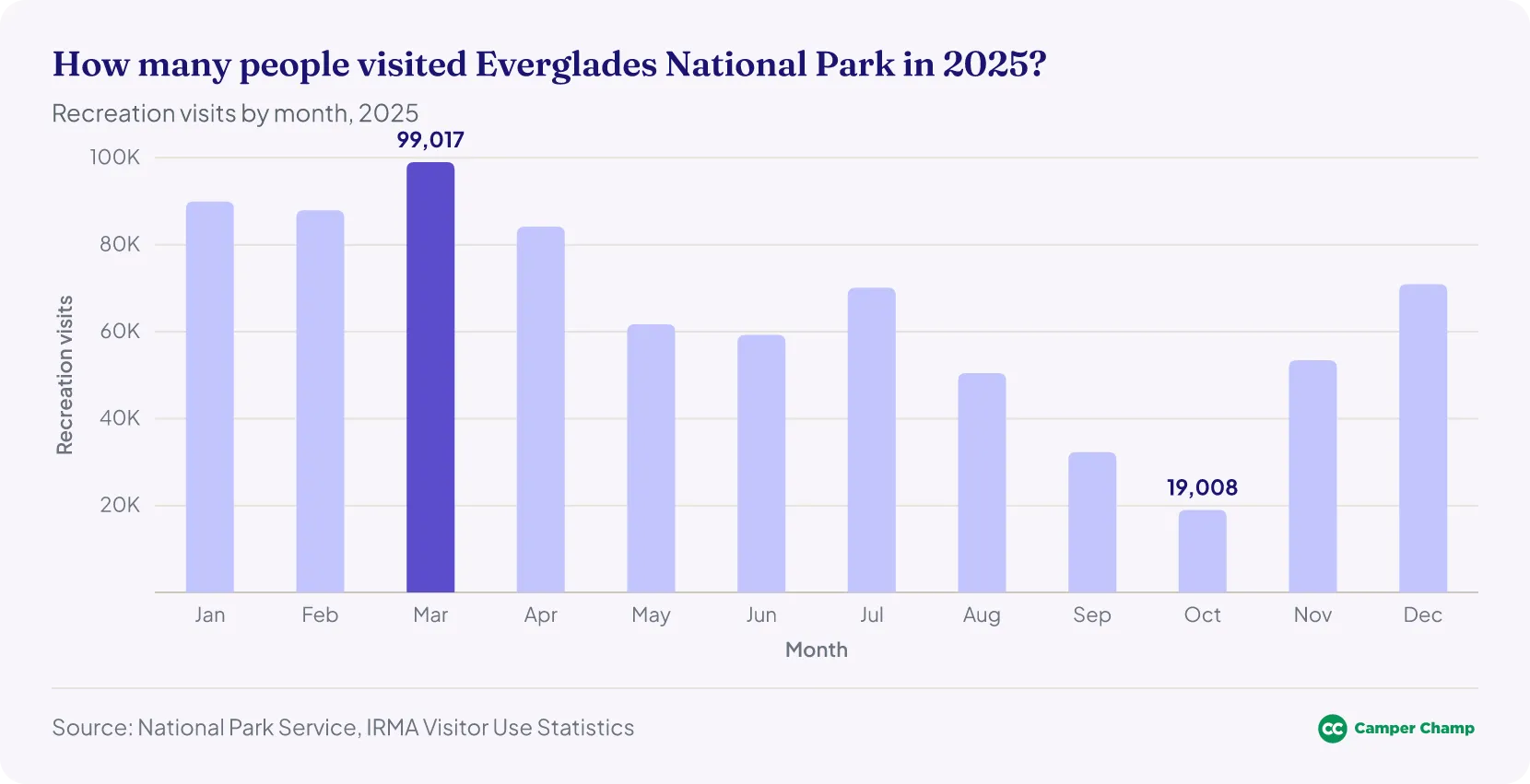
- March was the busiest month of 2025, with 99,017 visitors6
- 1.5 million acres across three South Florida counties7
How many people visit Everglades National Park each year?
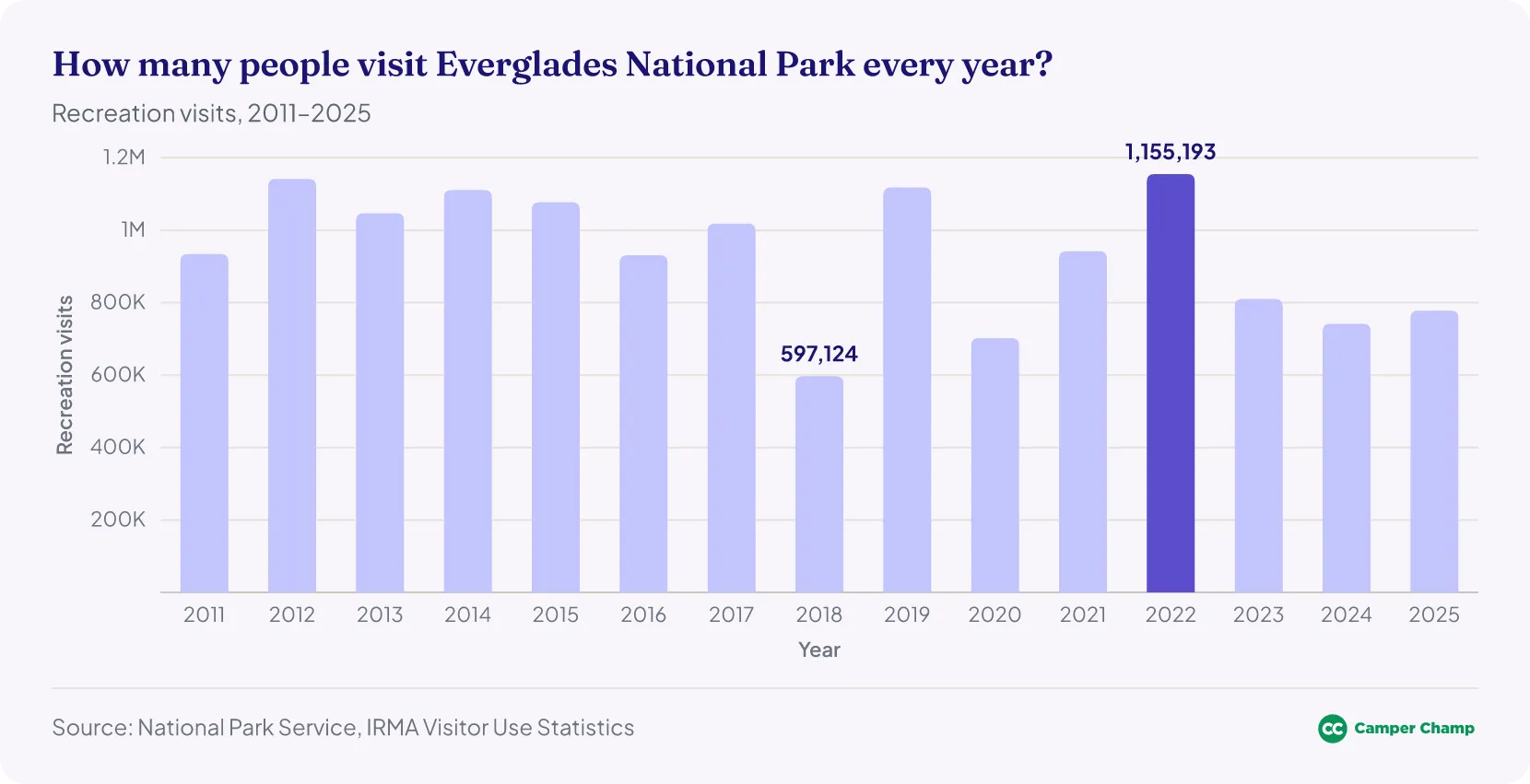
Everglades National Park recorded 778,198 recreation visits in 20251, along with 79,899 overnight camping stays.4
- In 2019, the park welcomed 1.12 million visitors.1 When the pandemic hit in 2020, the total fell by 37% to 702,319.
- Visits began to recover in 2021, reaching 942,130.1
- In 2022, visits climbed to 1.16 million, overtaking the 2019 total.1 They then fell by 30% to 810,189 in 2023 and dropped again to 741,983 in 2024.
- In 2025, visitor numbers rose by 5% to 778,198, still about 30% below the 2019 level.1
How many people have visited Everglades National Park in 2026?
Everglades National Park recorded 496,220 recreation visits from January to August 2026, 17.6% fewer than the 602,559 recorded over the same months of 20252.
- August 2026 brought 41,079 visits, down 18.6% from 50,464 in August 20252.
- Royal Palm logged 174,733 visits so far in 2026, down 21.8%, while Shark Valley recorded 128,092, down 12.5%2.
- Flamingo boat use was the exception, rising 12.2% to 29,068 visits2.
- The park's concessioner-run campgrounds recorded 43,508 overnight stays (14,929 at Long Pine Key and 28,579 at Flamingo), down from 52,290 over the same months of 20252.
The 2026 figures are preliminary; the National Park Service finalizes them by the end of the first quarter of the following year.
How much do visitors spend at Everglades National Park every year?
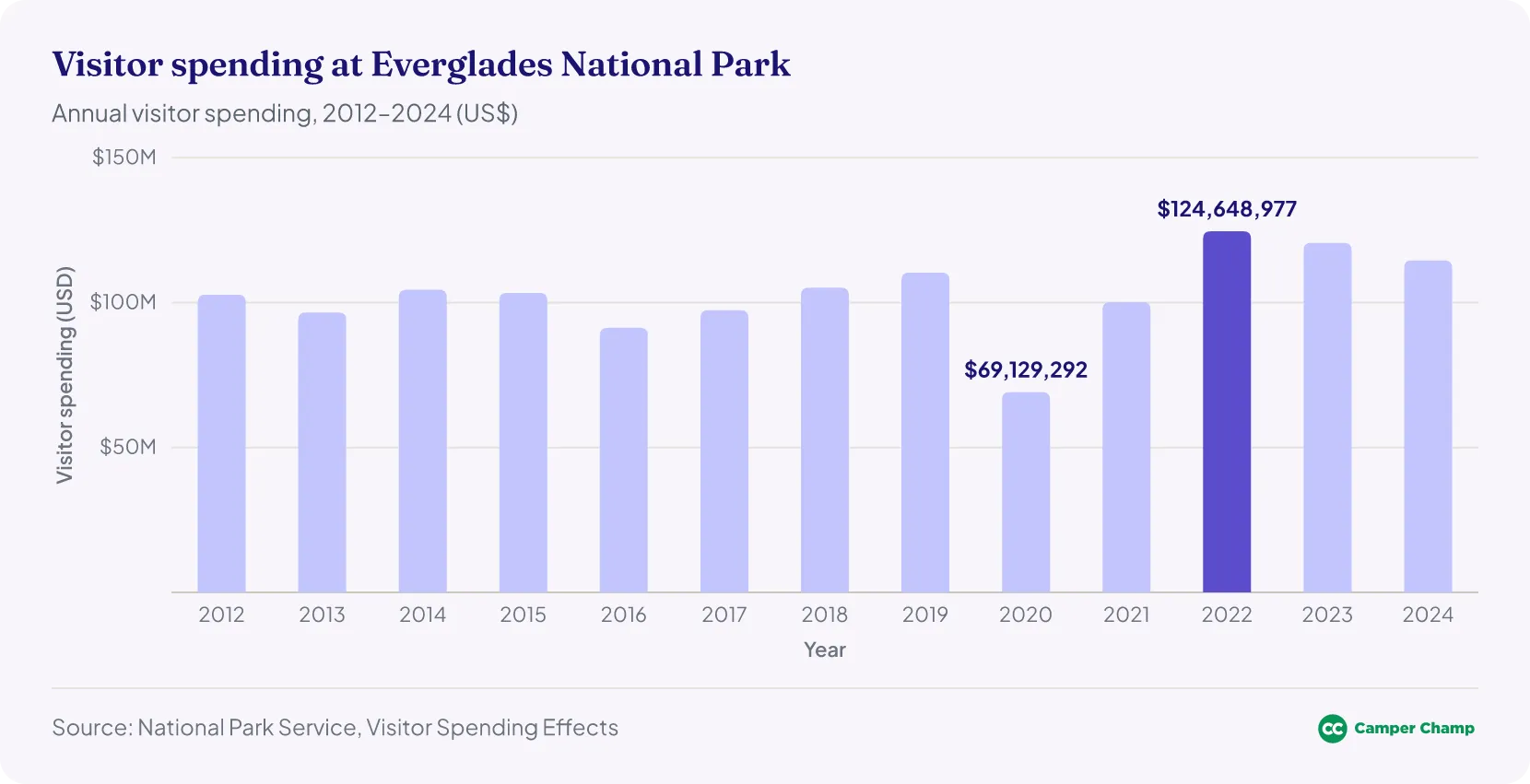
Visitors spent $114.60 million at Everglades National Park in 20248, about 4% above the 2019 pre-pandemic level.
- In 2019, visitors spent $110.37 million.5 In 2020, spending fell by 37% to $69.13 million.9
- Spending recovered to $100.21 million in 2021.5
- Spending hit $124.65 million in 202210, the highest since National Park Service spending records began in 2012. It then eased to $120.65 million in 2023 and $114.60 million in 2024.5
These are the latest figures available: the National Park Service has not yet published visitor spending for 2025.
What threats does Everglades National Park face?
Everglades National Park faces serious threats from climate change and from air pollution caused by industrial sources and emissions.11
- Sea-level rise: About 60% of the park lies less than 3 feet above mean sea level12. Park Service projections put sea-level rise in Florida Bay at 10 to 16 inches by 2050, and at 30 inches by 2100 in the median case, or up to 63 inches in the worst case13.
- Air pollution: Sugarcane burning in Florida, along with industrial emissions from nearby Miami, pollutes the park's air and harms its soil and water quality.11
- Pollutant deposition: Nitrogen compounds disrupt aquatic ecosystems and harm wildlife. Poor air quality, increasing wildfires, and rising sea levels pose serious threats to marshes and mangrove forests.11
- Climate change: Rising sea levels, increased rainfall, and stronger hurricanes raise the risk of saltwater intrusion, threatening drinking water, vegetation, and habitats dependent on the park’s unique freshwater-saltwater balance.11
What is being done to address these challenges?
- Efforts include updating industrial facilities to reduce pollution, monitoring air quality in nearby communities, and advocating for stronger climate science.11
- The National Parks Conservation Association (NPCA) leads advocacy in support of the Western Everglades Restoration Project, which would improve ecosystem connectivity and could lead to fewer, less severe wildfires. Congress authorized the project at $2.1 billion in the Water Resources Development Act of 2024.14 With partners, the NPCA is also advocating for a strong regional haze rule and better controls on sugarcane burning.11
- NPCA experts also support the Everglades Agricultural Area Reservoir, which will provide clean water to reduce wildfire frequency and improve wetland health in the park.11
How many Burmese pythons are in the Everglades?
More than 19,000 Burmese pythons have been removed from South Florida by Florida Fish and Wildlife Conservation Commission and South Florida Water Management District contractors since 201715.
- The 2026 Florida Python Challenge removed 280 pythons in 10 days15. The winner caught 96, all of them in Everglades National Park, and the longest python of the event, at 16 feet 5 inches, was also caught in the park.
- Pythons have hit the park's mammals hard: road surveys from 2003 to 2011 recorded a 99.3% drop in raccoon sightings, 98.9% for opossums and 87.5% for bobcats, and found no rabbits at all16.
There is no reliable count of how many pythons remain: they are so well camouflaged that the National Park Service says estimating their number is very difficult17.
How does Everglades rank among U.S. national parks?
Everglades is the most visited of Florida's three national parks, drawing more visitors in 2025 than Biscayne and Dry Tortugas combined.
- Everglades National Park – 778,198 visits in 2025 (31st of 63 national parks)3
- Biscayne National Park – 486,567 visits in 2025 (41st)3
- Dry Tortugas National Park – 89,355 visits in 2025 (56th)3
- In Travel Lemming's 2024 ranking of the best U.S. national parks, Everglades placed 9th and was the highest-scoring park in Florida, thanks mainly to its accessibility (ranked 5th) and relatively low crowds (ranked 11th)18.
- See the full ranking of U.S. national parks.
When is the best time to visit Everglades National Park?
- The dry season, typically December to April, is the best time to visit Everglades National Park: warm winters draw the widest variety of wading birds and their predators, while the May–November wet season is rainy and brings many mosquitoes.19
- The dry season is also the busiest time to visit, while September and October are the quietest months, with fewer than 33,000 visitors each in 2025.6
What were Everglades National Park’s peak tourist months in 2025?
These were the park's five busiest months in 2025, and what drew visitors in each:
- March was the busiest month, with 99,017 visitors6 as favorable weather and spring break drew families and vacationers outdoors.
- January welcomed 89,939 visitors6 as people took advantage of the dry season and mild winter weather.
- February had 87,926 visitors6, drawn by the cool, comfortable weather that makes hiking, wildlife viewing, and other outdoor activities much more enjoyable.
- In April, 84,148 visitors6 made the most of the last cool weather before the summer heat and rainy season set in.
- With the holiday season in full swing, December attracted 70,926 visitors6. Mild winter temperatures make the park a warm escape from colder places.
How many people visit Everglades National Park per day?
Everglades National Park averaged about 2,130 recreation visits a day in 2025, based on 778,198 visits over the year1. That is down from about 3,060 a day in 2019.
How many people camp in Everglades National Park?
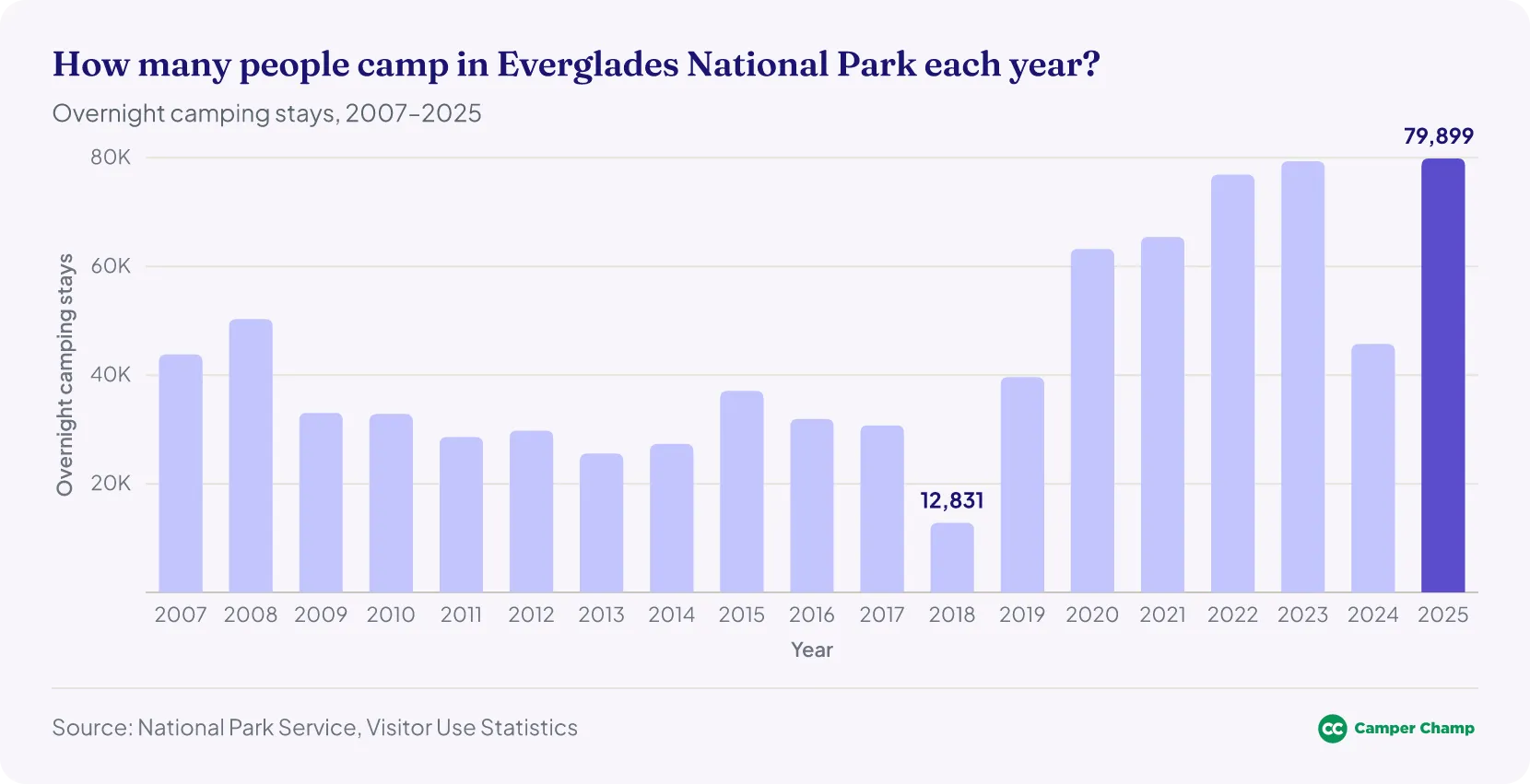
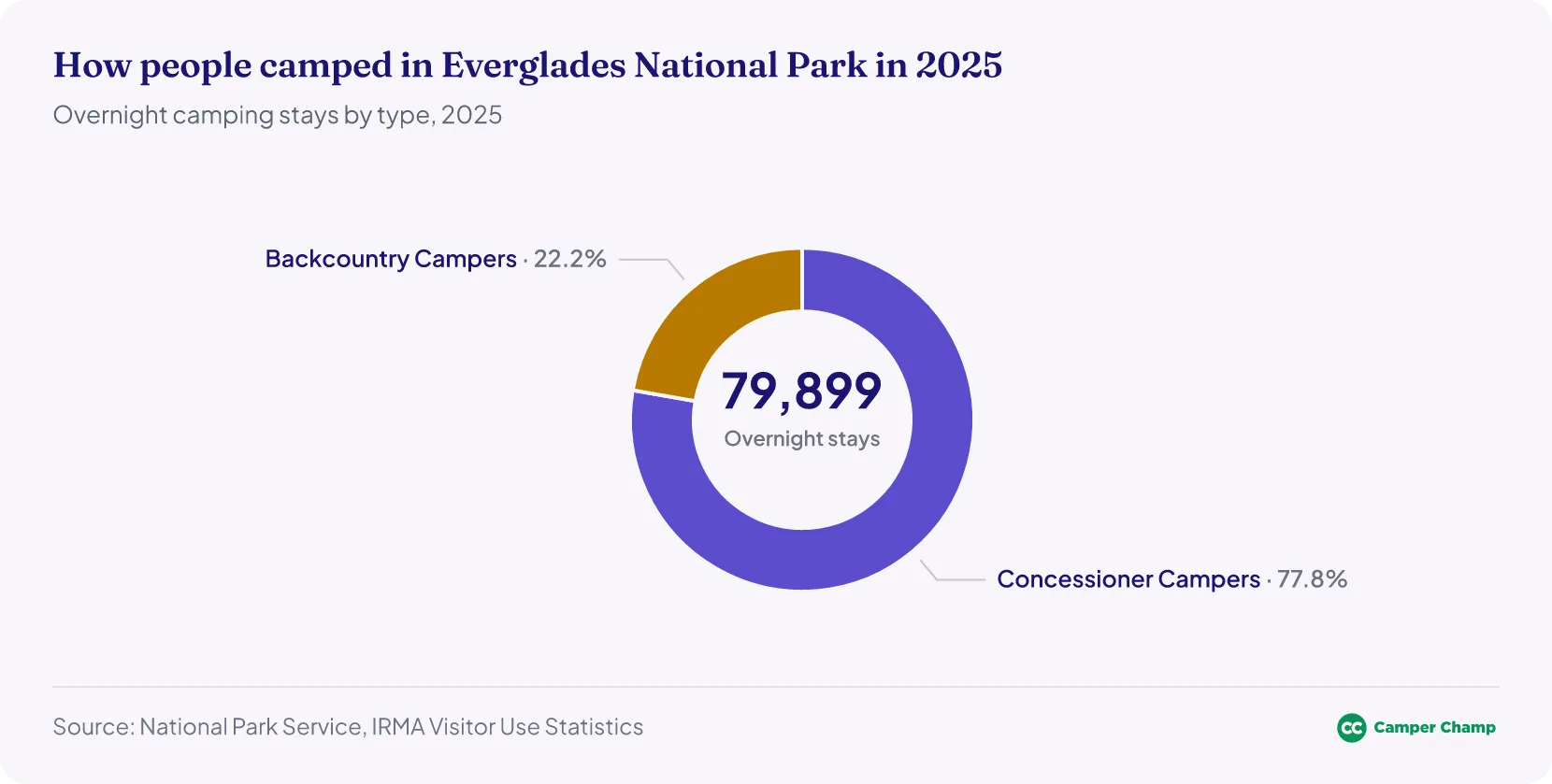
Everglades National Park recorded 79,899 overnight camping stays in 20254.
- Camping has grown sharply in recent years. Overnight camping stays doubled from 39,633 in 2019 to 79,899 in 2025, despite a dip to 45,744 in 20244.
- The 2025 total was the highest since 1990 (83,566 stays), but still well below the 118,749 recorded in 1979.4 The low point came in 2018, with just 12,831 overnight camping stays.
How do people camp in Everglades National Park?
Most people who camp in Everglades National Park stay at one of its two drive-in campgrounds. In 2025, about 78% of overnight camping stays (62,122 of 79,899) were in these concessioner-run campgrounds, and the other 17,777 were in the wilderness.4
- Drive-in campgrounds: Long Pine Key and Flamingo, both reached from the Homestead entrance, take tents and RVs and have a limited number of group sites. There are no other front-country campsites in the park.20
- Long Pine Key: Seven miles (11 km) from the main entrance, it allows RVs up to 35 feet and up to eight people and two vehicles per site.20 Its 2026–2027 season runs from November 1, 2026 to April 30, 2027.21
- Flamingo: Open year-round, with bathhouses, dump stations, picnic tables and grills. Its T-Loop has pull-through RV sites, some with electrical hookups. The Bayside campground is closed for the 2026 season.21
- Wilderness camping: Ground sites, beach sites and elevated platforms called chickees, most reached by canoe, kayak or motorboat. Every wilderness site needs a permit and is booked in advance on Recreation.gov.20
RV rental in the USA
- Miami RV rental
- Alaska RV rental
- Atlanta RV rental
- RV rental in Cincinnati
- Colorado RV rental
- RV rental in Florida
- RV rental in Los Angeles
- New York RV rental
- Phoenix RV rental
- RV rental in Pittsburgh
How big is Everglades National Park?
Everglades National Park covers 1.5 million acres of South Florida and spans three counties: Monroe, Miami-Dade and Collier7.
Everglades National Park facts: size, wildlife and status
- Everglades National Park is the largest continuous sawgrass prairie in North America and the largest mangrove ecosystem in the western hemisphere.22 It is also the most important breeding ground for tropical wading birds in North America.
- The park is South Florida's main water recharge area, feeding the Biscayne Aquifer, and is recognized as a World Heritage Site, Biosphere Reserve, and Wetland of International Importance.22
- Everglades National Park is home to 13 endangered species and 10 threatened species.22
- The park contains significant ethnographic resources and hosts a nationally important estuarine complex in Florida Bay22, making it a key site for both ecological and cultural preservation.
- As the only subtropical preserve on the North American continent22, the Everglades is an "edge" area where temperate species from the north meet subtropical species from the south.
How many people have died in Everglades National Park?
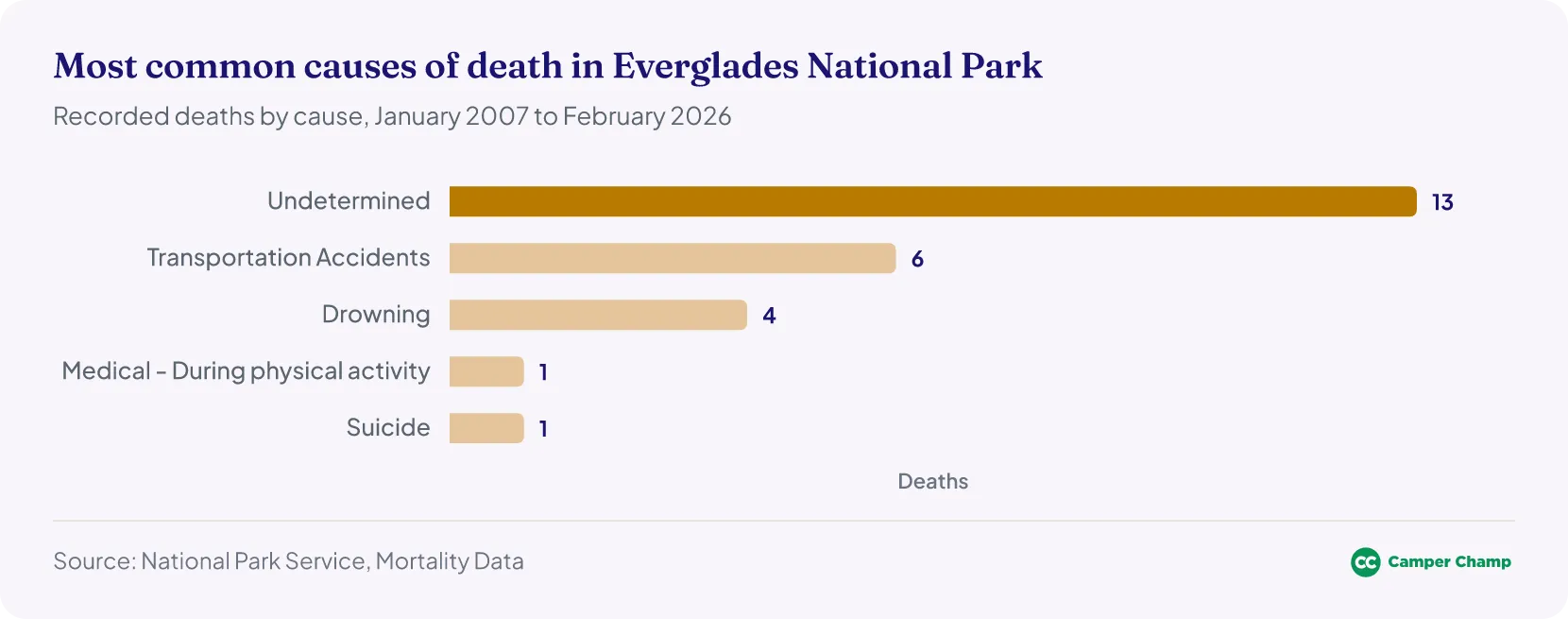
There were 25 recorded deaths in Everglades National Park from 2007 to February 2026.23 Here are the main causes of death in the park:
- Undetermined (13 deaths)23
- Transportation accidents (6 deaths)23
- Drowning (4 deaths)23
- Medical emergency during physical activity (1 death)23
- Suicide (1 death)23
Three of these deaths were recorded in January and February 2026, all with an undetermined cause.23 National Park Service figures from 2020 onward are provisional.
Is Everglades National Park dangerous?
Deaths in Everglades National Park are rare, as the figures above show, but the subtropical heat, open water, wildlife and mosquitoes all call for care. To stay safe and protect the park, follow these guidelines:
- Plan your trip: South Florida's dry and wet seasons are very different, so prepare for the conditions you will meet.
- Fitness and weather: Know your limits and watch the weather. Drink plenty of water and take breaks when you need them.
- Know the terrain: Learn the trails and terrain before you set out.
- Supervise children and pets: Always keep a close watch on small children and pets, as wildlife and challenging terrain can pose risks.
- Wildlife awareness: Do not feed wildlife, and be cautious of alligators, crocodiles, and poisonous plants in the park.
- Mosquito protection: South Florida's wetlands are home to many mosquitoes, so bring insect repellent and wear protective clothing.
- Vultures and vehicles: Vultures may damage vehicles by tearing rubber parts. To prevent damage, park in full sun, use a car cover, or cover exposed rubber with a wet sheet. If vultures approach, use loud noises to scare them away, but remember they are a protected species and cannot be harmed.24
Everglades National Park FAQs
How much does it cost to enter Everglades National Park?
A seven-day entrance pass costs $35 per private vehicle, $30 per motorcycle and $20 per person entering on foot or by bicycle.25 Non-US residents aged 16 and over pay an extra $100 per person on top of the standard pass.
Is Everglades National Park open 24 hours?
The main entrance in Homestead is open 24 hours a day, every day of the year.7 The Shark Valley entrance gate on the Tamiami Trail is open from 8:30 a.m. to 6:00 p.m. daily.
Can you stay overnight in Everglades National Park?
There is no lodging inside the park, but there are two campgrounds: Long Pine Key, with 108 drive-up sites for tents and RVs near the Homestead entrance, and Flamingo, with 234 drive-up sites, 41 of them with electric hookups.7 Wilderness camping needs a permit.
How close can you get to alligators in the Everglades?
Stay at least 15 feet away from alligators and crocodiles. If an animal is hissing, you are too close. They are most active at night, doing most of their hunting between dusk and dawn.24
Other Resources
- Badlands National Park Tourism Statistics
- Big Bend National Park Tourism Statistics
- Biscayne National Park Tourism Statistics
- Grand Teton National Park Tourism Statistics
- Great Smoky Mountains National Park Tourism Statistics
- US National Parks Ranking
- Olympic National Park Tourism Statistics
- Rocky Mountain National Park Tourism Statistics
- US National Parks Statistics
- Hawai’i Volcanoes National Park Tourism Statistics
- Voyageurs National Park Tourism Statistics
- Yosemite National Park Tourism Statistics
References
- NPS Visitor Use Statistics — Annual Park Recreation Visitation (1904 - Last Calendar Year), Everglades NP · irma.nps.gov ↑ b c d e f g
- NPS Visitor Use Statistics — Park YTD Version 1, Everglades NP · irma.nps.gov ↑ b c d e f
- Most Visited National Parks in 2025 — Ranked by Visitation · publiclandsdata.com ↑ b c d
- NPS Visitor Use Statistics — Overnight Stays (1979 - Last Calendar Year), Everglades NP · irma.nps.gov ↑ b c d e f
- NPS Visitor Spending Effects — park results for Everglades NP (visitor spending by sector and by year, VSE data API behind the NPS VSE interactive tool) · irmaservices.nps.gov ↑ b c d
- NPS Visitor Use Statistics — Recreation Visitors By Month (1979 - Last Calendar Year), Everglades NP · irma.nps.gov ↑ b c d e f g h i j
- Frequently Asked Questions — Everglades National Park (NPS) · nps.gov ↑ b c d
- 2024 National Park Visitor Spending Effects: Economic Contributions to Local Communities, States, and the Nation (NPS Visitor Spending Effects report series) · nps.gov ↑
- 2020 National Park Visitor Spending Effects: Economic Contributions to Local Communities, States, and the Nation · nps.gov ↑
- 2022 National Park Visitor Spending Effects: Economic Contributions to Local Communities, States, and the Nation · nps.gov ↑
- Case Study: Everglades National Park (Air & Climate Report) — National Parks Conservation Association · npca.org ↑ b c d e f g
- Superintendent's climate change testimony — Everglades National Park (NPS) · nps.gov ↑
- Sea-level rise and inundation scenarios for national parks in South Florida (NPS Park Science 33(1), 2017) · nps.gov ↑
- Recent Developments in Everglades Restoration (CRS In Focus IF11336) · congress.gov ↑
- Results of the 2026 Florida Python Challenge (South Florida Water Management District) · sfwmd.gov ↑ b
- Severe mammal declines coincide with proliferation of invasive Burmese pythons in Everglades National Park (Dorcas et al., PNAS 2012) · pubs.usgs.gov ↑
- Burmese Python — Everglades National Park (NPS) · nps.gov ↑
- Travel Lemming Ranks Everglades National Park 9th Best in the U.S. · wqcs.org ↑
- Basic Information — Everglades National Park (NPS) · nps.gov ↑
- Camping — Everglades National Park (NPS) · nps.gov ↑ b c
- Campgrounds — Flamingo Adventures (Everglades Guest Services) · flamingoeverglades.com ↑ b
- Everglades National Park Quick Facts (Park Significance) — National Park Service · nps.gov ↑ b c d e
- NPS Mortality Data, CY2007 onward (Prevention and Response Branch FOIA release) · nps.gov ↑ b c d e f g
- Safety — Everglades National Park (NPS) · nps.gov ↑ b
- Entrance Fees — Everglades National Park (NPS) · nps.gov ↑
- NPS: Facts and Figures – Visitations, Spending, Ranking, and Park Reports · nps.gov