

Updated
U.S. wildlife ranges from large mammals such as bears and deer to rare birds and reptiles. With 64 national parks1 and more than 570 wildlife refuges2, the country gives that wildlife a lot of protected habitat.
At a Glance
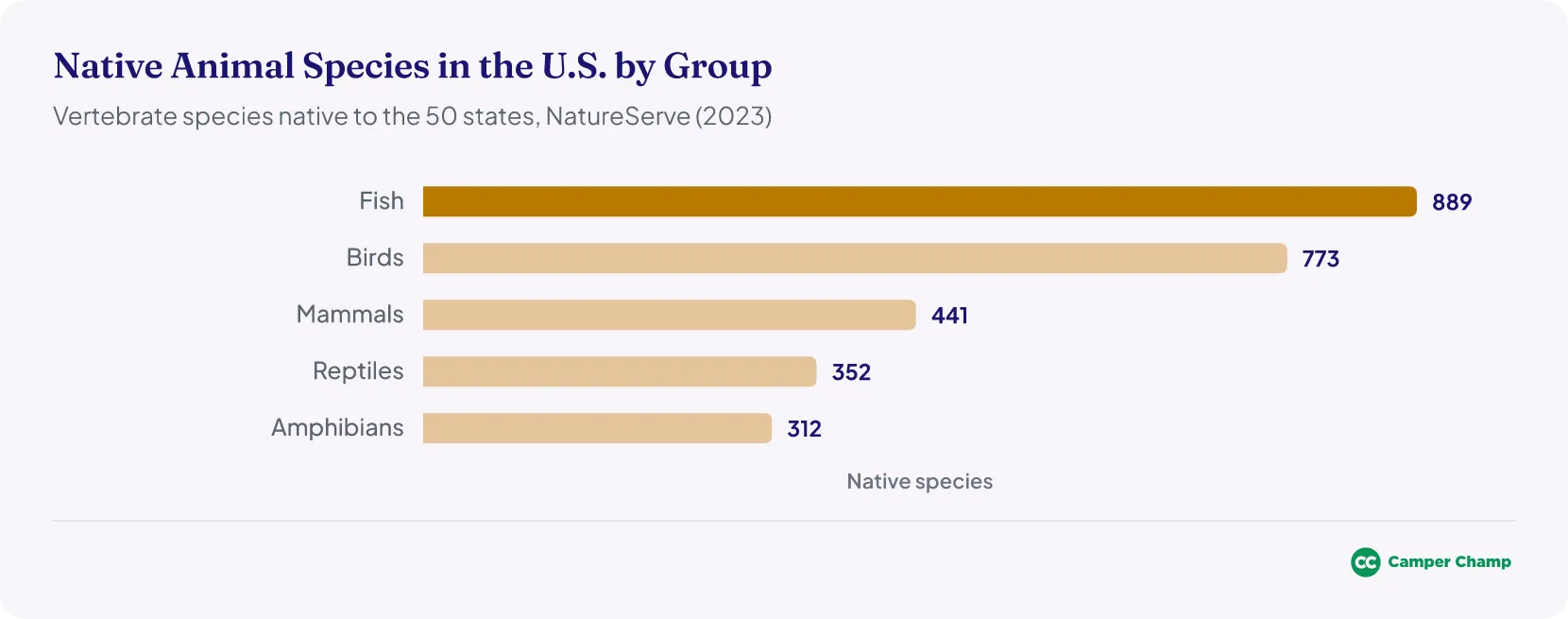
- The U.S. has 10,914 native animal species in the groups NatureServe has fully assessed, including 773 birds and 441 mammals.3
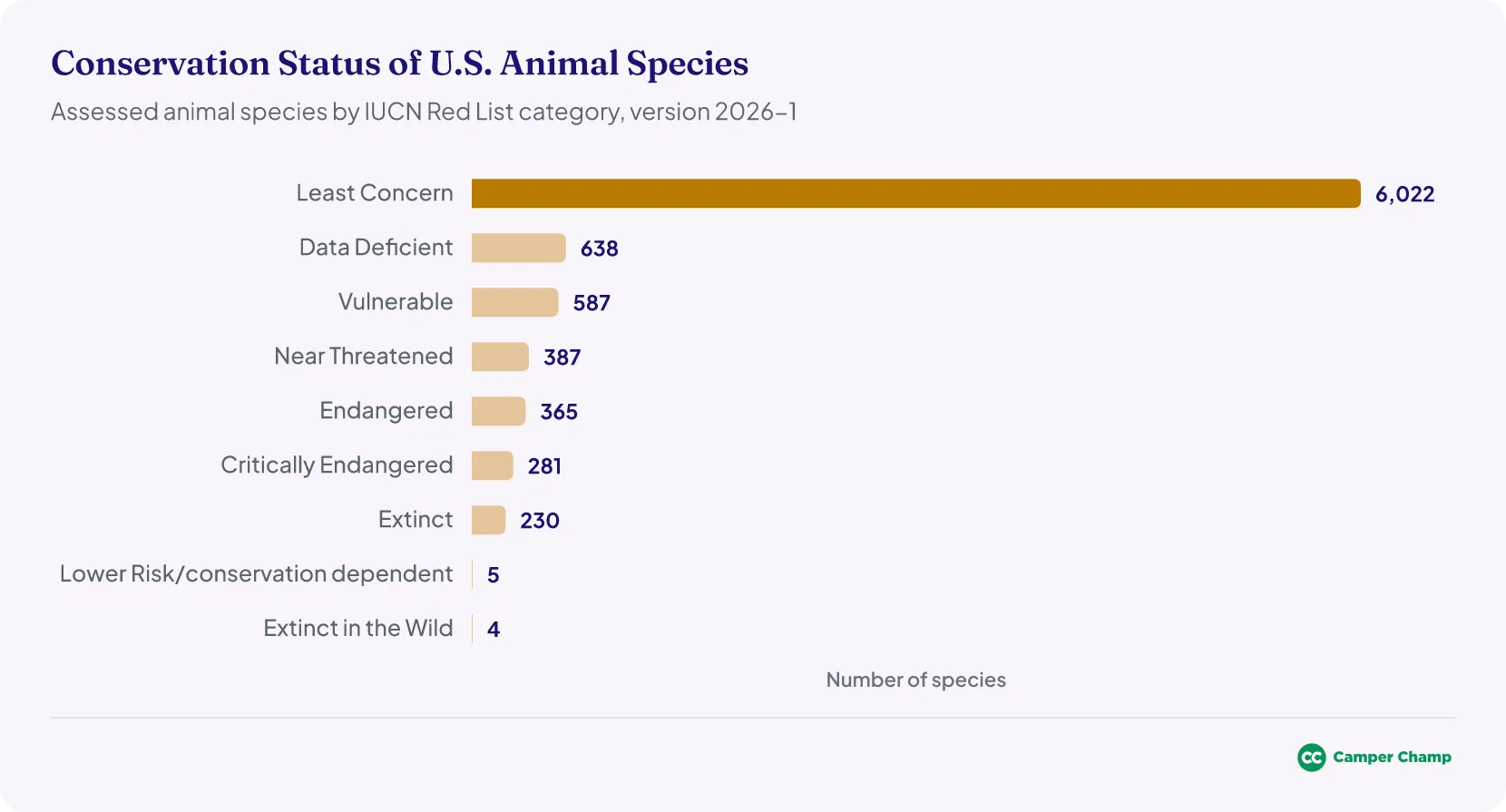
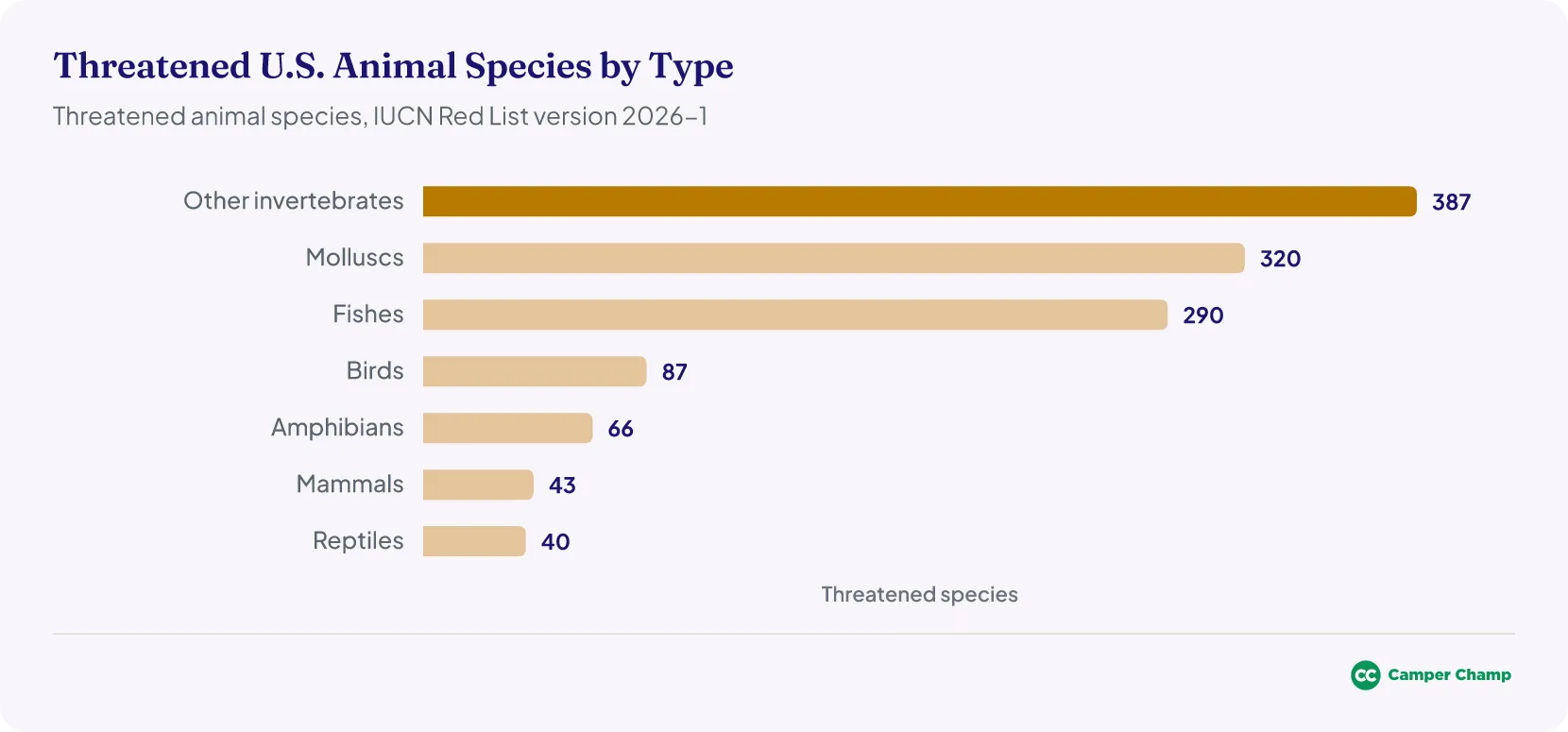
- 1,233 U.S. animal species are threatened on the IUCN Red List4, and 230 have gone extinct.5
- 743 U.S. animal listings are protected under the Endangered Species Act.6
- Hunters took 6.2 million deer in the 2024–25 season.7
- About 200 people a year die in animal encounters, most often involving horses and cattle; bees, wasps and hornets account for about 60 of those deaths.8
How Many Animal Species Are There in the U.S.?
NatureServe counts 10,914 native U.S. animal species in the groups it has fully assessed, from mammals, birds and fish to snails, bees and freshwater mussels.3
What Are the Most Common Wild Animals in the U.S.?
- White-tailed Deer: Roughly 30–35 million across North America.9
- American Robin: About 366 million breeding birds across North America, making it the continent's most numerous landbird.10
- American Alligator: Once endangered, now nearly 5 million across the southeastern U.S.11
- Mourning Dove: One of the most hunted birds, with about 15.5 million harvested in the 2025–26 season.12
Wildlife Conservation and Threats
How Many Species Have Gone Extinct in the U.S.?
- The IUCN Red List records 230 animal species as extinct in the United States.5
- In 2023, the U.S. Fish and Wildlife Service officially declared 21 species extinct, including Bachman's warbler and eight freshwater mussels; the ivory-billed woodpecker was left off the final list while its status is reviewed.13
- Habitat loss, climate change and invasive species are still among the main causes of extinction.
How Many Animals Are Threatened With Extinction in the U.S.?
The IUCN Red List rates 1,233 U.S. animal species as threatened.4
How Many Endangered Species Are in the U.S.?
There are 743 U.S. animal listings under the Endangered Species Act: 495 endangered and 248 threatened.6
- Fish have the most listings (167), followed by mammals (99), clams and mussels (96), insects (94) and birds (90).6
- Snails (53), reptiles (51), amphibians (43) and crustaceans (32) make up most of the rest.6
- Some animals are counted more than once because separate populations are listed on their own, including the gray wolf, the piping plover, the loggerhead sea turtle and Chinook salmon.6
- With plants included, there are 1,680 U.S. listings in total.6
These are the federal government's legal listings. The IUCN Red List figures above are a separate scientific assessment, which is why the two counts differ.
How Many Animals Are Hunted Each Year in the U.S.?
Poaching and Illegal Wildlife Trade
Poaching and Wildlife Crime Cases Each Year
Poaching is the illegal killing or capturing of wild animals. The U.S. Fish and Wildlife Service (FWS) pursues roughly 10,000 wildlife crime investigations a year, from poaching to trafficking.
- FWS reported more than 21,000 wildlife crime investigations across 2013 and 2014.15
- The caseload was 10,350 in fiscal year 201616 and fell to just under 9,900 in 2019.17
Note: 2019 is the latest year available. FWS has not published a newer annual caseload, and its counts cover all wildlife crime, not just poaching.
Which Animals Do Poachers Target in the U.S.?
No agency ranks poached species nationally, but U.S. Fish and Wildlife Service cases show the main targets:
- Big game: white-tailed and mule deer, elk, moose, caribou and Dall sheep.16
- Bears: grizzly bears are illegally killed16, and black bear gallbladders are smuggled for the illegal trade.15
- Birds: bald and golden eagles, whooping cranes and waterfowl.16
- Fish: paddlefish, harvested illegally for their caviar15, and young American eels (elvers).16
- Reptiles: freshwater turtles, including native turtles trafficked under false labels.17
Best Places to See Wildlife in the U.S.
- Yellowstone National Park: Home to bison, wolves, elk and bears.
- Everglades National Park: Known for its birdlife, alligators and panthers.
- Great Smoky Mountains: Home to 70 mammal species18 and more than 240 bird species.19
What Wildlife Can You See in U.S. National Parks?
- Denali National Park: The "big five" are moose, caribou, Dall sheep, wolves and grizzly bears, among 39 mammal species.20
- Grand Teton National Park: Bison, moose, black bears, coyotes, ospreys, golden eagles and yellow-bellied marmots.21
- Rocky Mountain National Park: Elk, bighorn sheep, mule deer, moose, marmots and pikas, among 67 native mammal species.22
- Olympic National Park: Elk, deer, cougars and bears on land, with whales, sea lions and sea otters offshore. The Olympic marmot lives nowhere else in the world.23
- Acadia National Park: One of the country's top bird-watching spots, with 338 bird species recorded, including peregrine falcons, eagles and loons.24
- Big Bend National Park: More than 450 bird species, 75 mammal species and 56 reptile species, including black bears and javelinas.25
- Voyageurs National Park: More than 50 mammal species, such as bobcats, and more than 100 bird species, including loons.26
Where to Start an RV Trip to These National Parks
An RV lets you move between parks at your own pace and stay close to the wildlife. These cities are good starting points for each park:
- Denali: pick up an RV in Anchorage, or plan a one-way trip from Fairbanks to Anchorage.
- Grand Teton and Yellowstone: start from Salt Lake City.
- Rocky Mountain: start from Denver.
- Olympic: start from Seattle.
- Acadia: start from Boston.
- Voyageurs: start from Minneapolis.
- Great Smoky Mountains: start from Nashville or Atlanta.
- Everglades: start from Miami.
- Big Bend: start from Austin.
For more on how Americans camp, see our RV camping statistics.
RV rental in the USA
- RV rental in Albuquerque
- RV rental in Austin
- RV rental in Chicago
- Colorado RV rental
- Denver RV rental
- RV rental in Los Angeles
- Miami RV rental
- RV rental in New York
- RV rental in Phoenix
- RV rental in Salt Lake City
How Many Zoos and Aquariums Are There in the U.S.?
The U.S. has 229 zoos, aquariums and related facilities accredited by the Association of Zoos and Aquariums (AZA), spread across 47 states and the District of Columbia.27
- AZA-accredited zoos and aquariums welcomed more than 209 million visitors worldwide in 2024.27
How Many People Die in Animal Encounters in the U.S.?
- About 200 people die in animal encounters each year.
- CDC mortality data for 2008–2015 recorded 1,610 deaths, a median of 201 a year (range 186–216).8
What Are the Deadliest Animals in the U.S.?
Average deaths a year in 2008–2015, from CDC mortality data:8
- Other mammals, mostly horses and cattle: 72 deaths/year, the largest group (farm incidents, kicks and trampling).
- Bees, wasps and hornets: 60 deaths/year, the largest venomous cause.
- Dogs: 34 deaths/year.
- Other venomous arthropods: 11 deaths/year.
- Venomous snakes and lizards: 6 deaths/year, with rattlesnakes the deadliest.
- Venomous spiders: 6 deaths/year (black widows and brown recluses).
- Marine animals (including sharks): 2 deaths/year.
- Bears: fatal attacks are rare; CDC data does not count them separately.
- Alligators and crocodiles: 1 death in the entire 2008–2015 period.
FAQs
Why do the IUCN Red List and the Endangered Species Act give different numbers?
They measure different things. The IUCN Red List is a global scientific assessment and counts 1,233 threatened animal species in the U.S.4 The Endangered Species Act list is the federal government's legal list, with 743 U.S. animal listings6, and some species appear on it more than once because separate populations are listed on their own.
Are bees more dangerous than snakes in the U.S.?
Yes. CDC mortality data for 2008–2015 averages 60 deaths a year from bees, wasps and hornets, against 6 a year from venomous snakes and lizards.8
More National Park Statistics
- Acadia National Park Tourism Statistics
- Big Bend National Park Tourism Statistics
- Biscayne National Park Tourism Statistics
- Denali National Park Tourism Statistics
- Grand Teton National Park Tourism Statistics
- Great Smoky Mountains National Park Tourism Statistics
- Joshua Tree National Park Tourism Statistics
- US National Parks Ranking
- Olympic National Park Tourism Statistics
- US National Parks Statistics
- Voyageurs National Park Tourism Statistics
- Yosemite National Park Tourism Statistics
References
- National Park System — units by designation · nps.gov ↑ b
- National Wildlife Refuge System · fws.gov ↑ b
- Biodiversity in Focus: United States Edition (NatureServe, 2023) · natureserve.org ↑ b c d
- IUCN Red List Summary Statistics — Table 5: Threatened species in each country (totals by taxonomic group), version 2026-1 · nc.iucnredlist.org ↑ b c d e
- IUCN Red List Summary Statistics — Table 6a: Red List Category summary country totals (Animals), version 2026-1 · nc.iucnredlist.org ↑ b
- Listed Species Summary (Boxscore) — ECOS Environmental Conservation Online System · ecos.fws.gov ↑ b c d e f g
- Deer Report: Doe Harvest Jumps, Mature Buck Harvest Sets Another Record (Deer Report 2026, 2024–25 season) · deerassociation.com ↑ b c
- An Update on Fatalities Due to Venomous and Nonvenomous Animals in the United States (2008–2015) — Forrester, Weiser & Forrester, Wilderness & Environmental Medicine 29(1), 2018 · journals.sagepub.com ↑ b c d e
- How Many White-Tailed Deer Are There in North America? · deerassociation.com ↑ b
- Partners in Flight Population Estimates Database · pif.birdconservancy.org ↑
- Celebrating the American Alligator · fws.gov ↑ b
- Mourning Dove Population Status, 2026 · fws.gov ↑
- 21 Species Delisted from the Endangered Species Act due to Extinction · fws.gov ↑
- Migratory Bird Hunting Activity and Harvest During the 2025–26 Hunting Seasons · fws.gov ↑
- Office of Law Enforcement Annual Report FY2013–FY2014 · fws.gov ↑ b c
- Office of Law Enforcement Annual Report FY2016 · fws.gov ↑ b c d e
- Office of Law Enforcement Annual Report 2019 · fws.gov ↑ b
- Mammals — Great Smoky Mountains National Park · nps.gov ↑
- Birds — Great Smoky Mountains National Park · nps.gov ↑ b
- Mammals — Denali National Park & Preserve · nps.gov ↑
- Animals — Grand Teton National Park · nps.gov ↑
- Mammals — Rocky Mountain National Park · nps.gov ↑
- Animals — Olympic National Park · nps.gov ↑
- Animals — Acadia National Park · nps.gov ↑ b
- Animals — Big Bend National Park · nps.gov ↑ b
- Animals — Voyageurs National Park · nps.gov ↑
- Zoo and Aquarium Statistics · aza.org ↑ b
- FWS — Grizzly Population Trends and Fatal Attack Records · fws.gov
- U.S. Wildlife Population Statistics · WWF
- CDC — Fatality Rates and Historical Animal Attack Causes · cdc.gov
- USGS — Bear Species Attack Data and Wildlife Conflict Tracking · usgs.gov
- Endangered and Extinct Species in the US · iucnredlist.org