

Published
How popular is mountain biking in the United States?
Bicycling, including mountain biking, consistently ranks among the top outdoor recreational activities in the United States, with approximately 53 million Americans participating in 2024 in the overall bicycling category.
- Bicycling, including mountain biking, is the fifth most popular outdoor activity in the U.S., behind hiking, fishing, running/trail running, and camping but ahead of activities like snow sports and hunting.
- Mountain biking participation increased by 15% between 2014 and 2023, growing from approximately 8 million–9.2 million participants.
| 2024 Most Popular Outdoor Activities in the United States | ||
|---|---|---|
| Rank | Activity | Estimated Participants (millions) |
| 1 | Hiking (Day) | 60 |
| 2 | Fishing (All Types) | 55 |
| 3 | Running/Trail Running | 54 |
| 4 | Camping (All Types) | 54 |
| 5 | Bicycling (Road/MTB/BMX) | 53 |
| 6 | Wildlife Viewing/Birdwatching | 52 |
| 7 | Swimming (Natural Waters) | 50 |
| 8 | Kayaking | 20 |
| 9 | Skiing/Snowboarding | 18 |
| 10 | Hunting | 15 |
How many people participate in mountain biking in the U.S. annually?
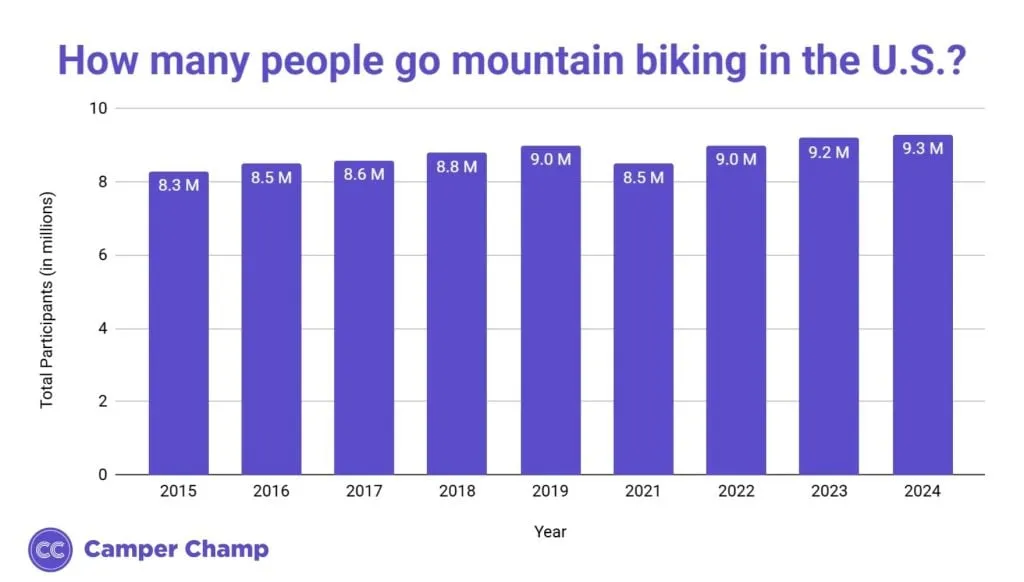
Around 9 million people participate in mountain biking in the U.S. each year.
- Approximately 8 million Americans participated in mountain biking in 2014.
- Participation increased to 8.3 million in 2015 and 8.6 million by 2017.
- The number of mountain bikers peaked at approximately 9 million in 2019, before the pandemic.
- After a slight decline to 8.5 million in 2021 (post-COVID adjustment), numbers recovered to 9.2 million in 2023.
- Approximately 9.3 million Americans participated in mountain biking in 2024.
How does mountain biking compare to dirt biking in popularity and participation?
Mountain biking (human-powered off-road cycling) attracts a similar number of participants as dirt biking (motorized off-road motorcycling), and both activities have shown growth over the past decade.
- In 2024, around 9.3 million individuals participated in mountain biking across the United States, while dirt biking recorded approximately 9.5 million participants, representing a 2% higher engagement rate compared to mountain biking.
- Both activities saw pandemic-related participation boosts in 2020, with dirt biking sales jumping 50% in early 2020.
- Mountain biking participation increased by about 15% from 2014-2023, while dirt biking grew by approximately 35% during the same period.
- Participation in both mountain biking and dirt biking is projected to continue growing in 2025 and beyond.
How much do Americans spend on mountain biking each year?
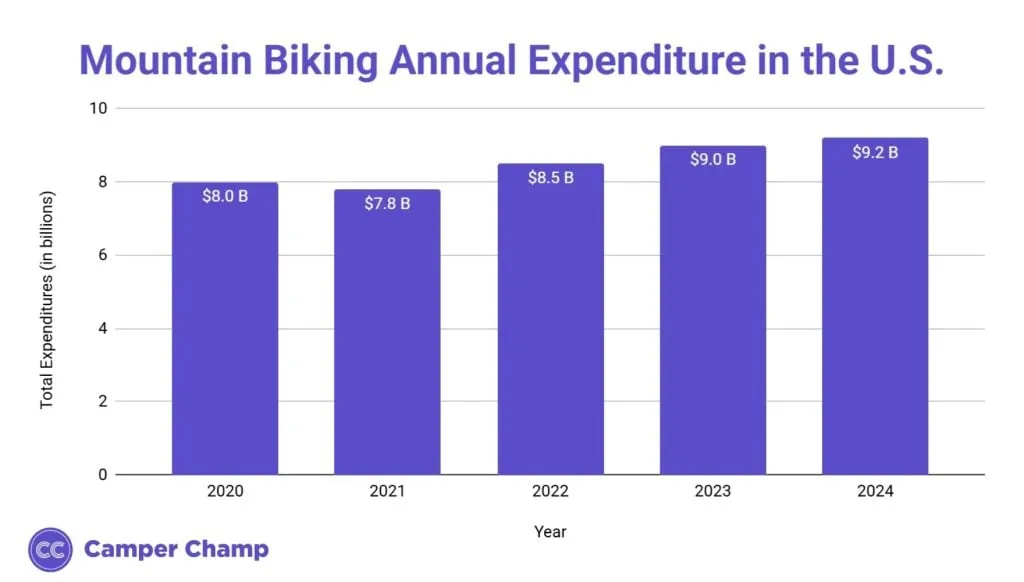
Americans spend approximately $8 billion annually on mountain biking through equipment purchases, travel expenses, events, and tourism, creating significant economic impact across the country.
- Separately, according to a 2017 Outdoor Industry Association report, Americans spend approximately $97 billion per year on “wheeled sports,” primarily cycling (including mountain biking).
- This overall wheeled sports expenditure breaks down to roughly $14 billion on gear (bikes, parts, apparel) and $83 billion on trips (travel, tourism, transportation).
What is the average spending on mountain biking in the U.S.?
Avid mountain biking participants can spend over $5,000 annually on bicycles and related gear.
- A new mountain bike costs between $750-$2,500 on average, with mid-range bikes in the $1,000-$1,200 range. High-end models easily exceed $5,000.
- Initial setup costs beyond the bike itself often reach several hundred dollars, including:
- Helmet: $50-$150
- Protective gear: $50-$200
- Shoes: $100+
- Apparel, tools, and hydration packs: $200+
- Annual maintenance costs typically run hundreds of dollars for serious riders due to replacement parts (tires at $50-$100 each, brake pads, drivetrain components) and regular service.
- Event participation and access fees add further expenses:
- Race entry fees: $50-$150
- Bike park season passes: $300-$400
- Day tickets: $40-$60
How much do professional mountain bikers make in the U.S.?
Over half of professional mountain bikers earn less than $20,000 per year from the sport.
- Only a small percentage of pros make six-figure incomes.
- The highest-paid U.S. mountain biking athletes (mostly domestic downhill or enduro stars) earn around $500,000 annually in salary and endorsements, far less than top road cyclists or mainstream sports athletes.
- Professional mountain biking salaries remain relatively modest even as the sport grows in popularity and economic impact.
Which U.S. states have the highest number of mountain biking participants?
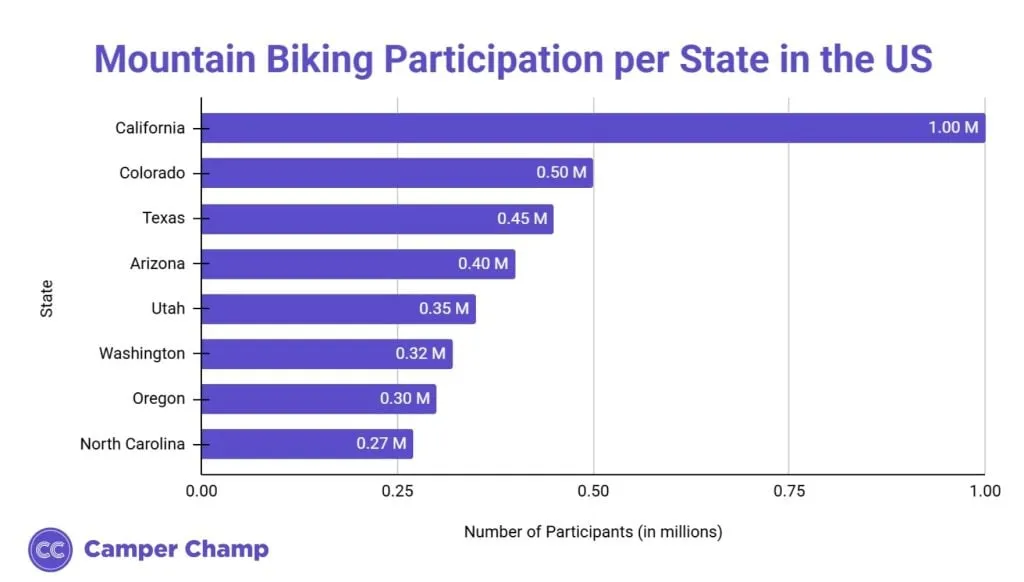
California has the largest number of mountain biking participants, with over 1 million mountain bikers, benefiting from its large population and world-class riding areas from Marin County to SoCal bike parks.
- Colorado ranks second with an estimated 500,000 participants, often considered the home base for American mountain biking with approximately 15% of Coloradans biking outdoors.
- Texas has over 450,000 mountain bikers, leveraging its large population and growing trail networks, particularly in the Hill Country and Austin area.
- Arizona follows with approximately 400,000 participants, offering year-round riding opportunities in destinations like Sedona and Phoenix.
- Utah has about 350,000 mountain bikers, with world-renowned destinations like Moab and Park City attracting riders from across the country.
- Other states with significant participation include Washington (325,000), Oregon (300,000), North Carolina (275,000), Michigan (250,000), and Pennsylvania (250,000).
What are the top states for mountain biking based on trails and ridership?
When ranking states by trail quality, density, and ridership per capita (rather than total numbers), a different picture emerges highlighting mountain biking hotspots.
- Colorado and Utah are consistently ranked as the top two states for trail quality, offering endless high-caliber trails, bike parks, and strong community support in areas like Fruita, CO and Moab, UT.
- Oregon and Washington are renowned for the Pacific Northwest’s loamy trails and technical features, with Bend, OR and Bellingham, WA serving as rider magnets.
- Vermont, despite its small size, has an outsized impact with the Kingdom Trails drawing approximately 94,000 visitors annually.
- Arkansas has emerged as a rising star with Northwest Arkansas (Bentonville) building dozens of miles of premier trails, earning IMBA “gold-level ride center” status and attracting 90,000+ MTB tourists per year.
Demographics of Mountain Bikers in the U.S
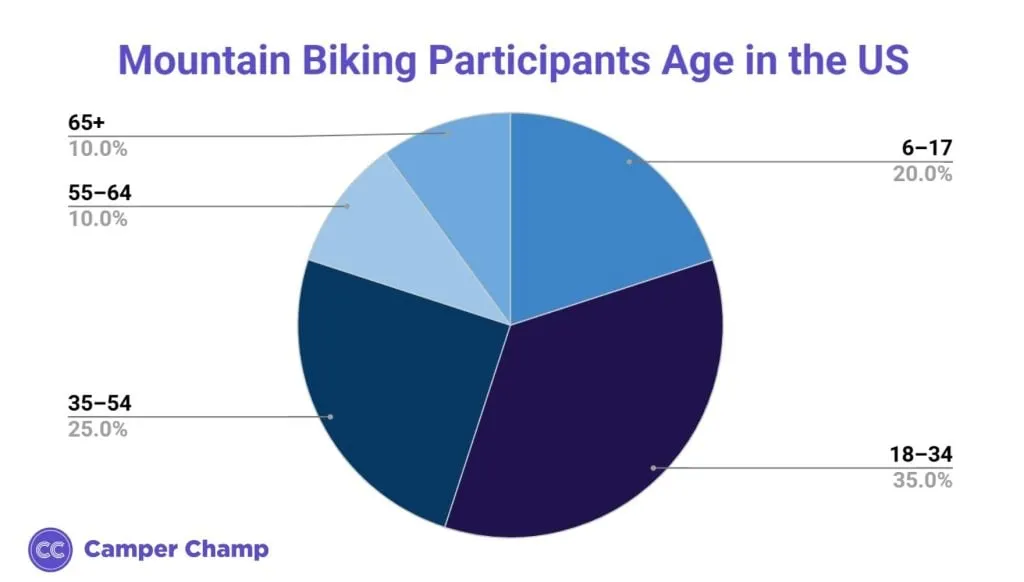
Age Distribution (2024):
Young Adults aged 18-34 account for approximately 35% of mountain biking participants, representing the core MTB demographic
- Adults ages 35-54 represent approximately 25% of participants, many with disposable income for expensive bikes and travel.
- Youth (6-17) represent approximately 20% of participants.
- Older Adults (55-64) and Seniors (65+) both account for approximately 10% of participants.
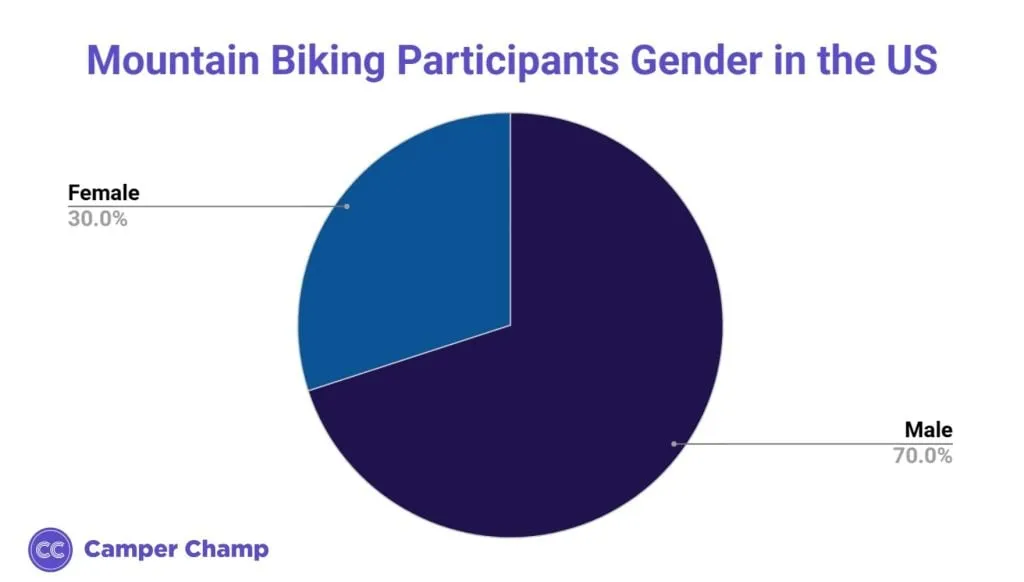
Gender Distribution (2024):
Men comprise approximately 70% of mountain bikers.
- Women make up approximately 30% of participants, with female participation rising.
Other Resources
What are the best mountain biking trails in the U.S.?
The United States offers world-class mountain biking destinations across diverse landscapes from desert to mountains to forests.
The following trails consistently rank among the most acclaimed in the country:
- Western Rim Trail (Fruita, Colorado): A flowing singletrack along high desert rims with stunning views of the Colorado River, attracting approximately 25,000+ riders annually.
- Bomb Dog (Anniston, Alabama): A standout downhill run in Coldwater Mountain (an IMBA Silver-level Ride Center) with over 10,000 riders visiting annually.
- Lower Whoops (Bend, Oregon): A machine-built flow trail of endless berms and jumps in Deschutes National Forest, part of a network logging over 300,000 trail visits annually.
- Spencer Branch/Trace Ridge (Asheville, North Carolina): A quintessential Blue Ridge Mountain trail with a mix of climbs, fast flow, and technical features, seeing an estimated 5,000-10,000 riders per year.
- “Rodeo” Trail (Moab, Utah): Part of the Horsethief Trails near Moab, drawing from the hundreds of thousands of mountain bikers who visit Moab annually.
What are the top-rated mountain biking destinations for winter riding in the U.S.?
- Sedona, Arizona: Arguably the #1 winter riding destination in the U.S., offering sublime red rock trails in cooler months with sunny days around 50°F, perfect for rides like Hiline or Hangover trails.
- Grand Junction & Fruita, Colorado: These high desert towns typically have rideable conditions all winter with only occasional snow, featuring legendary trails like 18 Road and Lunch Loops.
- Bootleg Canyon, Nevada: Located just outside Las Vegas, this area is a winter magnet for gravity riders, featuring rocky, technical trails and hosting winter downhill races.
- Laguna Beach (Orange County), California: Southern California’s coastal trails are prime in winter with mild temperatures and tacky dirt after occasional rains.
- Moab & St. George, Utah: While Moab can get cold in deep winter, southwestern Utah (St. George/Hurricane area, including Gooseberry Mesa and Virgin) is usually dry and cool – an increasingly popular winter riding area.
How dangerous is mountain biking in the U.S.?
Mountain biking involves inherent risks as riders tackle high speeds, technical terrain, and remote backcountry routes.
- Mountain biking injuries in the U.S. are common but usually minor, with cuts, scrapes, bruises, and occasional fractures representing the majority of incidents.
- Compared to the millions of rider outings each year, the fatality rate is very low, estimated to represent around 0.025% of reported mountain biking injuries.
- Protective gear, particularly helmets, has contributed significantly to safety – helmet use reduces head injury risk by approximately 85% in cycling accidents.
- Most serious injuries occur during downhill or gravity riding at high speeds, particularly when attempting jumps, drops, or technical features beyond a rider’s skill level.
- Unlike road cycling, where collisions with vehicles are a primary concern, mountain biking accidents typically involve loss of control, crashes on terrain features, or falls.
How many mountain bikers die each year in the U.S.?
Approximately 20-40 mountain biking deaths occur per year in the United States on average.
- While the overall number of participants increased by about 15% from 2014-2023, there hasn’t been a proportional increase in fatalities, suggesting improvements in safety equipment, trail design, or rider education.
Which mountain biking trails in the U.S. have the highest death rates?
While mountain biking is generally safe, certain trails have gained notoriety for serious accidents.
- Portal Trail (Moab, Utah): Perhaps the most notorious, Portal has claimed multiple lives due to its extreme exposure where riders have fallen off cliffs. Warning signs grimly remind visitors of past fatalities.
- Downieville Downhill (California): The long descent in the Sierra Nevada has very exposed sections where riders have fallen from steep mountainsides, including a fatal incident in 2014.
- Northstar Bike Park (California) and Trestle Bike Park (Colorado): These popular lift-served bike parks have experienced fatalities, typically involving skilled riders attempting expert features. A professional rider died at Northstar in 2019 on a double-black trail.
- Aspen Snowmass (Colorado): In 2018, a 61-year-old mountain biker died on the resort’s Valhalla trail, highlighting risks at ski resorts converted to summer bike parks.
- Phoenix Mountain Preserves (Arizona): The combination of technical desert trails and extreme heat has resulted in both crash-related fatalities and heat-related deaths during summer months.
The common threads in most mountain biking fatalities are:
- Extreme terrain: Exposed sections with significant fall consequences
- High-speed descents: Gravity-oriented riding at velocities that amplify crashes
- Technical features: Advanced jumps, drops, or obstacles that challenge even skilled riders
- Environmental factors: Heat, altitude, or remoteness that complicate accidents
What is the future outlook for the mountain biking industry in the U.S.?
Mountain biking participation is projected to exceed 10 million Americans. The e-MTB (electric mountain bike) segment is expected to drive significant growth by attracting older riders and those who might not otherwise attempt mountain biking, broadening the sport’s demographic appeal.
- Trail development is at an all-time high, with 619 communities across the country involved in trail projects as of 2023, according to IMBA’s annual report.
- Economic impact is expanding, with regions increasingly recognizing mountain biking as a driver for tourism and local economies. The Northwest Arkansas cycling impact grew from $137 million in 2017 to $159 million in 2022.
- Professional events continue to elevate the sport’s profile, with the U.S. hosting major competitions like the UCI Mountain Bike World Championships (West Virginia, 2024) and the Life Time Grand Prix series.
- Diversity efforts aim to make the sport more inclusive, with programs targeting urban youth and initiatives to increase participation among women and underrepresented groups.
- Technology advancements in bikes, safety gear, and trail access tools are expected to make riding safer and more accessible to new participants.
RV rental in the USA
- Albuquerque RV rental
- RV rental in Austin
- Boston RV rental
- RV rental in Cincinnati
- Colorado RV rental
- RV rental in Denver
- RV rental in Los Angeles
- RV rental in Minneapolis
- RV rental in Seattle
- Washington Dc RV rental
References
- Outdoor Industry Association — Outdoor Participation Trends Reports · outdoorindustry.org
- National Safety Council — Injury Facts · injuryfacts.nsc.org
- International Mountain Bicycling Association — reports · imba.com