

Published
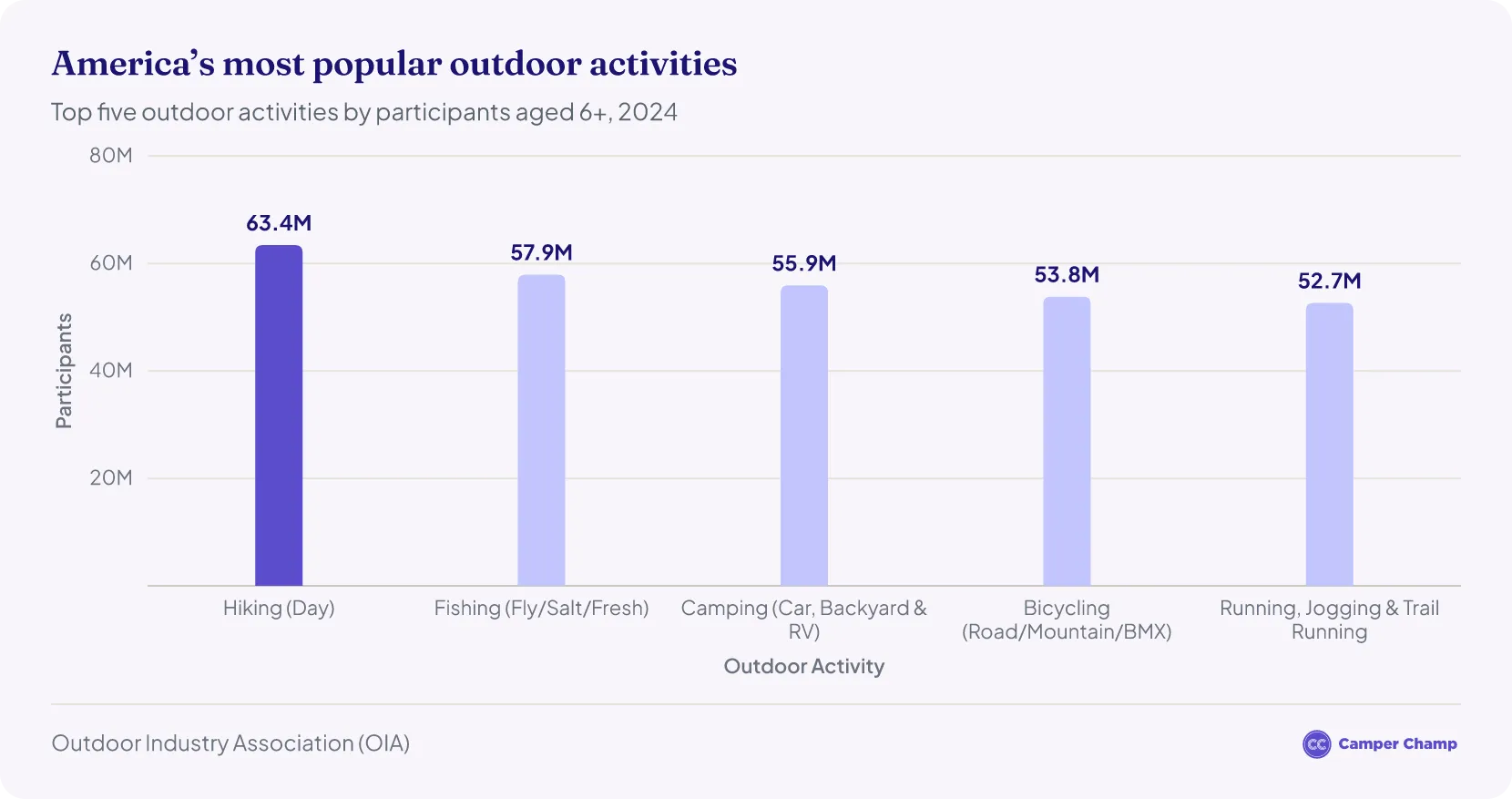
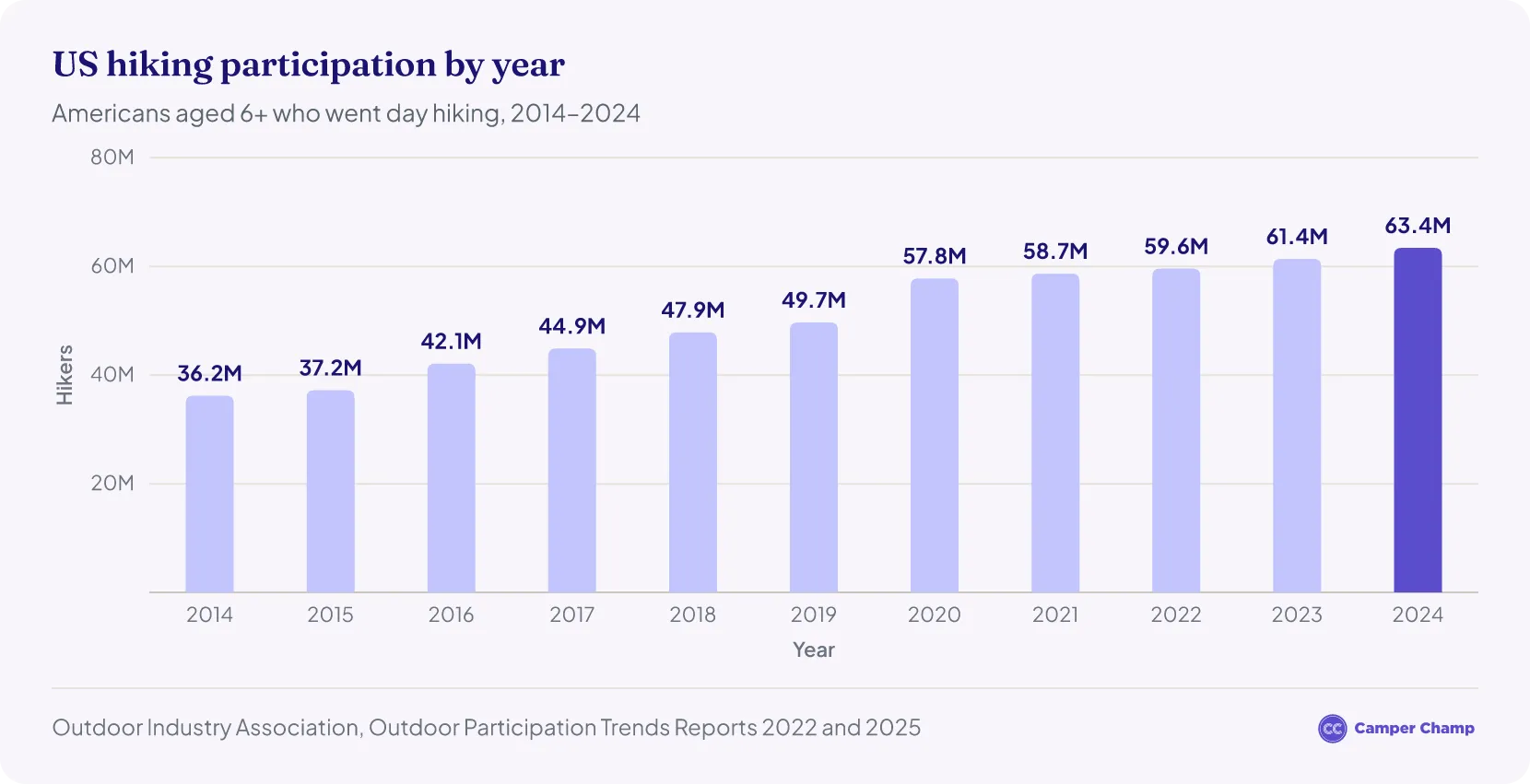
Hiking is the most popular outdoor activity in the US: a record 63.4 million Americans aged 6 and older went hiking in 2024, one in five people in that age group, and the number of hikers has nearly doubled since 2012.1
At a Glance
- A record 183.2 million Americans got outside in 2025, according to the latest report from the Outdoor Industry Association (OIA).2
- Hiking is the most popular outdoor activity in the US, with a record 63.4 million participants in 2024.1
- Participation jumped 16.3% during the pandemic, from 50 million in 2019 to 57.8 million in 2020.3
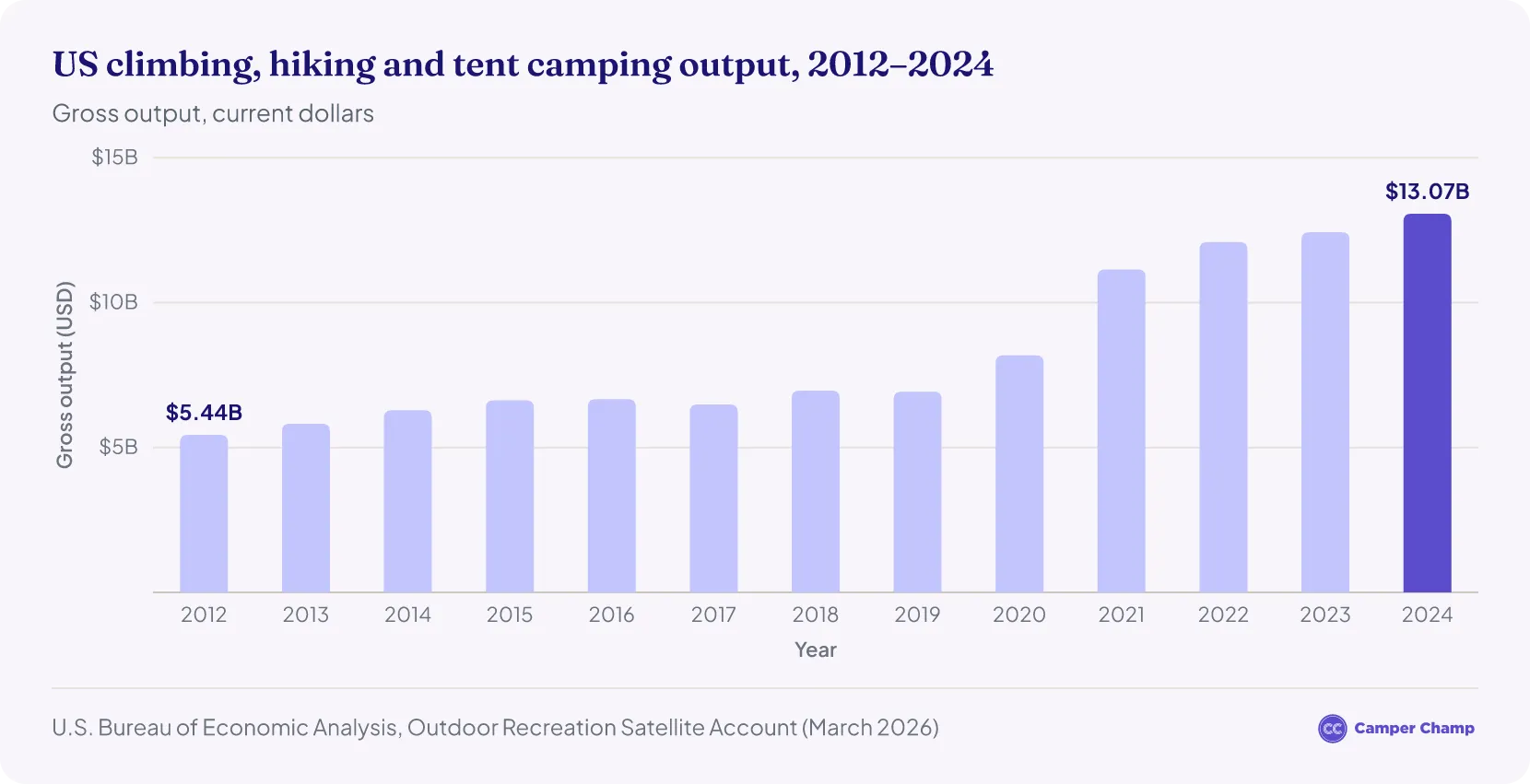
- Climbing, hiking and tent camping generated $13.1 billion of economic output in 2024, more than double the 2014 level, Bureau of Economic Analysis (BEA) data show.4
- 31.4 million women went hiking in 2024, about half of all hikers and over a million more than in 2023.5
- Participation has nearly doubled since 2012, OIA reports.1
How popular is hiking in the US?
A record 183.2 million Americans, 59% of those aged 6 and older, got outside in 2025, OIA's latest report shows.2 Hiking tops the list of outdoor activities, with a record 63.4 million participants aged 6 and older in 2024 (20.5% of that age group).1
- Hiking has surpassed both fishing and bicycling in popularity.5
How many people hike in the US each year?
63.4 million people went hiking in the US in 2024.1
- The COVID-19 pandemic pushed hiking participation up 16.3% in 2020, from 50 million in 2019 to 57.8 million.3
- Growth has continued since the pandemic surge: hiking has added more than 13 million participants since 2019, an average of 5.2% a year over five years.1
OIA's 2025 hiking count is so far available only to its members, so 2024 is the latest public figure.
How much is hiking worth to the US economy?
Climbing, hiking and tent camping generated $13.1 billion of gross output in the US in 2024, more than double the $6.3 billion of 2014, according to BEA.4
- Output stood at $6.9 billion in 2019, before the pandemic.
- It jumped 18% to $8.2 billion in 2020 and another 36% to $11.1 billion in 2021, the biggest rise since BEA's series began in 2012, as hiking participation surged.4
- Growth has since slowed: output reached $12.4 billion in 2023 and rose 5.1% to $13.1 billion in 2024.4
- BEA counts climbing, hiking and tent camping as one activity, so these figures cover all three, not hiking alone.
- BEA has not yet published 2025 figures, so 2024 is the latest year available.
Who goes hiking in the US?
Hiking is the top outdoor activity for White and Asian/Pacific Islander participants, and one of the top two for Hispanic participants, OIA's 2025 participation report shows.5
How popular is hiking across racial and ethnic groups?
- About one in four White Americans who took part in any outdoor activity went hiking in 2024.5
- Hiking was the most popular activity among Asian/Pacific Islander participants, with 4.1 million hikers in 2024.5
- 3.2 million Black Americans hiked in 2024, making hiking their fourth most popular outdoor activity. OIA names access, safety concerns and transportation as major barriers.5
- Hiking and running are the most popular outdoor activities for Hispanic participants.5
How old are US hikers?
- Hiking ranks third among outdoor activities for participants aged 55 and older, behind birding and wildlife viewing.5 Low-impact activities such as hiking gain the most from the growing number of older participants.
- Along with camping, biking, fishing and running, hiking is one of the most popular outdoor activities for kids and young adults.5
How often do Americans hike?
- The average hiker goes 18.4 times a year, and 26.2% go 13 or more times.5
What is the gender split among US hikers?
- 31.4 million women went hiking in 2024, over a million more than in 2023, making hiking their favorite outdoor activity, OIA reports. About a million more men also took up hiking that year.5
- In 2021, about 52% of hikers were male and 48% female (30.5 million men and 28.2 million women), a near-even split, according to OIA.3
Best Hiking Destinations in the US
Most Popular and Scenic Hiking Trails
- Appalachian Trail: The trail saw 16.9 million recreation visits in 20256.
- Pacific Crest Trail: Thousands of hikers explore parts of the 2,650-mile PCT each year7.
- Angels Landing (Utah): A permit system now limits daily hikers to reduce overcrowding.
- Half Dome (California): One of the most famous hikes in Yosemite National Park, where permits cap the trail at 300 hikers a day in cable season8.
Long-Distance Trekking and Backpacking
What are the best places to go backpacking in the US?
- John Muir Trail (California): A 211-mile scenic trail through the High Sierra.9
- Wind River High Route (Wyoming): A challenging backcountry trek through high alpine country.
- The Enchantments (Washington): A high-altitude backpacking destination known for its alpine lakes.
What is backcountry hiking and where can you do it in the US?
- Backcountry hiking means hiking remote, undeveloped trails with no nearby amenities.
- Top locations include Yellowstone’s Thorofare, Glacier National Park and the Wind River Range.
How many people thru-hike the Appalachian Trail and the PCT?
834 hikers reported completing the whole Appalachian Trail in 2025, down from 920 in 2024 and 1,492 in 2022, according to the Appalachian Trail Conservancy.10
- 2,187 northbound thru-hikers started at Amicalola Falls, Georgia, in 2025, and 550 reported finishing, a 25% completion rate.10
- Southbound, 195 hikers set off from Baxter State Park in Maine and 60 finished, a 31% completion rate.10
- Another 108 flip-flop thru-hikers and 116 section hikers completed the trail in 2025.10
- The Pacific Crest Trail Association issued 6,840 long-distance permits in 2024, including 3,935 for northbound and 532 for southbound thru-hikes.11 It has not yet posted its 2025 numbers.
Hardest and Most Dangerous Hiking Trails in the US
What are the hardest hiking trails in the US?
- Half Dome Cables Route (California): A steep, exposed climb that needs a permit and great care.
- Capitol Peak (Colorado): Notorious for its Knife Edge ridge.
What are the most dangerous hikes in the US?
- Angels Landing (Utah): A narrow ridge with steep drop-offs where several hikers have died.
- Kalalau Trail (Hawaii): Prone to flash floods and other hazards.
Do hikers also go camping?
Hikers and campers rarely stick to one activity: 85% of hikers and 91% of campers also take part in other outdoor activities, and campers and backpackers are the most likely to do several, OIA reports.5
- Camping, including car, backyard and RV camping, is the third most popular outdoor activity in the US, with 55.9 million participants in 2024.5
- Outdoor trips often turn into overnight stays: 81% of North American travelers who do outdoor activities stay at a campground or hotel, and hiking or trail running is their second most popular activity, at 49%, Kampgrounds of America's (KOA) 2026 report finds.12 More than 52 million North American households camped in 2025.
RV rental in the US
How many people die hiking in US national parks?
255 people died while hiking in US national parks from 2014 to 2019, about 43 a year and roughly one in eight of all park deaths in that period, according to National Park Service (NPS) mortality data.13
- Medical emergencies during physical activity caused 106 of those hiking deaths (42%), falls 73 (29%) and environmental causes 50 (20%).13
- 84% of the hikers who died were male.13
- Across all activities, parks averaged 358 deaths a year in 2014–2019, but at 0.11 deaths per 100,000 visits in 2019, the risk for any one visitor is very low.14
- NPS's provisional count shows 198 deaths in national parks in 2025, down from 374 in 2021. Deaths since 2020 are not yet validated and are mostly not broken down by activity.13
Longest Hiking Trails in the US
| The 10 longest hiking trails in the US | ||
|---|---|---|
| Rank | Trail | Length (miles) |
| 1 | American Discovery Trail | 6,80015 |
| 2 | Eastern Continental Trail | About 5,400 |
| 3 | North Country Trail | Nearly 5,00016 |
| 4 | Continental Divide Trail | 3,10017 |
| 5 | Pacific Crest Trail | 2,6507 |
| 6 | Appalachian Trail | 2,197.96 |
| 7 | Florida Trail | 1,50018 |
| 8 | Ice Age Trail | 1,20019 |
| 9 | Pacific Northwest Trail | 1,20020 |
| 10 | Arizona Trail | 80021 |
Hiking Gear Market in the US
How big is the camping and hiking gear market in the US?
- The US camping and hiking gear market was worth an estimated $8.6 billion in 2024, and Grand View Research expects it to grow 4.2% a year to 2030.22
Future of Hiking in the US
Is hiking still growing in the US?
- Outdoor recreation overall hit a record 183.2 million participants in 2025, though OIA finds Americans are heading outdoors less often than before the pandemic.2
- Hikers are getting out more often: 16.7 million "core" hikers now hit the trail 13 or more times a year, and that group is growing faster (7.6% a year) than hiking overall (5.2%), OIA reports.1
- Conservation efforts are increasing to protect trails from overcrowding and climate change.
What are the biggest challenges facing hiking trails in the US?
- Overcrowding, climate change and maintenance funding are the main concerns.
- Permit systems and Leave No Trace education are helping to ease the pressure.
Hiking is still growing, and millions of Americans take to the trails each year for exercise and time outdoors.
FAQs
More outdoor recreation statistics
- Glamping Statistics in the USA
- Mountain Biking Statistics in the USA
- Rock Climbing Statistics in the USA
References
- 2026 Hiking Report (Outdoor Industry Association) · outdoorindustry.org ↑ b c d e f g h
- 2026 Outdoor Participation Trends Report (Outdoor Industry Association) · outdoorindustry.org ↑ b c
- 2022 Outdoor Participation Trends Report (Outdoor Foundation / Outdoor Industry Association) · outdoorindustry.org ↑ b c d
- Outdoor Recreation Gross Output by Activity, 2012–2024 (Table 18) — U.S. Bureau of Economic Analysis · bea.gov ↑ b c d e
- 2025 Outdoor Participation Trends Report (Outdoor Foundation / Outdoor Industry Association) · material-civet.files.svdcdn.com ↑ b c d e f g h i j k l m
- Hike the Trail — Appalachian Trail Conservancy · appalachiantrail.org ↑ b c
- Pacific Crest Trail Association — Discover the Trail · pcta.org ↑ b c
- Half Dome Permits — Yosemite National Park (NPS) · nps.gov ↑
- NPS Yosemite National Park — John Muir Trail and Pacific Crest Trail · nps.gov ↑
- 2,000-Milers — Appalachian Trail Conservancy · appalachiantrail.org ↑ b c d
- PCT visitor use statistics — Pacific Crest Trail Association · pcta.org ↑
- 2026 Camping & Outdoor Hospitality Report (Kampgrounds of America) · koa.uberflip.com ↑
- NPS Mortality Data, CY2007 onward (Prevention and Response Branch FOIA release) · nps.gov ↑ b c d
- NPS Mortality Dashboard Data (CY2007–Feb 2026 release) · nps.gov ↑
- American Discovery Trail Society — The American Discovery Trail · discoverytrail.org ↑ b
- North Country Trail Association — The North Country National Scenic Trail · northcountrytrail.org ↑ b
- Continental Divide Trail Coalition — The Continental Divide National Scenic Trail · cdtcoalition.org ↑
- Florida National Scenic Trail — USDA Forest Service · fs.usda.gov ↑
- Ice Age National Scenic Trail (U.S. National Park Service) · nps.gov ↑
- Pacific Northwest National Scenic Trail — USDA Forest Service · fs.usda.gov ↑
- Arizona Trail Association — The Arizona National Scenic Trail · aztrail.org ↑
- U.S. Camping And Hiking Gear Market Size, Share & Trends Analysis Report, 2024–2030 (Grand View Research) · grandviewresearch.com ↑
- Outdoor Industry Association — Outdoor Participation Trends Reports · outdoorindustry.org
- NPS — Annual Bear Attacks, Park Reports, Demographics and Trends · nps.gov
- Bureau of Economic Analysis — Outdoor Recreation Satellite Account · bea.gov
- Pacific Crest Trail Association (PCTA) — PCT hiking statistics and permit numbers · pcta.org