

Published
How Many People Get Bitten by Snakes in the US Each Year?
About 7,000 to 8,000 people are bitten by venomous snakes in the United States each year, and about 5 of them die.1
- Deaths are rare: on average, only about 0.07% (1 in 1,400) of venomous bites are fatal1.
- Many more people are bitten by nonvenomous snakes or receive dry bites (no venom injected), which typically cause only minor injury.
How Many People Die From Snakebites in the US?
About 5 people die from snakebites in the US each year.1 Death certificates bear this out: 30 people died from venomous snake and lizard bites from 2018 to 2023, an average of 5 a year.2
- 23 of the 30 (77%) were male.2
- Every one of these deaths happened in the South.2
- Venomous snakes and lizards caused just 1.9% of the 1,604 animal-related deaths in those six years, far fewer than bees, wasps and hornets (497) or dogs (420).2
Which States and Regions Have the Most Snakebites?
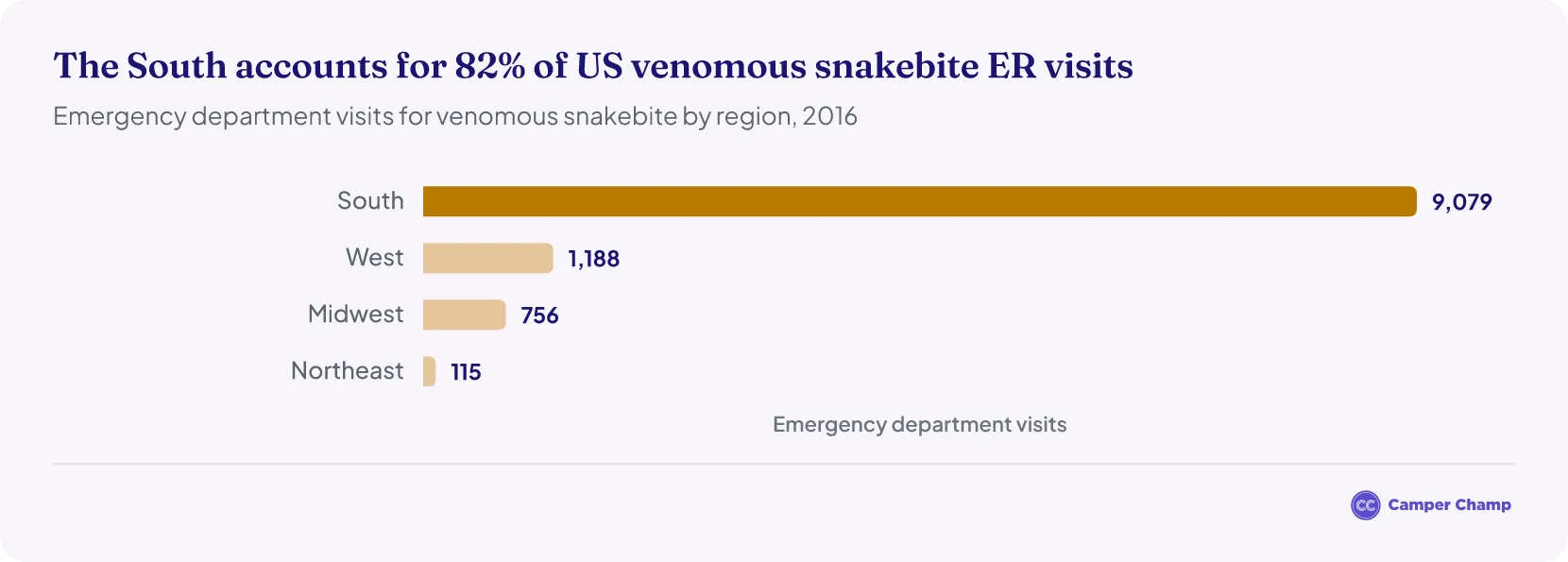
The South accounts for most venomous snakebites in the US: 9,079 of the 11,138 emergency department visits for venomous snakebite in 2016, or 82%.3
- The West followed with 1,188 visits (11%), then the Midwest with 756 (7%) and the Northeast with 115 (1%).3
- In the West, rattlesnakes caused 879 of these bites, about 74% of the region's visits.3
- 34% of patients were treated in rural counties, although only 19% of Americans live in one.3
Note: These figures come from a national sample of emergency department visits, which reports regions rather than individual states. Widely shared state rankings, such as Texas with 1,408 bites a year, come from estimates for 1959.4
Snakebite Fatalities in the US Compared to Other Countries
Worldwide, an estimated 5.4 million snakebites a year cause between 81,410 and 137,880 deaths.5 The US accounts for less than 0.01% of those deaths.
| Rank | Country | Snakebite Deaths | Age-Standardized Deaths per 100,000 |
|---|---|---|---|
| 1 | India | 51,1006 | 4 |
| 2 | Pakistan | 2,0706 | 1.06 |
| 3 | Nigeria | 1,4606 | 1.13 |
| 4 | Bangladesh | 1,170 | 0.78 |
| 5 | DR Congo | 5456 | 1.29 |
| 6 | Ethiopia | 499 | 1.07 |
| 7 | Kenya | 349 | 1.63 |
| 8 | Somalia | 317 | 4.5 |
| 9 | Burkina Faso | 279 | 2.04 |
| 10 | Cameroon | 264 | 1.68 |
| 11 | Ivory Coast | 256 | 1.78 |
| 12 | Ghana | 245 | 1.34 |
| 13 | Chad | 236 | 2.57 |
| 14 | Nepal | 234 | 0.9 |
| 15 | Mali | 234 | 1.68 |
| 16 | Brazil | 233 | 0.11 |
| 17 | China | 223 | 0.01 |
| 18 | Niger | 223 | 1.66 |
| 19 | Tanzania | 211 | 0.78 |
| 20 | Guinea | 191 | 2.35 |
Which Snakes Bite the Most People in the US?
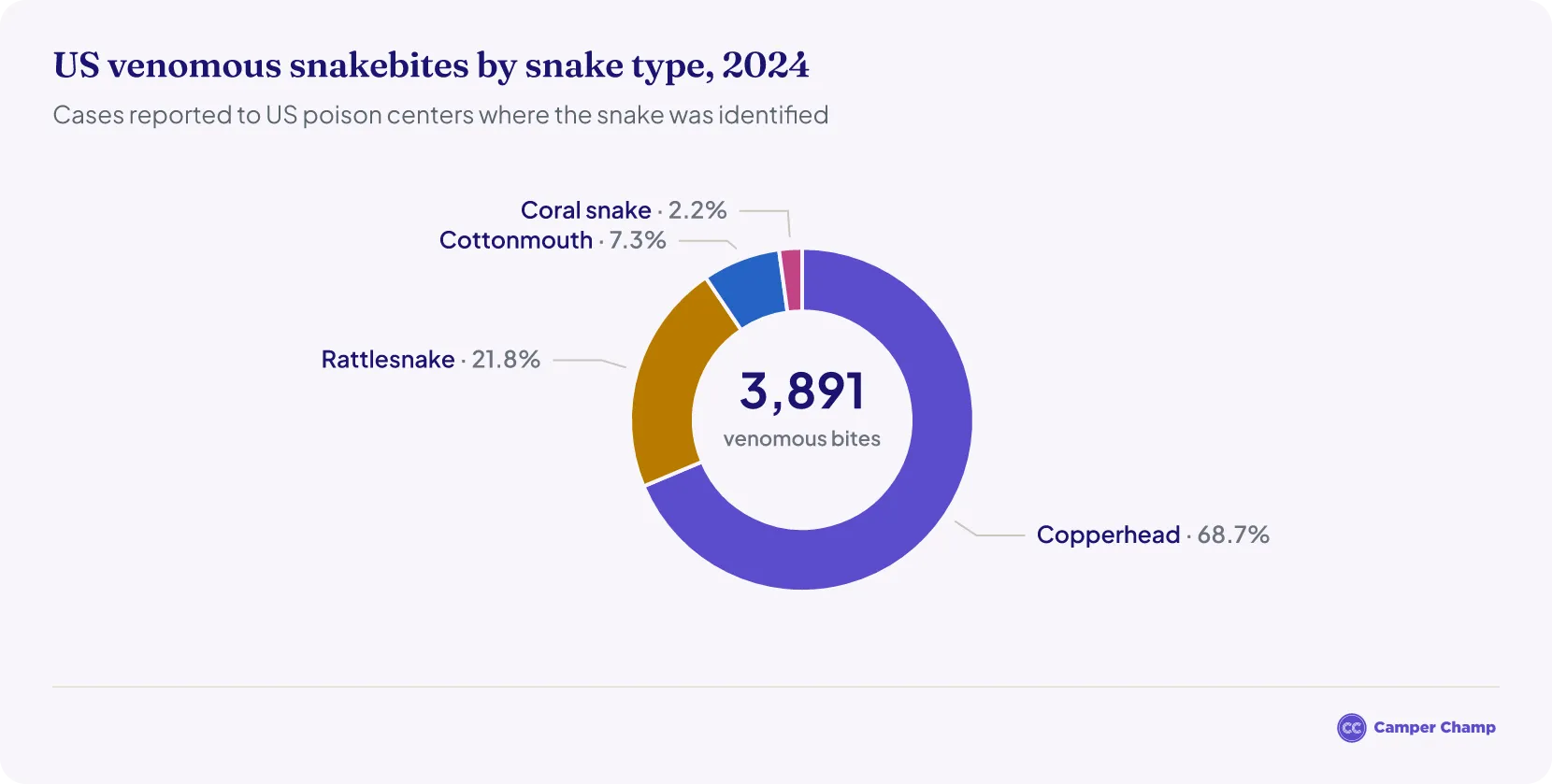
Copperheads caused about 69% of the venomous snakebites reported to US poison centers in 2024 where the snake was identified: 2,672 of 3,891 cases.7
Rattlesnakes (all species) came second with 850 cases, about 22% of identified bites.7
- Cottonmouths accounted for 285 cases (7%) and coral snakes for 84 (2%).7
- Another 1,212 bites came from unidentified pit vipers.7 These counts include only bites reported to a poison center, so they don't capture every bite.
- Rattlesnake bites tend to be more serious. In 2016 rattlesnakes caused 19% of all venomous snakebite ER visits but 41% of those that ended in a hospital stay (983 patients).3
US Snakebite Victims: Who Is Most Likely to Be Bitten?
Are Men More Likely to Be Bitten by Snakes?
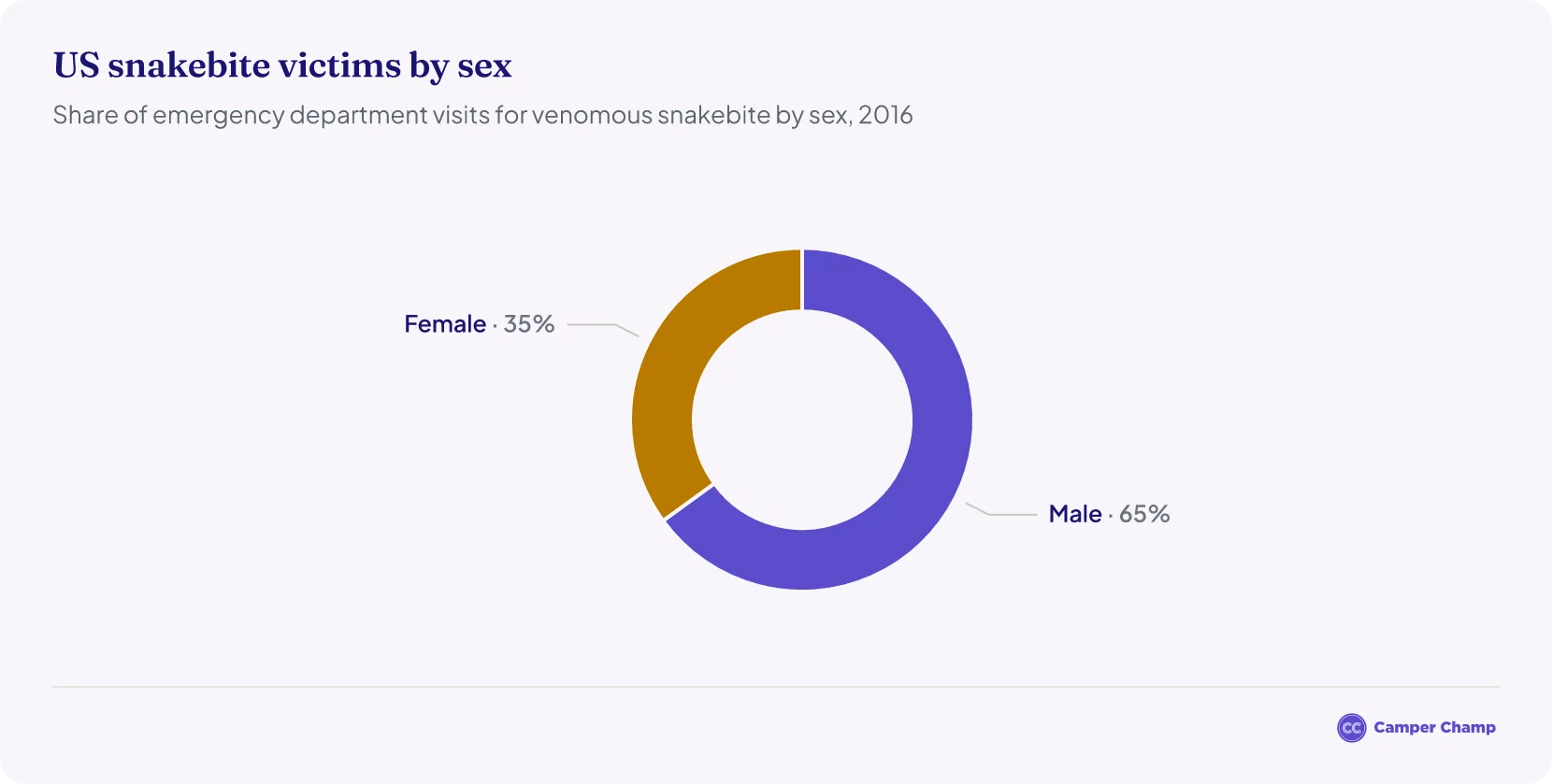
Yes: most people bitten by snakes are male. A national study of 2016 emergency department visits found that 65% of venomous snakebite patients were male3; older regional and national studies reported 69% to 80%. The gap is usually put down to behavior: men, especially younger men, are more likely to handle snakes or take risks, and many outdoor jobs with higher exposure are mostly done by men.
- Females made up the other 35% of those 2016 visits3.
More Outdoor Statistics and Guides
When and Where Do Most Snakebites Happen?
Half of all venomous snakebite ER visits in 2016 (50%) happened in summer, and 32% fell on a weekend.3
Intentional handling means the person was holding or handling the snake when it bit.
Examples include:
- Recreational handling of snakes: Picking up or playing with wild or pet snakes.
Accidental encounters are bites from stepping on a snake, reaching too close to one or coming across one by surprise.
Common situations include:
- Hiking and camping: Stepping on a hidden snake.
- Hunting: Moving through snake country when snakes are most active.
- Gardening and yard work: Reaching into thick plants where you can't see.
- Fishing: Especially around cottonmouths, also called water moccasins.
Seasonal Trends: What Time of Year Do Snakebites Peak?
The vast majority of snakebites happen in the warmer months, which in the US usually means late spring, summer, and early fall.
- Time of Year: Cases climb in April and May, peak from June to August (50%)3, and drop off by late fall. Winter (December–February) accounts for less than 5% because snakes are dormant (brumating) in the cold.
- Day of the Week: 32% of venomous snakebite ER visits in 2016 fell on a Saturday or Sunday3, when more people are out hiking, gardening or camping and crossing paths with snakes.
- Time of Day: Most bites happen in the afternoon and early evening, when both snakes and people are most active. In a nationwide survey of hospital cases (1958–59), 43% of bites happened between 3 p.m. and 9 p.m. and only 9% between 6 a.m. and 9 a.m.4
- Weather: Heat and rain are strong predictors of snake activity, and bites rise on warm days, especially in southern and desert states such as Georgia and Arizona.
Snakebite Risk, First Aid and Prevention
What Should You Do If You’re Bitten by a Snake in the US?
If a snake bites you:
- Move away from the snake to prevent additional bites
- Call 911 immediately; don't wait for symptoms
- Keep still and calm to slow venom spread
- Remove rings, watches, or tight items near the bite site
- Clean the wound gently with soap and water if available
- Mark the edge of swelling with a pen to track progress
- Transport to the nearest hospital as quickly as possible
Never use a tourniquet, cut the wound, try to suck out the venom, apply ice, or drink alcohol or caffeine after a bite. Stay calm, avoid harmful first aid and get medical help fast.
Are Snakebites in the US Usually Fatal?
Rarely. More than 99% of people bitten survive1: of the roughly 7,000 to 8,000 venomous snakebites each year, only about 5 are fatal, a fatality rate of 0.07%.
How Can You Prevent Snakebites in the US?
To lower your risk:
- Never handle wild snakes, even if they appear dead
- Avoid tall grass, dense brush, rock piles, and woodpiles
- Look before placing hands or feet in areas where snakes might hide
- Wear long pants and boots in snake-prone areas
- Stay alert in the afternoon and early evening, when most bites happen
- Keep yards clear of debris that could attract snakes
- Learn to identify venomous species in your region
- Use a flashlight when walking at night in snake country
RV rental in the USA
- Alaska RV rental
- Albuquerque RV rental
- Atlanta RV rental
- Austin RV rental
- RV rental in Boston
- RV rental in California
- RV rental in Houston
- Orlando RV rental
- Portland RV rental
- RV rental in San Jose
References
- CDC — Annual Snakebite Stats, Fatality Rates, High-Risk States, and Prevention · cdc.gov ↑ b c d e
- Animal-Related Fatalities in the United States (2018-2023) (Langley & Kearney, Environmental Health Insights, 2025 — CDC WONDER death certificates) · pmc.ncbi.nlm.nih.gov ↑ b c d
- The "T's" of snakebite injury in the USA: fact or fiction? (Trauma Surgery & Acute Care Open, 2019 — National Emergency Department Sample, 2016) · pmc.ncbi.nlm.nih.gov ↑ b c d e f g h i j k l m
- Incidence of Treated Snakebites in the United States (Parrish, Public Health Reports 81(3), 1966) · stacks.cdc.gov ↑ b
- WHO — Global Snakebite Incidence and Mortality by Country · who.int ↑
- Global mortality of snakebite envenoming between 1990 and 2019 · nature.com ↑ b c d e
- 2024 Annual Report of the National Poison Data System (NPDS) from America’s Poison Centers: 42nd Annual Report (Clinical Toxicology, 2025) · piper.filecamp.com ↑ b c d
- AAPCC — U.S. Snakebite Data by Species and Poison Control Reports · aapcc.org
- NPDS — U.S. Victim Demographics, Bite Intent, and Exposure Activities · aapcc.org